Modal verbs worksheet for Year 5: Spot the modal verb
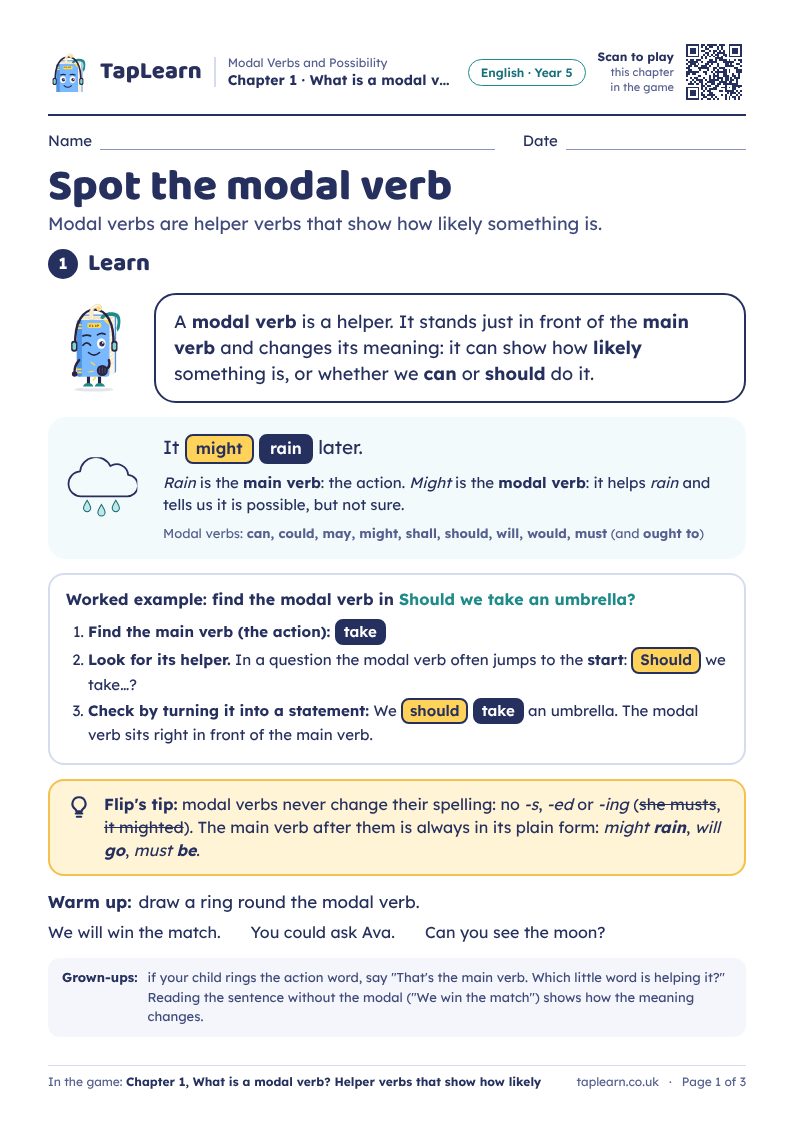
Spot the Modal Verb is a printable modal verbs worksheet for Year 5 (ages 9 to 10) that teaches children that a modal verb, like might, should or must, is a helper that stands in front of the main verb and changes its meaning. It covers the Year 5 statements on the term modal verb and on showing degrees of possibility with modal verbs.
Free to print, no account needed.
Print it on A4, in colour or black and white. Do it after the chapter, or before it to see what your child already knows.
What's on the worksheet
Your child learns what a modal verb is and finds it in a sentence, including at the start of a question, along with the main verb it helps. Includes a modal verb hunt in a story book and an answers sheet.
- Page 1 · Learn
- "It might rain later" with the modal and main verb labelled, the list of modal verbs, a worked example finding should in a question, Flip's no-endings tip, and a ring-the-modal warm-up.
- Page 2 · Try it together
- Modal verb hunt: read a few lines of a story book with lots of talking, find modal verbs including short forms like won't and I'll, write each with its main verb, and read the sentence without it.
- Page 3 · Practise
- Ring modal verbs and underline main verbs, turn statements into questions, decide whether words in bold are modal verbs, write sentences about tomorrow, and a challenge about snow.
- Answers sheet
- Every answer, mix-ups like picking the main verb, and take-it-out and question-flip ideas.
3 A4 pages and an answers sheet · about 25 minutes
Using it at home
- If your child rings the action word, say "That's the main verb. Which little word is helping it?"
- In the modal verb hunt, "I'll" hides will and "won't" hides will not. For a question like "Could you…?", turn it into a statement to find the main verb.
- Say a sentence with a modal ("We must hurry"), then without it, and talk about what changes.
Watch out for
- Picking the main verb, like rain instead of might.
- Ask, "Which word is helping the action?"
- Missing the modal verb in a question, like "Should we go?".
- Turn it into a statement ("We should go") and the modal appears next to the main verb.
- Calling verbs like want or need modal verbs.
- They change their endings (wants, wanted) and are usually followed by "to".
Questions from the worksheet
- Draw a ring round the modal verb. Underline the main verb it helps: The bus should arrive soon. That noise must be the wind. Might the snow stop by lunch?
- Turn each statement into a question. Draw a ring round the modal verb in your question: We should leave now. Mia can play the drums.
- Is the word in bold a modal verb? Tick yes or no: The cat could climb the fence. The cat climbed the fence. I want to try this soup.
- Write a sentence about tomorrow using each modal verb: might, will.
- Leo says the modal verb in It could snow tonight is snow. Is he right? Explain how you know.
The answers are on the answers sheet, for grown-ups.
National curriculum in England
This worksheet practises these statements from the Year 5 english programme of study:
- Terminology: modal verb, relative pronoun, relative clause, parenthesis, bracket, dash, cohesion, ambiguity
- Sentence: indicating degrees of possibility using adverbs or modal verbs
- Develop their understanding of the concepts set out in English appendix 2 by: using modal verbs or adverbs to indicate degrees of possibility (Years 5–6 english)
In the classroom
- Play question flip as a starter: pupils turn statements with modals into questions.
- Run the modal verb hunt in pairs with class novels.
Questions and answers
What is a modal verb?
A modal verb is a helper verb, like can, might, should, will or must, that stands in front of the main verb and changes its meaning.
How do you find the modal verb in a question?
Turn the question into a statement: "Should we go?" becomes "We should go", and the modal sits next to the main verb.
Do modal verbs change their spelling?
No. Modal verbs never add -s, -ed or -ing, and the main verb after them stays in its plain form: might rain, will go.
 TapLearn