Modal verbs of possibility worksheet for Year 5: Possible, likely, certain
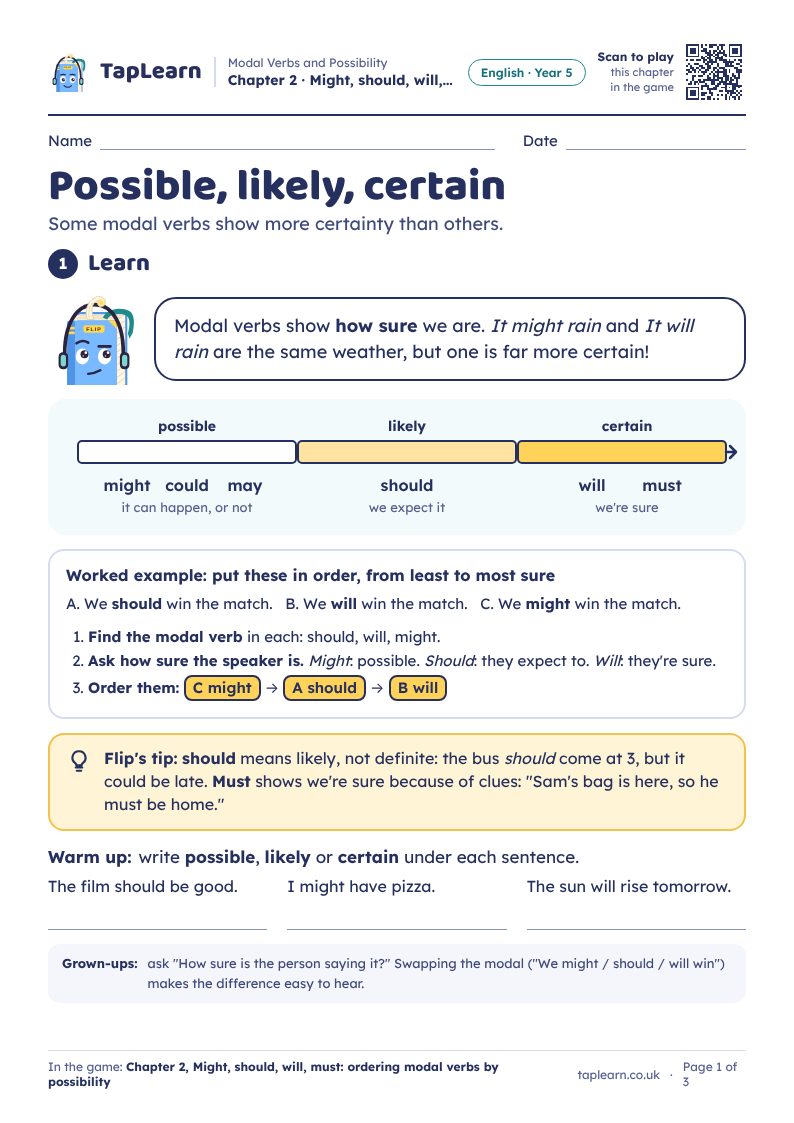
Possible, Likely, Certain is a printable modal verbs of possibility worksheet for Year 5 (ages 9 to 10) that teaches children that might and could show something is possible, should shows it is likely, and will and must show we're sure. It covers the Year 5 statements on the term modal verb and on showing degrees of possibility with modal verbs.
This worksheet is for members
Membership opens every chapter of every game and every worksheet, for all your children.
See the plansAlready a member? Log in to print it.
Start with the free one: Spot the modal verb (chapter 1).
Print it on A4, in colour or black and white. Do it after the chapter, or before it to see what your child already knows.
What's on the worksheet
Your child orders modal verbs from possible to certain: might and could, then should, then will and must, and chooses the one that fits the clues. Includes a forecast-the-day activity and an answers sheet.
- Page 1 · Learn
- A possible-likely-certain scale of modal verbs, a worked example ordering three sentences about winning a match, Flip's tip on should and must, and a possible-likely-certain warm-up.
- Page 2 · Try it together
- Forecast the day: take turns making forecasts with might, should or will, talk about how likely each really is, mark P, L or C, and check at the end of the day what happened.
- Page 3 · Practise
- Number sentences from least to most sure, choose might, should or must to fit each clue, rewrite sentences to change how sure they are, and a challenge about a parcel.
- Answers sheet
- Every answer, mix-ups like thinking should means certain, and swap-the-modal and detective-clues ideas.
3 A4 pages and an answers sheet · about 25 minutes
Using it at home
- Ask "How sure is the person saying it?" Swapping the modal ("We might / should / will win") makes the difference easy to hear.
- In forecast the day, a should forecast that didn't happen is a good talking point: it was likely, not certain.
- Spot a clue at home (a wet umbrella by the door) and make a must sentence: "It must be raining."
Watch out for
- Thinking should means certain.
- Ask, "Could it still not happen?" If yes, it's likely, not certain.
- Thinking might or could means it will happen.
- "We might go to the beach" means maybe yes, maybe no.
- Being puzzled that must has two jobs.
- "You must tidy up" means you have to. Here it means "I'm sure, because of the clues": "That must be Sam."
Questions from the worksheet
- Number each set from 1 (least sure) to 3 (most sure): Ava should be home by six. Ava will be home by six. Ava might be home by six.
- Read the clue and choose might, should or must: Mum's car is outside and her coat is on the hook. Mum ___ be home.
- Rewrite each sentence with a different modal verb to change how sure it is: Leo might come to the party. (more sure)
- Mia read: "Your parcel should arrive today." She says, "That means it's definitely coming today!" Is she right? Explain.
The answers are on the answers sheet, for grown-ups.
National curriculum in England
This worksheet practises these statements from the Year 5 english programme of study:
- Terminology: modal verb, relative pronoun, relative clause, parenthesis, bracket, dash, cohesion, ambiguity
- Sentence: indicating degrees of possibility using adverbs or modal verbs
- Develop their understanding of the concepts set out in English appendix 2 by: using modal verbs or adverbs to indicate degrees of possibility (Years 5–6 english)
In the classroom
- Make a class possible-likely-certain line and place modal verb cards on it.
- Use Practise B as a clue-reasoning task in pairs.
Questions and answers
Which modal verbs show possibility?
Might, could and may show something is possible; should shows it is likely; will and must show we're sure.
Does should mean something will definitely happen?
No. Should means likely: the bus should come at 3, but it could still be late.
What does must mean when showing possibility?
Must shows we're sure because of clues: "Sam's bag is here, so he must be home."
 TapLearn