Adverbs of possibility worksheet for Year 5: Perhaps or definitely?
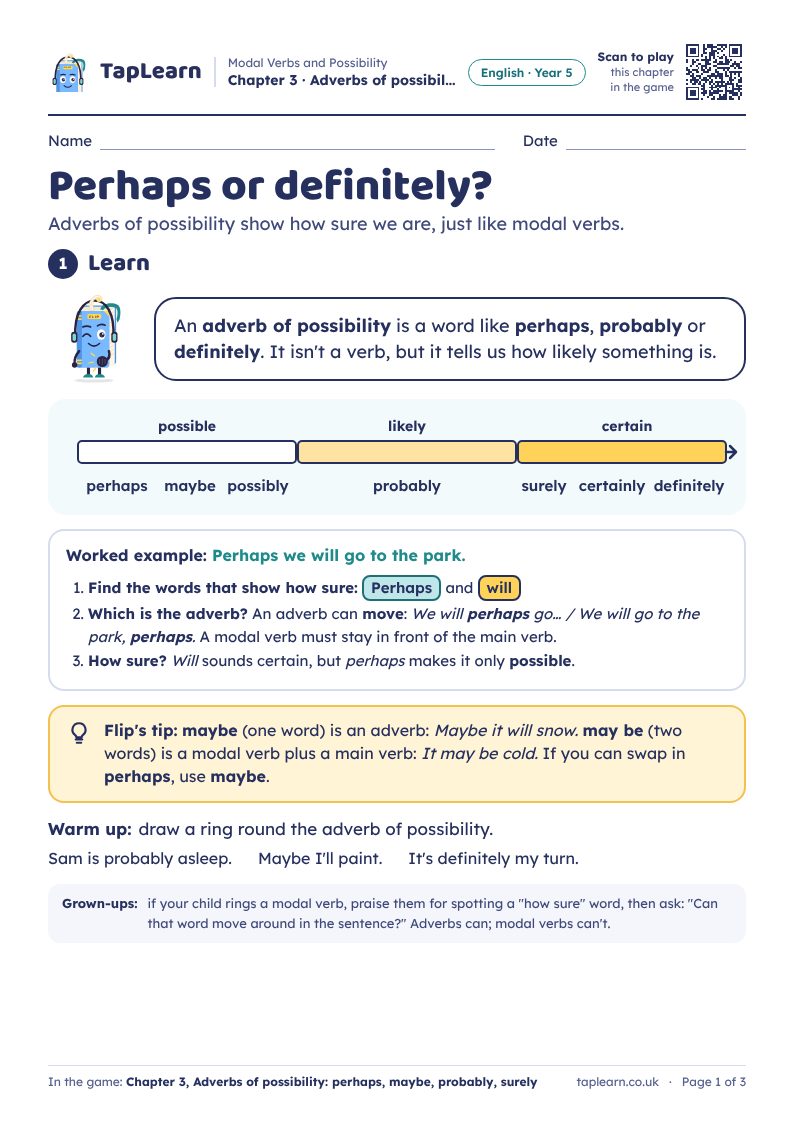
Perhaps or Definitely? is a printable adverbs of possibility worksheet for Year 5 (ages 9 to 10) that teaches children that adverbs like perhaps, probably and definitely show how likely something is, and can usually move around a sentence, unlike modal verbs. It covers the Year 5 statement on indicating degrees of possibility using adverbs or modal verbs.
This worksheet is for members
Membership opens every chapter of every game and every worksheet, for all your children.
See the plansAlready a member? Log in to print it.
Start with the free one: Spot the modal verb (chapter 1).
Print it on A4, in colour or black and white. Do it after the chapter, or before it to see what your child already knows.
What's on the worksheet
Your child spots adverbs of possibility such as perhaps, probably, surely and definitely, orders them by how likely they are, and tells maybe from may be. Includes a hold-up-the-word sticky-note game and an answers sheet.
- Page 1 · Learn
- A possible-likely-certain scale of adverbs, a worked example with "Perhaps we will go to the park", Flip's maybe-or-may-be tip, and a ring-the-adverb warm-up.
- Page 2 · Try it together
- Hold up the word: write perhaps, probably and definitely on sticky notes, the grown-up says a weekend plan and the child holds up the word that fits, then you swap.
- Page 3 · Practise
- Ring adverbs and underline modal verbs, add adverbs to show how sure you are, sort adverbs into possible, likely and certain, write maybe or may be, and a challenge.
- Answers sheet
- Every answer, mix-ups like thinking perhaps means certain, and move-it and mood-check ideas.
3 A4 pages and an answers sheet · about 25 minutes
Using it at home
- If your child rings a modal verb, praise them for spotting a "how sure" word, then ask "Can that word move around in the sentence?"
- In hold up the word, disagreeing is good: talk about what you each know about the plan.
- Ask "Will it rain tomorrow?" and answer with perhaps, probably or definitely.
Watch out for
- Thinking perhaps or maybe means certain.
- Both mean "it could happen, or it could not".
- Mixing up adverbs and modal verbs.
- Modal verbs sit right before the main verb. Adverbs like perhaps and surely can usually move.
- Mixing up maybe and may be.
- Swap in perhaps: if it works, write maybe as one word.
Questions from the worksheet
- Draw a ring round the adverb of possibility. Underline the modal verb if there is one: We will probably be late. Surely that isn't the last biscuit!
- Add an adverb so each sentence shows how sure you are: We will go swimming. (likely) The match is cancelled. (certain)
- Sort the adverbs into possible, likely and certain: definitely, maybe, probably, certainly, possibly, perhaps, surely.
- Write maybe or may be in each gap: ___ we could build a den. It ___ too windy for kites.
- Sam says: "Perhaps it will snow means it will definitely snow, because it has will in it." Is Sam right? Explain.
The answers are on the answers sheet, for grown-ups.
National curriculum in England
This worksheet practises these statements from the Year 5 english programme of study:
- Sentence: indicating degrees of possibility using adverbs or modal verbs
- Develop their understanding of the concepts set out in English appendix 2 by: using modal verbs or adverbs to indicate degrees of possibility (Years 5–6 english)
In the classroom
- Play move it: say "Perhaps we'll have soup" and pupils move perhaps to two other places.
- Use Practise C as a three-column card sort.
Questions and answers
What are adverbs of possibility?
Adverbs of possibility, like perhaps, maybe, probably, surely and definitely, show how likely something is.
What is the difference between maybe and may be?
Maybe (one word) is an adverb meaning perhaps. May be (two words) is a modal verb plus a verb: "It may be cold."
How is an adverb of possibility different from a modal verb?
A modal verb sits right in front of the main verb; an adverb can usually move to another place in the sentence.
 TapLearn