Minibeasts under logs worksheet for Year 2: Who lives under a log?
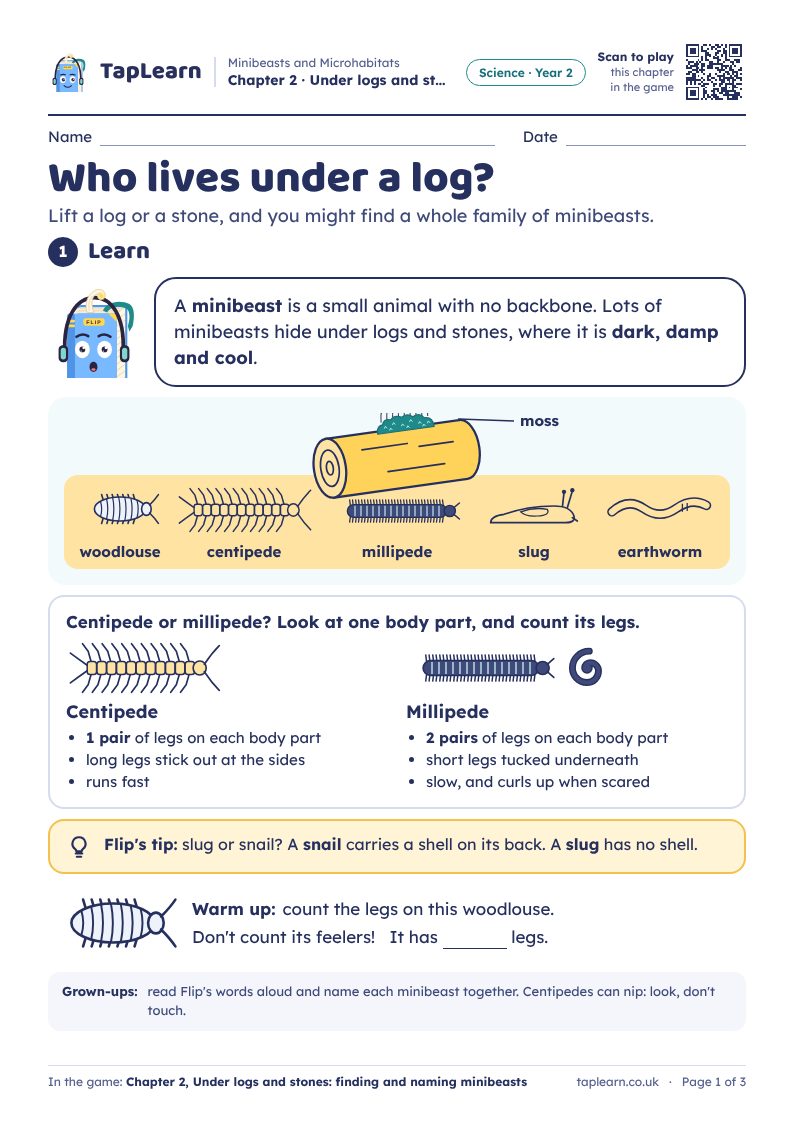
Who Lives Under a Log? is a printable minibeasts worksheet for Year 2 (ages 6 to 7) that teaches children to name woodlice, centipedes, millipedes, slugs and worms found under logs and stones, and to tell them apart. It covers the Year 2 science national curriculum statement: identify and name a variety of plants and animals in their habitats, including microhabitats.
Free to print, no account needed.
Print it on A4, in colour or black and white. Do it after the chapter, or before it to see what your child already knows.
What's on the worksheet
Name the minibeasts that hide under logs and stones, tell a centipede from a millipede and a slug from a snail, and learn why we put logs back. With a log-lift tally to do together, and answers.
- Page 1 · Learn
- The minibeasts under a log, how to tell a centipede from a millipede by its legs, and Flip's tip on slugs and snails. Warm-up: count a woodlouse's legs.
- Page 2 · Try it together
- Log lift: a grown-up slowly lifts a log, stone or flowerpot, you tally each minibeast you see, then put it back. No log? Leave cardboard on damp soil for a few days.
- Page 3 · Practise
- Name minibeasts from a word box, ring the right names, choose where each one lives, explain why we put logs back, and Mia's woodlice-on-the-sunny-path challenge.
- Answers sheet
- All answers, four mix-ups to watch for, and a guess-who minibeast game.
3 A4 pages and an answers sheet · about 20 minutes
In the classroom
- Leave cardboard or a log in a shady corner of the school grounds and lift it as a class a week later.
- Guess who: describe a minibeast ("no shell, slimy, two pairs of feelers") and pupils name it.
Questions from the worksheet
- Where does it live? Ring the best place: under a stone or on a hot, sunny path.
- Why do minibeast hunters always put logs and stones back?
- Mia finds woodlice under a stone. She says, "Let's put them on the sunny path so they can warm up!" Is that a good idea? Why?
The answers are on the answers sheet, for grown-ups.
National curriculum in England
This worksheet practises this statement from the Year 2 science programme of study:
- Identify and name a variety of plants and animals in their habitats, including microhabitats
Source: National curriculum in England: science programmes of study (DfE)
Using it at home
- Look, don't touch: centipedes can nip. Do the lifting yourself and wash hands afterwards.
- Ask "Why do we put it back?" The minibeasts need their dark, damp home, or they dry out and birds find them.
Watch out for
- Mixing up centipedes and millipedes.
- Look at one body part: 1 pair of legs sticking out is a centipede, 2 pairs tucked underneath is a millipede.
- Mixing up slugs and snails.
- Only the snail has a shell on its back.
- Thinking log minibeasts like sunny spots.
- They need dark, damp places, not hot, sunny paths.
Questions and answers
What minibeasts live under logs and stones?
Woodlice, centipedes, millipedes, slugs, snails and earthworms often live under logs and stones. It's dark, damp and cool there.
How can you tell a centipede from a millipede?
A centipede has 1 pair of long legs on each body part and runs fast. A millipede has 2 pairs of short legs on each body part and is slow, curling up when scared.
 TapLearn