Minibeasts on plants worksheet for Year 2: Bugs on plants
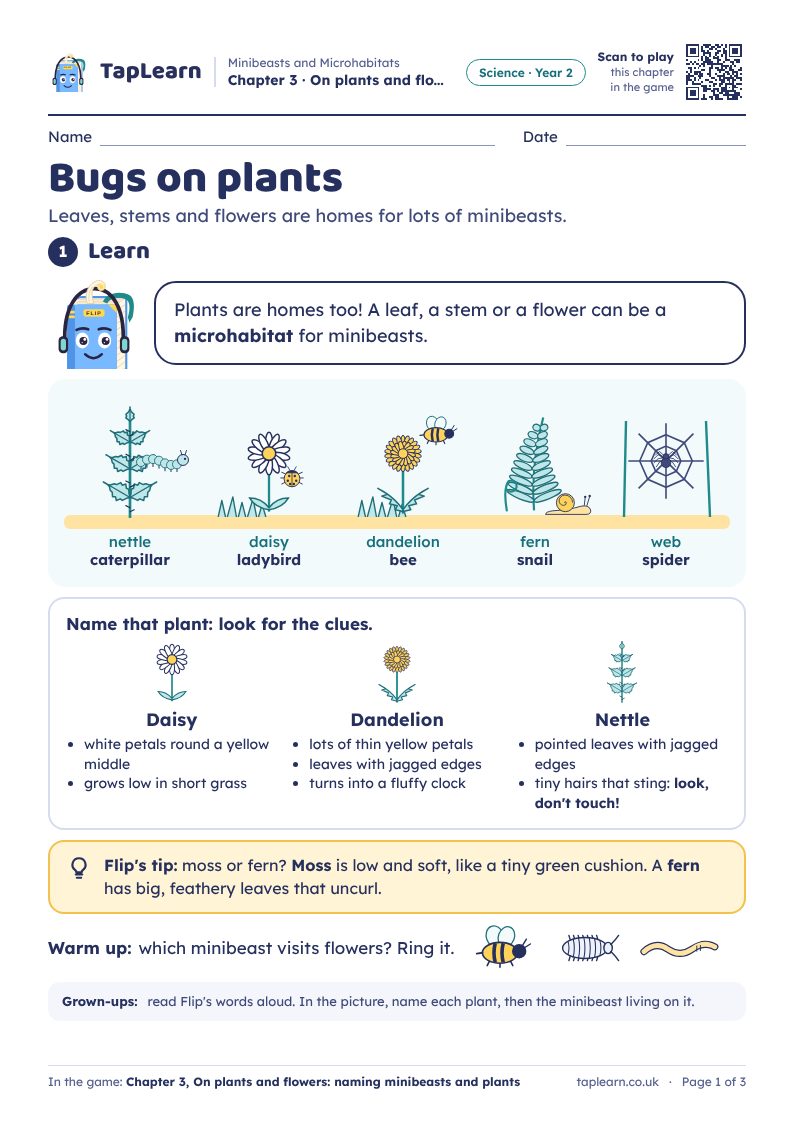
Bugs on Plants is a printable worksheet for Year 2 (ages 6 to 7) that teaches children to name minibeasts living on leaves and flowers and plants such as daisies, dandelions, nettles, moss and ferns. It covers the Year 2 science national curriculum statement: identify and name a variety of plants and animals in their habitats, including microhabitats.
Free to print, no account needed.
Print it on A4, in colour or black and white. Do it after the chapter, or before it to see what your child already knows.
What's on the worksheet
Find and name minibeasts that live on leaves and flowers, and name plants such as daisies, dandelions, nettles, moss and ferns. With a tap-and-look bug hunt to do together, and answers.
- Page 1 · Learn
- A garden of plants and the minibeasts on them, clues to tell a daisy, a dandelion and a nettle apart, and Flip's tip on moss and ferns. Warm-up: which minibeast visits flowers?
- Page 2 · Try it together
- Tap and look: hold white paper under a bush, tap the branch, name what lands, then check on top of leaves, under leaves and inside flowers.
- Page 3 · Practise
- Name plants from a word box, match minibeasts to a web, a flower and a nettle leaf, ring the right names, draw a minibeast on a flower, and Sam's moss-or-fern challenge.
- Answers sheet
- All answers, three mix-ups to watch for, and plant-spotting and under-the-leaf ideas.
3 A4 pages and an answers sheet · about 20 minutes
In the classroom
- Run tap and look on school hedges in small groups, recording finds on clipboards.
- Plant ID starter: show photos of a daisy, dandelion, nettle, moss and fern for pupils to name.
Questions from the worksheet
- Where does each minibeast live? Draw a line to match: in a web, on a flower, munching a nettle leaf.
- Draw a minibeast on this flower. Write its name.
- Sam finds soft, green moss on a log. He says, "It's a tiny fern!" Is he right? How can you tell?
The answers are on the answers sheet, for grown-ups.
National curriculum in England
This worksheet practises this statement from the Year 2 science programme of study:
- Identify and name a variety of plants and animals in their habitats, including microhabitats
Source: National curriculum in England: science programmes of study (DfE)
Using it at home
- Choose a plant with no stings or prickles for tap and look, not nettles, holly or roses, and tip the minibeasts gently back.
- Ask "Why might minibeasts hide under leaves?" It's shady and damp, and birds can't see them.
Watch out for
- Mixing up moss and ferns.
- A soft green cushion is moss; big feathery leaves that uncurl are a fern.
- Mixing up daisies and dandelions.
- A daisy is white with a yellow middle; a dandelion is all yellow.
- Naming pond plants, like a water lily, in the garden.
- Remind them water lilies grow in ponds.
Questions and answers
What minibeasts live on plants?
Caterpillars, ladybirds, snails and spiders live on leaves and stems, and bees visit flowers. Leaves and flowers are microhabitats for many minibeasts.
How do you tell moss from a fern?
Moss grows low and soft, like a tiny green cushion. A fern has big, feathery leaves that uncurl as they grow.
 TapLearn