Habitats and microhabitats worksheet for Year 2: Big homes, tiny homes
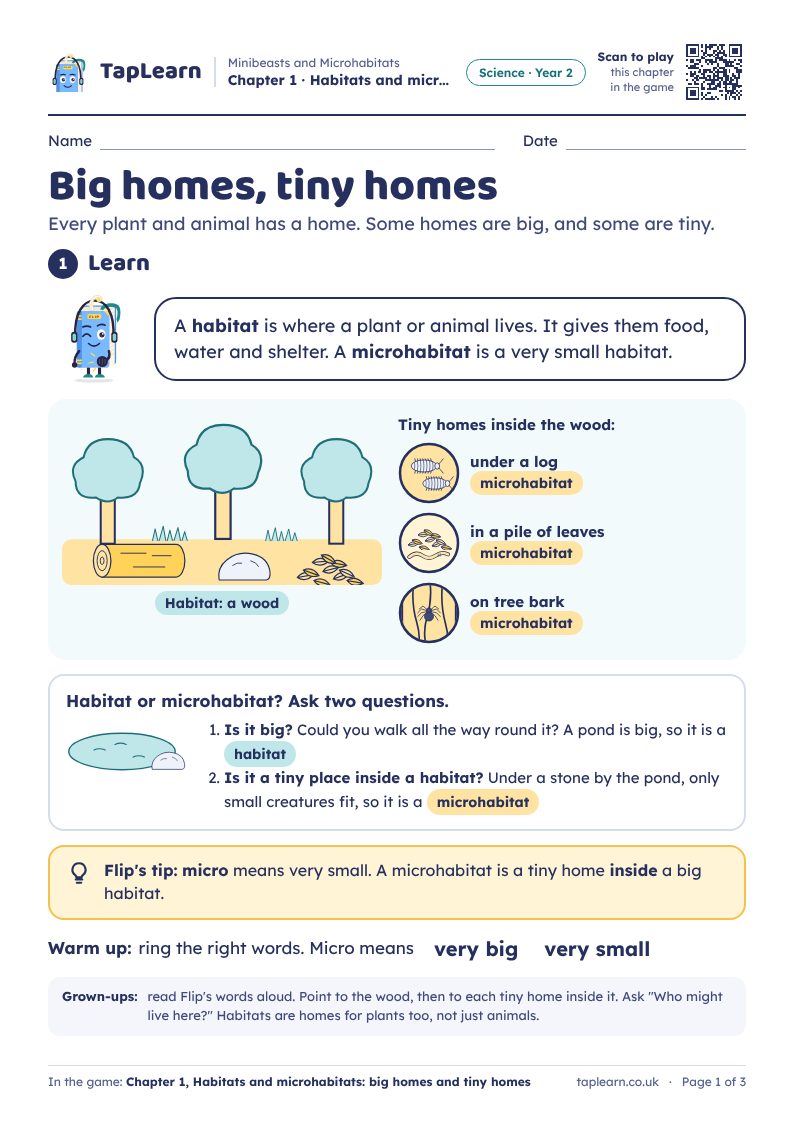
Big Homes, Tiny Homes is a printable habitats and microhabitats worksheet for Year 2 (ages 6 to 7) that teaches children what a habitat is and how to spot tiny homes, like under a stone, inside a bigger habitat. It covers the Year 2 science national curriculum statement: identify and name a variety of plants and animals in their habitats, including microhabitats.
Free to print, no account needed.
Print it on A4, in colour or black and white. Do it after the chapter, or before it to see what your child already knows.
What's on the worksheet
Learn what a habitat and a microhabitat are, then sort big homes like a wood or a pond from tiny homes like under a stone. With a habitat hunt to do together outside, and answers.
- Page 1 · Learn
- A wood with tiny homes inside it, like under a log and on tree bark, and two questions to tell a habitat from a microhabitat. Warm-up: what micro means.
- Page 2 · Try it together
- Habitat hunt: name the big habitat you're in, find 3 tiny homes inside it, decide if each is damp or dry and dark or light, and note the living things there.
- Page 3 · Practise
- Ring habitat or microhabitat for six places, match tiny homes to big habitats, a word-box gap fill, draw a tiny home in a garden, and Leo's "a wood is a microhabitat" challenge.
- Answers sheet
- All answers, three mix-ups to watch for, and a big-or-tiny naming game.
3 A4 pages and an answers sheet · about 20 minutes
In the classroom
- Big or tiny? starter: name a place (a beach, a crack in a wall, a field) and pupils call "habitat!" or "microhabitat!"
- Take the habitat hunt into the school grounds, with groups comparing which tiny home had the most living things.
Questions from the worksheet
- Is it a big habitat or a tiny microhabitat? Ring one word: a wood, inside a flower, under a stone, the seashore.
- A pile of leaves is a ___.
- A big field is a ___.
- Leo says, "A wood is a microhabitat." Is he right? What would you tell him?
The answers are on the answers sheet, for grown-ups.
National curriculum in England
This worksheet practises this statement from the Year 2 science programme of study:
- Identify and name a variety of plants and animals in their habitats, including microhabitats
Source: National curriculum in England: science programmes of study (DfE)
Using it at home
- Do any lifting yourself, slowly, and put things back exactly as they were, then wash hands afterwards.
- Point to the wood on page 1, then each tiny home inside it, and ask "Who might live here?"
Watch out for
- Calling a big place, like a wood or a pond, a microhabitat.
- Ask "Could you walk all the way round it?" If yes, it's a habitat.
- Calling a tiny home, like under a log, a habitat.
- Add: "It's a very small habitat, so it's a microhabitat."
- Thinking only animals have habitats.
- Plants live in habitats too: moss grows on logs and water lilies grow in ponds.
Questions and answers
What is the difference between a habitat and a microhabitat?
A habitat is the big place where a plant or animal lives, like a wood or a pond. A microhabitat is a very small habitat inside it, like the space under a log.
What are examples of microhabitats?
Microhabitats include under a log or stone, in a pile of leaves, on tree bark, inside a flower and in a rock pool.
 TapLearn