Pond habitat worksheet for Year 2: Pond life
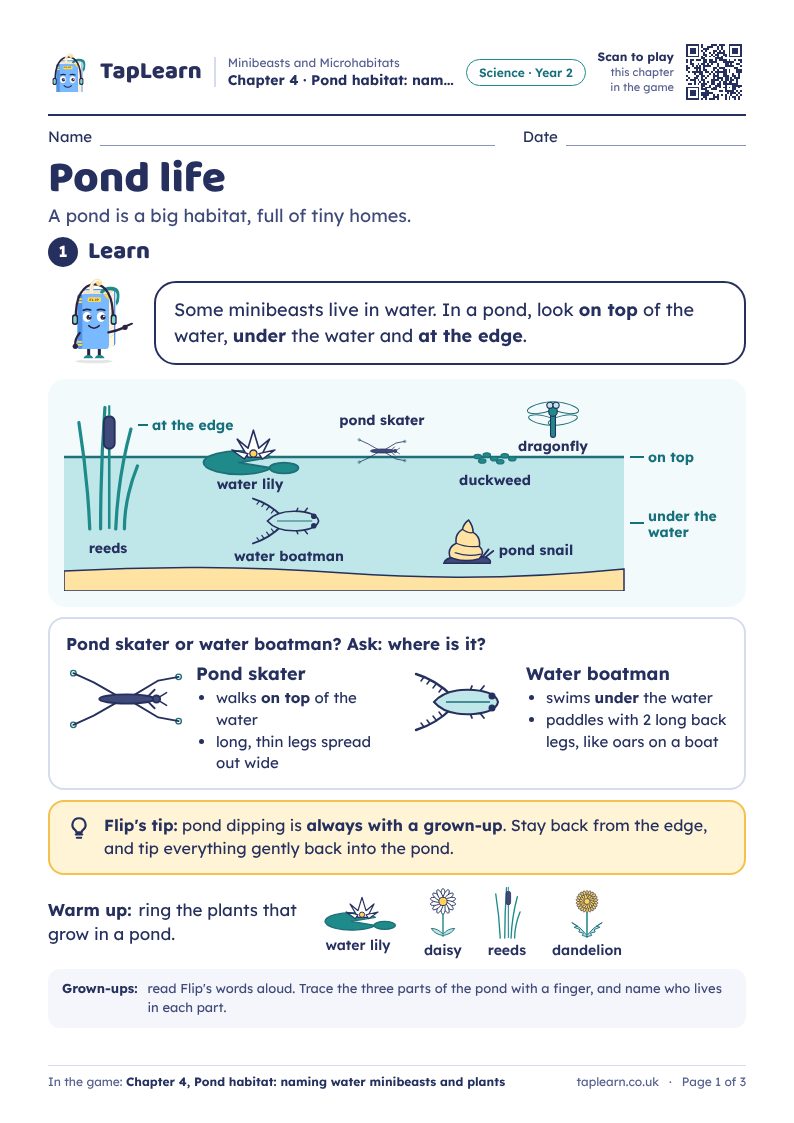
Pond Life is a printable pond habitat worksheet for Year 2 (ages 6 to 7) that teaches children to name pond minibeasts and plants and tell a pond skater, which walks on the water, from a water boatman, which swims underneath. It covers the Year 2 science national curriculum statement: identify and name a variety of plants and animals in their habitats, including microhabitats.
Free to print, no account needed.
Print it on A4, in colour or black and white. Do it after the chapter, or before it to see what your child already knows.
What's on the worksheet
Name pond minibeasts and plants, tell a pond skater from a water boatman, and sort what lives on top, under the water and at the edge. With a walk-on-water bowl experiment, and answers.
- Page 1 · Learn
- A pond with minibeasts and plants on top, under the water and at the edge, and how to tell a pond skater from a water boatman. Warm-up: ring the plants that grow in a pond.
- Page 2 · Try it together
- Walk on water: lay a paper clip on tissue in a bowl of water to see it float on the water's skin, then add washing-up liquid and watch it sink.
- Page 3 · Practise
- Name pond minibeasts, tick on top or under the water, ring the minibeasts that live in a pond, draw a plant and 2 minibeasts in a pond, and Ava's pond skater challenge.
- Answers sheet
- All answers, three mix-ups to watch for, and a pond-or-land sorting game.
3 A4 pages and an answers sheet · about 20 minutes
Using it at home
- Let your child predict float or sink before each step of the paper clip experiment and write it in the table.
- If you go pond dipping, stay with your child, keep back from the edge and tip everything gently back into the pond.
Watch out for
- Mixing up pond skaters and water boatmen.
- Ask "Is it on top of the water, or swimming underneath?"
- Putting land minibeasts in the pond.
- Woodlice, ladybirds and centipedes live on land. Ask "Could it swim?"
- Mixing up pond and garden plants.
- Water lilies and reeds need water; daisies and dandelions grow on land.
Questions from the worksheet
- Where does it live? Tick on top of the water or under the water.
- Pond or land? Ring the minibeasts that live in a pond: woodlouse, ladybird, centipede.
- Finish this pond. Draw 1 plant and 2 minibeasts in the right places.
- Ava sees a minibeast with long, thin legs walking on top of the pond. "It's a water boatman!" she says. Is she right? How do you know?
The answers are on the answers sheet, for grown-ups.
National curriculum in England
This worksheet practises this statement from the Year 2 science programme of study:
- Identify and name a variety of plants and animals in their habitats, including microhabitats
Source: National curriculum in England: science programmes of study (DfE)
In the classroom
- Demonstrate the paper clip experiment at the front, then let groups try it with their own bowls.
- Pond sort plenary: name a living thing and pupils say "pond!" or "land!", then "on top, under or at the edge?"
Questions and answers
What minibeasts live in a pond?
Pond skaters, water boatmen, pond snails and dragonflies all live in or around ponds. Some live on top of the water, some under it and some at the edge.
What is the difference between a pond skater and a water boatman?
A pond skater walks on top of the water on long, thin legs spread wide. A water boatman swims under the water, paddling with 2 long back legs like oars.
 TapLearn