Interpreting remainders worksheet for Year 6: What to do with remainders
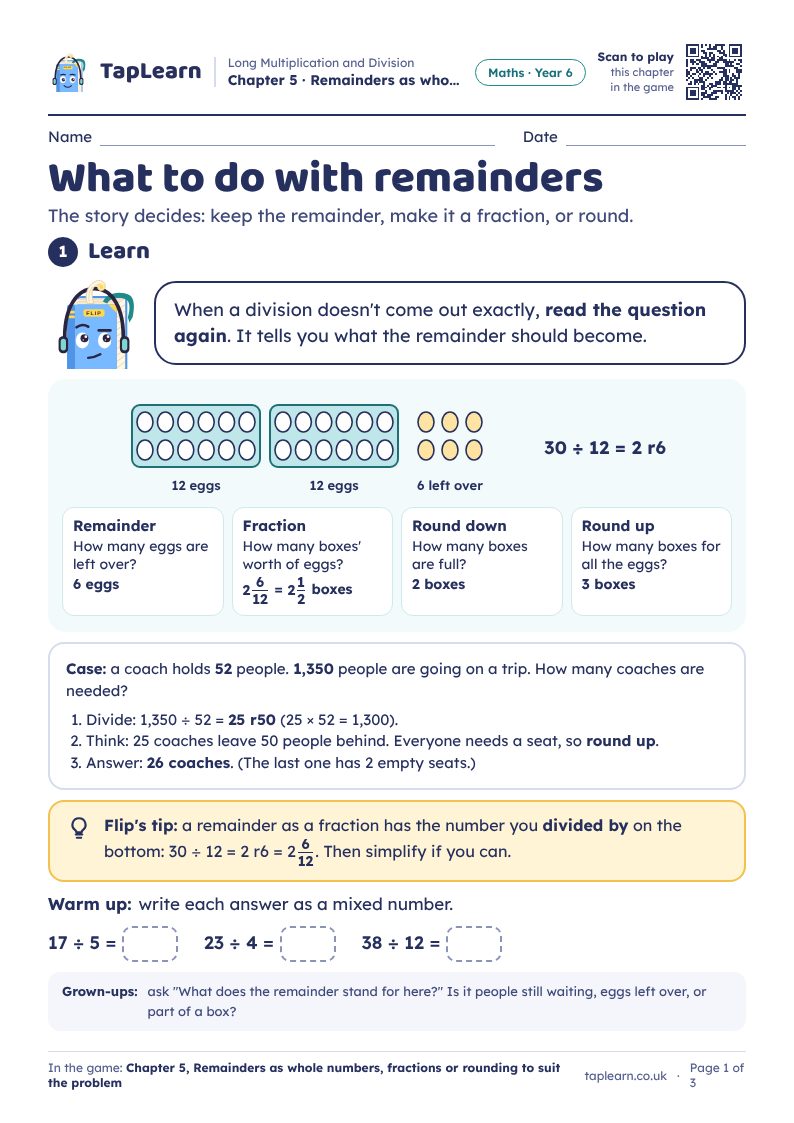
What to Do with Remainders is a printable interpreting remainders worksheet for Year 6 (ages 10 to 11) that teaches children to read the question again and decide whether a remainder stays, becomes a fraction or means rounding up or down. It covers the Year 6 maths statement to interpret remainders as whole number remainders, fractions, or by rounding, as appropriate for the context.
This worksheet is for members
Membership opens every chapter of every game and every worksheet, for all your children.
See the plansAlready a member? Log in to print it.
Start with the free one: Two rows, then add (chapter 1).
Print it on A4, in colour or black and white. Do it after the chapter, or before it to see what your child already knows.
What's on the worksheet
Your child decides what a remainder means in a word problem: leave it as a remainder, write it as a fraction, or round up or down. Includes a fill-the-boxes activity with pasta and cups and an answers sheet.
- Page 1 · Learn
- 30 eggs in boxes of 12 answered four ways, a worked example finding how many coaches 1,350 people need, Flip's tip on writing remainders as fractions, and a mixed-number warm-up.
- Page 2 · Try it together
- Fill the boxes: count out 50 pasta pieces, fill cups that hold 12, write the division, then answer full boxes, boxes needed, left over and as a fraction, and try boxes of 8.
- Page 3 · Practise
- Match stories using 100 ÷ 8 to the right answers, write answers as mixed numbers, decide what to do with remainders for minibuses, pencils, rope and seeds, and a challenge.
- Answers sheet
- Every answer, mix-ups like the wrong bottom number in a fraction, and egg-box and real-story ideas.
3 A4 pages and an answers sheet · about 30 minutes
Using it at home
- Ask "What does the remainder stand for here?" Is it people still waiting, eggs left over, or part of a box?
- In fill the boxes, ask which answer you'd need if you were buying boxes, and which if you were selling full boxes.
- Talk through real stories: car seats on a family trip, slices of pizza, chairs at a party. Round up or down?
Watch out for
- Rounding down when one more is needed.
- 21 minibuses leaves 4 people behind. Everyone needs a seat, so round up.
- Rounding up when only full groups count.
- There's no rule to always round up: it depends on the story.
- Using the wrong bottom number in a fraction.
- The bottom number is what you divided by: 30 ÷ 12 = 2 r6 = 2 and 6/12.
Questions from the worksheet
- Each story uses 100 ÷ 8 = 12 r4. Match each to the right answer: 100 cakes go in boxes of 8. How many boxes are needed?
- Write each answer as a mixed number. Simplify the fraction: 250 ÷ 12; 435 ÷ 20; 1,000 ÷ 15.
- A minibus holds 16 people. 340 people need a lift. How many minibuses are needed?
- 2,000 seeds are planted in rows of 35. How many seeds are left after filling as many rows as possible?
The answers are on the answers sheet, for grown-ups.
National curriculum in England
This worksheet practises these statements from the Year 6 maths programme of study:
- Divide numbers up to 4 digits by a two-digit whole number using the formal written method of long division, and interpret remainders as whole number remainders, fractions, or by rounding, as appropriate for the context
- Divide numbers up to 4 digits by a two-digit number using the formal written method of short division where appropriate, interpreting remainders according to the context
Source: National curriculum in England: mathematics programmes of study (DfE)
In the classroom
- Use Practise A as a discussion task: the same division gives four different answers.
- Have groups write their own story for each way of showing a remainder.
Questions and answers
How do you write a remainder as a fraction?
Put the remainder over the number you divided by. 30 ÷ 12 = 2 r6, which is 2 and 6/12, or 2 and 1/2 when simplified.
When do you round a remainder up or down?
Round up when everyone or everything needs a place, like coaches for people. Round down when only full groups count, like full boxes.
Is there a rule to always round up when there's a remainder?
No. The story decides: keep the remainder, write it as a fraction, or round up or down.
 TapLearn