Multiplying 4-digit numbers worksheet for Year 6: Estimate, then multiply
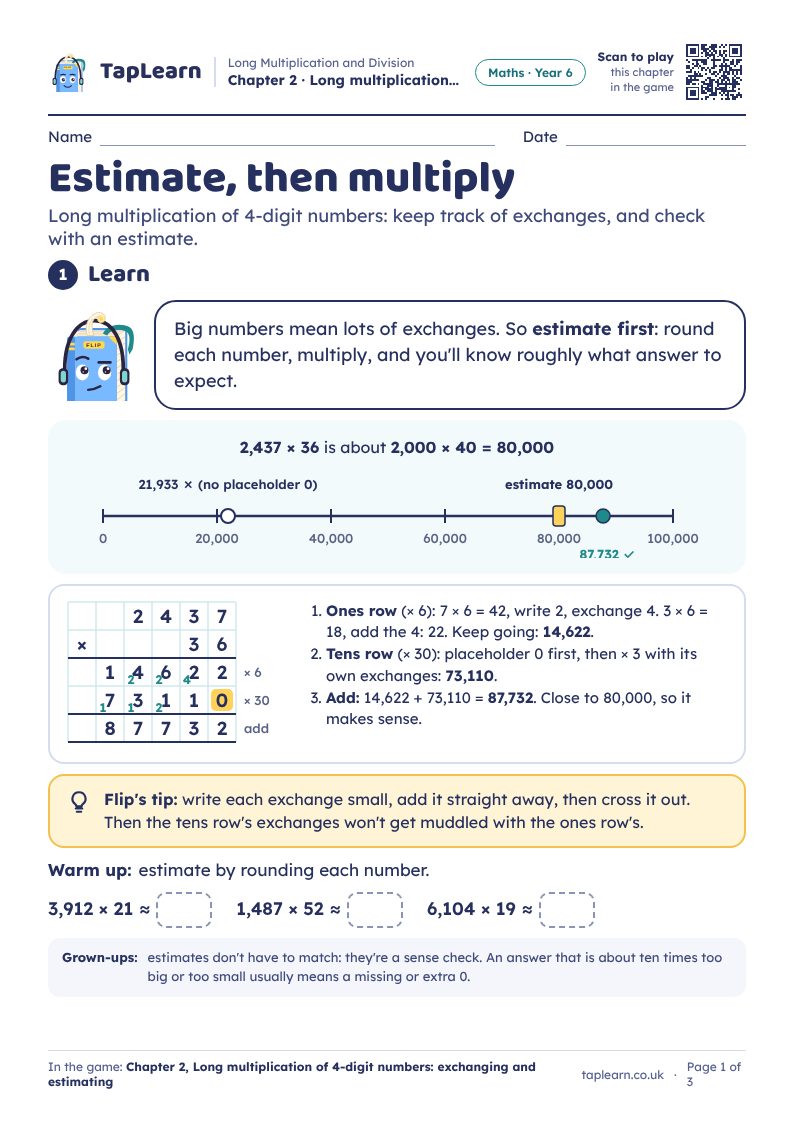
Estimate, Then Multiply is a printable multiplying 4-digit numbers worksheet for Year 6 (ages 10 to 11) that teaches children to round and estimate first, then use long multiplication and spot answers that are ten times out. It covers the Year 6 maths statement to multiply numbers up to 4 digits by a two-digit whole number using the formal written method of long multiplication.
This worksheet is for members
Membership opens every chapter of every game and every worksheet, for all your children.
See the plansAlready a member? Log in to print it.
Start with the free one: Two rows, then add (chapter 1).
Print it on A4, in colour or black and white. Do it after the chapter, or before it to see what your child already knows.
What's on the worksheet
Your child multiplies 4-digit numbers by two-digit numbers with long multiplication, keeps track of exchanges, and estimates first to check the answer makes sense. Includes a how-many-minutes activity and an answers sheet.
- Page 1 · Learn
- 2,437 × 36 estimated as about 80,000, then worked in columns with exchanges in each row, Flip's tip to cross out each exchange once added, and an estimating warm-up.
- Page 2 · Try it together
- How many minutes?: choose a number of days from a calendar, estimate 1,440 minutes a day × the days, work it out with long multiplication, then check on a calculator.
- Page 3 · Practise
- Estimate and ring the answer that makes sense, estimate then multiply 4-digit by 2-digit numbers, check ones rows for mistakes, and a challenge using an estimate to catch an error.
- Answers sheet
- Every answer, mix-ups like mixing up the two rows' exchanges, and estimate-it and too-big-or-too-small ideas.
3 A4 pages and an answers sheet · about 30 minutes
In the classroom
- Use Practise A as an estimation-only starter on mini-whiteboards.
- Have pairs swap ones rows from Practise C and check each other's exchanges.
Questions from the worksheet
- Estimate, then ring the answer that makes sense. No need to work it out! 1,245 × 24: 4,980, 29,880 or 298,800.
- Estimate, then use long multiplication: 2,518 × 37; 4,075 × 63.
- These are ones rows. Tick right or wrong: 1,358 × 4 = 4,202; 2,671 × 8 = 21,368.
- Sam works out 3,214 × 25. He adds 16,070 + 6,428 = 22,498. Use an estimate to show it must be wrong. What went wrong?
The answers are on the answers sheet, for grown-ups.
National curriculum in England
This worksheet practises this statement from the Year 6 maths programme of study:
- Multiply multi-digit numbers up to 4 digits by a two-digit whole number using the formal written method of long multiplication
Source: National curriculum in England: mathematics programmes of study (DfE)
Using it at home
- Estimates don't have to match: they're a sense check. An answer about ten times too big or small usually means a missing or extra 0.
- In how many minutes?, 31 days gives 44,640. An answer of 5,760 means the tens row lost its placeholder 0.
- Say a sum like 2,980 × 31 and ask for a quick estimate: 3,000 × 30 = 90,000.
Watch out for
- Forgetting exchanges.
- Say each step aloud: "7 times 6 is 42, write 2, exchange 4."
- Missing the placeholder 0 in the tens row.
- An estimate catches it, because the answer is about ten times too small.
- Mixing up the two rows' exchanges.
- Cross each one out once it's added, before starting the tens row.
Questions and answers
How do you multiply a 4-digit number by a 2-digit number?
Multiply by the ones digit, then by the tens digit with a placeholder 0, adding each exchange as you go, then add the two rows.
Why estimate before long multiplication?
An estimate shows roughly what answer to expect. If your answer is about ten times too big or small, look for a missing or extra 0.
How do you estimate a long multiplication?
Round each number, then multiply. 2,437 × 36 is about 2,000 × 40 = 80,000.
 TapLearn