Long multiplication worksheet for Year 6: Two rows, then add
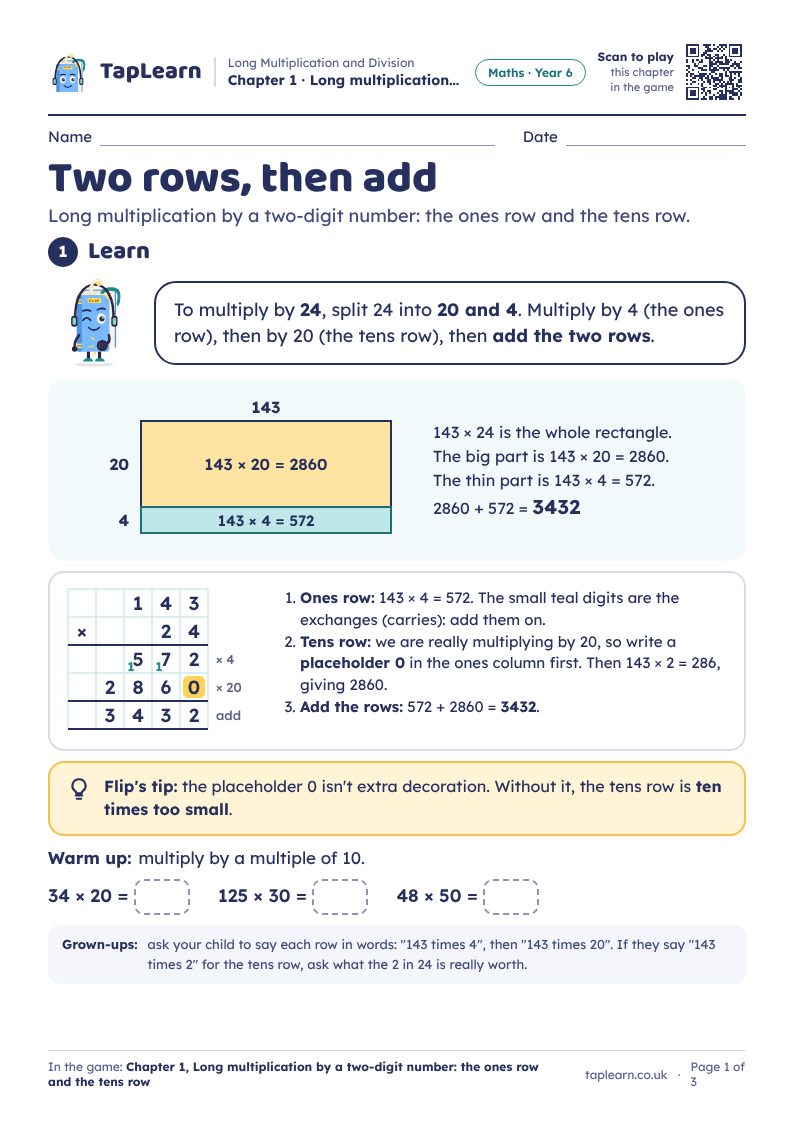
Two Rows, Then Add is a printable long multiplication worksheet for Year 6 (ages 10 to 11) that teaches children to split the two-digit number into tens and ones, write a placeholder zero in the tens row, then add the rows. It covers the Year 6 maths statement to multiply numbers up to 4 digits by a two-digit whole number using the formal written method of long multiplication.
Free to print, no account needed.
Print it on A4, in colour or black and white. Do it after the chapter, or before it to see what your child already knows.
What's on the worksheet
Your child practises long multiplication by a two-digit number: the ones row, the tens row with its placeholder zero, then adding the rows. Includes a words-on-a-page activity with books from home and an answers sheet.
- Page 1 · Learn
- 143 × 24 shown as an area model and in columns, with the ones row, the tens row and its placeholder 0, Flip's tip on why the 0 matters, and a multiply-by-tens warm-up.
- Page 2 · Try it together
- Words on a page: count the words in a line and lines on a page in a book, estimate by rounding, work out the total with long multiplication, then compare books.
- Page 3 · Practise
- Fill missing rows, estimate then multiply 2- and 3-digit numbers, spot the tens row, fill gaps, solve a hall chairs problem, and a challenge about a missing placeholder.
- Answers sheet
- Every answer, mix-ups like only doing the ones row, and split-it and seat-count ideas.
3 A4 pages and an answers sheet · about 30 minutes
In the classroom
- Show the area model alongside the written method so children see where each row comes from.
- Use Leo's challenge as a spot-the-mistake starter, checking with an estimate.
Questions from the worksheet
- Make a quick estimate, then use long multiplication. Is your answer close? 47 × 23; 128 × 15; 236 × 42.
- Fill the gaps: 52 × 37 = 52 × 7 + 52 × ___.
- A hall has 24 rows of chairs with 36 chairs in each row. How many chairs are there?
- Leo works out 53 × 26. His ones row is 318 and his tens row is 106, so he writes 318 + 106 = 424. Is he right? What did he forget?
The answers are on the answers sheet, for grown-ups.
National curriculum in England
This worksheet practises this statement from the Year 6 maths programme of study:
- Multiply multi-digit numbers up to 4 digits by a two-digit whole number using the formal written method of long multiplication
Source: National curriculum in England: mathematics programmes of study (DfE)
Using it at home
- Ask your child to say each row in words: "143 times 4", then "143 times 20". If they say 143 times 2, ask what the 2 is worth.
- In words on a page, talk about why the answer is an estimate of the whole page, since lines vary.
- Say 25 × 14 and let your child split it aloud: 250 + 100 = 350.
Watch out for
- Missing the placeholder 0 in the tens row.
- Ask "What is the 2 in 24 worth?" Without the 0, the row is ten times too small.
- Forgetting the exchanges (carries).
- Write them small and cross them off once added. Keep each row's carries separate.
- Only doing the ones row, so 143 × 24 comes out as 572.
- Two digits in 24 means two rows.
Questions and answers
How do you do long multiplication by a two-digit number?
Multiply by the ones digit for the first row, then by the tens digit with a placeholder 0 for the second row, then add the two rows.
Why is there a zero in the second row of long multiplication?
The second row multiplies by tens, like 20 rather than 2. The placeholder 0 makes the row ten times bigger, as it should be.
How can my child check a long multiplication?
Round both numbers and multiply for a quick estimate. If the answer is far off, look for a missing 0 or carry.
 TapLearn