Long division worksheet for Year 6: Long division steps
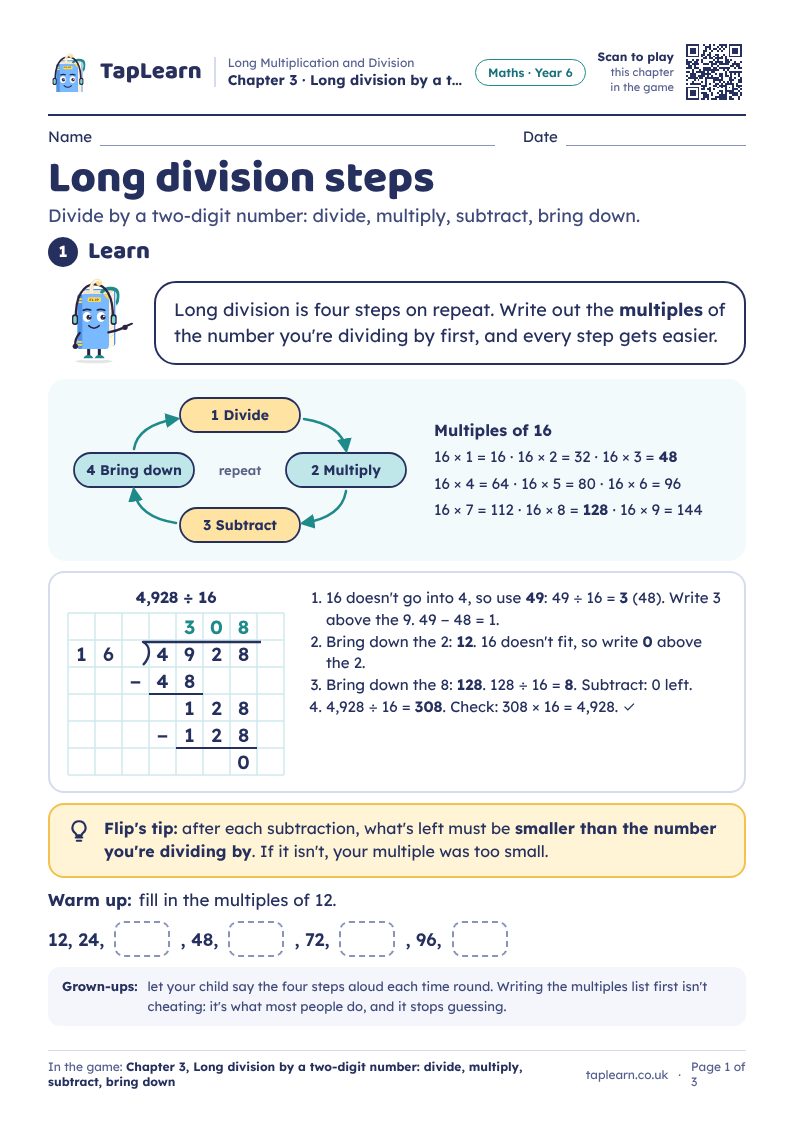
Long Division Steps is a printable long division worksheet for Year 6 (ages 10 to 11) that teaches children to write out the divisor's multiples first, then repeat divide, multiply, subtract and bring down. It covers the Year 6 maths statement to divide numbers up to 4 digits by a two-digit whole number using long division.
This worksheet is for members
Membership opens every chapter of every game and every worksheet, for all your children.
See the plansAlready a member? Log in to print it.
Start with the free one: Two rows, then add (chapter 1).
Print it on A4, in colour or black and white. Do it after the chapter, or before it to see what your child already knows.
What's on the worksheet
Your child divides numbers up to 4 digits by a two-digit number with long division: divide, multiply, subtract, bring down, including zeros in the answer. Includes a multiples strip activity and an answers sheet.
- Page 1 · Learn
- The four long division steps and a list of multiples of 16, a worked example for 4,928 ÷ 16 with a 0 in the answer, Flip's tip on remainders, and a multiples-of-12 warm-up.
- Page 2 · Try it together
- The multiples strip: write the 15 times table on a strip of paper, then slide your finger down it at each divide step to work out 7,335 ÷ 15, and check by multiplying.
- Page 3 · Practise
- Fill the gaps in 672 ÷ 12, use long division for 3- and 4-digit numbers, correct remainders that are too big, and a challenge about a missing 0 in the answer.
- Answers sheet
- Every answer, mix-ups like choosing the wrong multiple, and times-table chant and how-many-fit ideas.
3 A4 pages and an answers sheet · about 30 minutes
In the classroom
- Make multiples strips as a class for common divisors and keep them for later lessons.
- Use Practise C as a quick check on remainders that are too big.
Questions from the worksheet
- Use long division. Write the multiples you need at the side: 864 ÷ 18; 2,976 ÷ 24; 8,428 ÷ 14.
- Each remainder is too big. Write the right answer: 75 ÷ 18 = 3 r21; 150 ÷ 16 = 8 r22.
- Leo says 6,150 ÷ 15 = 41. Check by multiplying. Is he right? What did he forget?
The answers are on the answers sheet, for grown-ups.
National curriculum in England
This worksheet practises this statement from the Year 6 maths programme of study:
- Divide numbers up to 4 digits by a two-digit whole number using the formal written method of long division, and interpret remainders as whole number remainders, fractions, or by rounding, as appropriate for the context
Source: National curriculum in England: mathematics programmes of study (DfE)
Using it at home
- Let your child say the four steps aloud each time. Writing the multiples first isn't cheating: it stops guessing.
- For a second go at the multiples strip, make one for 25 and try 6,350 ÷ 25. Keep the strips for chapter 4.
- Ask quick-fire questions like "How many 14s in 100?"
Watch out for
- Leaving out a 0 in the answer, like 41 for 410.
- Every digit you bring down needs a digit above it, even if it's 0.
- Choosing the wrong multiple, so the remainder is too big.
- Ask "Could one more lot of 18 fit?"
- Losing your place.
- Use squared paper and keep digits in their columns.
Questions and answers
What are the steps of long division?
Divide, multiply, subtract, bring down, then repeat. Writing the divisor's multiples first makes each step easier.
Why write the multiples before long division?
A list like 16, 32, 48 shows the biggest multiple that fits at each divide step, so you don't have to guess.
Why does 6,150 ÷ 15 need a 0 in the answer?
When the last 0 is brought down, 15 doesn't fit, so a 0 goes in the answer: 410. Without it, the answer would be 41.
 TapLearn