Handwriting size and spacing worksheet for Years 3–4: Size and spacing
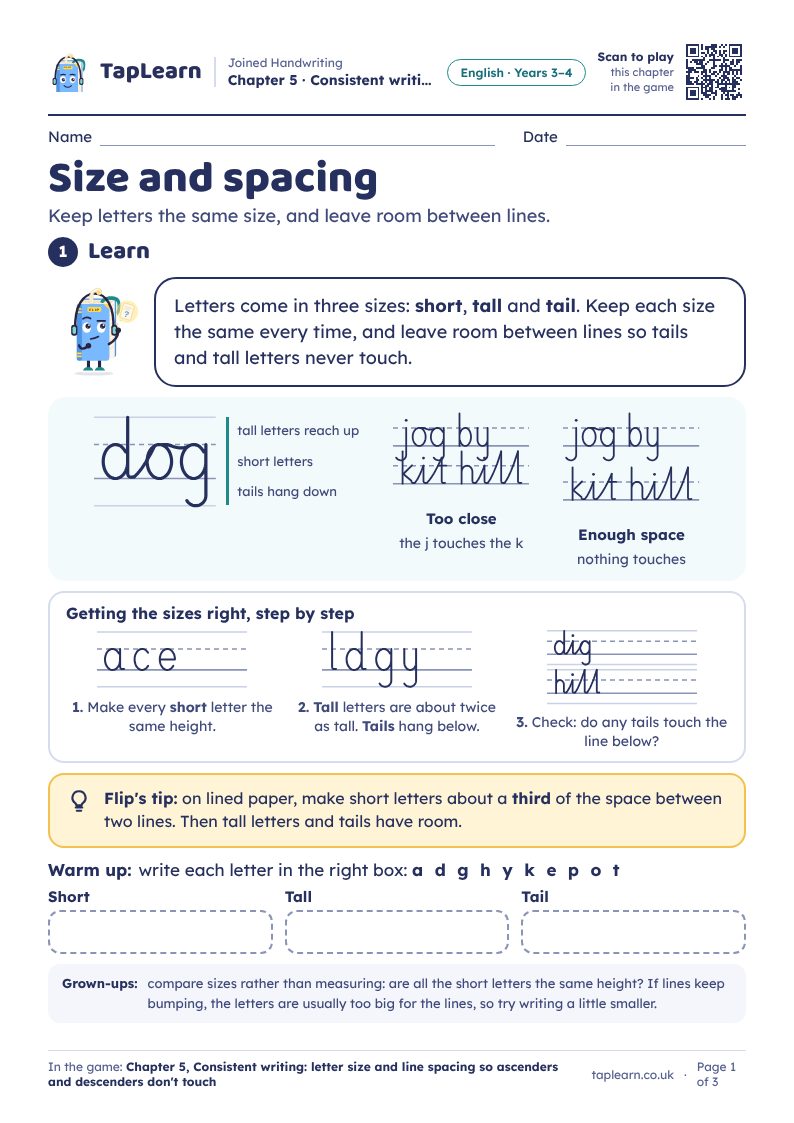
Size and Spacing is a printable handwriting size and spacing worksheet for Years 3 and 4 (ages 7 to 9) that teaches children to keep short, tall and tail letters a consistent size and space lines so they don't touch. It covers the Years 3 and 4 English statement to increase the legibility, consistency and quality of handwriting.
This worksheet is for members
Membership opens every chapter of every game and every worksheet, for all your children.
See the plansAlready a member? Log in to print it.
Start with the free one: Diagonal joins (chapter 1).
Print it on A4, in colour or black and white. Do it after the chapter, or before it to see what your child already knows.
What's on the worksheet
Your child practises keeping short, tall and tail letters the right size, and spacing lines so ascenders and descenders don't touch. Includes a bump detectives copying activity and an answers sheet.
- Page 1 · Learn
- The three letter sizes, lines too close and with enough space, three steps for getting sizes right, Flip's tip on how big short letters should be, and a sorting warm-up.
- Page 2 · Try it together
- Bump detectives: copy two lines from a favourite book onto lined paper, ring any place where a tail touches a tall letter below, count the bumps and try again.
- Page 3 · Practise
- Ring the letter that's the wrong size in each word, decide if tails touch tall letters below, write words at the right sizes, copy two lines, and a challenge.
- Answers sheet
- Every answer, mix-ups like letters floating above the line, and body sizes and book spotting games.
3 A4 pages and an answers sheet · about 25 minutes
Using it at home
- Compare sizes rather than measuring: are all the short letters the same height?
- If lines keep bumping, the letters are usually too big for the lines, so try writing a little smaller.
- If there are no bumps in bump detectives, celebrate, then look at letter sizes instead.
Watch out for
- Lines that touch, with tails and tall letters bumping.
- The letters are usually too big for the lines, so aim smaller.
- Mixed sizes, like an l that's no taller than an i.
- Compare letters side by side.
- Letters floating above the line.
- Every letter sits on the line; only tails go below it.
Questions from the worksheet
- Write each letter in the right box: short, tall or tail. a d g h y k e p o t
- In each word, one letter is the wrong size. Draw a ring round it.
- Copy these two lines. Check that no tails touch the tall letters below.
- Mia's tall letters are so big that they bump into the tails on the line above. She says, "I should press harder." What would really help?
The answers are on the answers sheet, for grown-ups.
National curriculum in England
This worksheet practises this statement from the Years 3–4 english programme of study:
- Increase the legibility, consistency and quality of their handwriting
In the classroom
- Play body sizes as a warm-up: call out letters and children stretch up for tall, crouch for tail and stand for short.
- Use bump detectives on a recent piece of class writing as peer assessment.
Questions and answers
What are ascenders and descenders?
Ascenders are the parts of tall letters that reach up, like in h and k. Descenders are the tails that hang down, like in g and y.
How big should short letters be on lined paper?
About a third of the space between two lines, so tall letters and tails have room.
Why do lines of handwriting bump into each other?
Usually the letters are too big for the lines. Writing a little smaller stops tails touching tall letters below.
 TapLearn