Break letters worksheet for Years 3–4
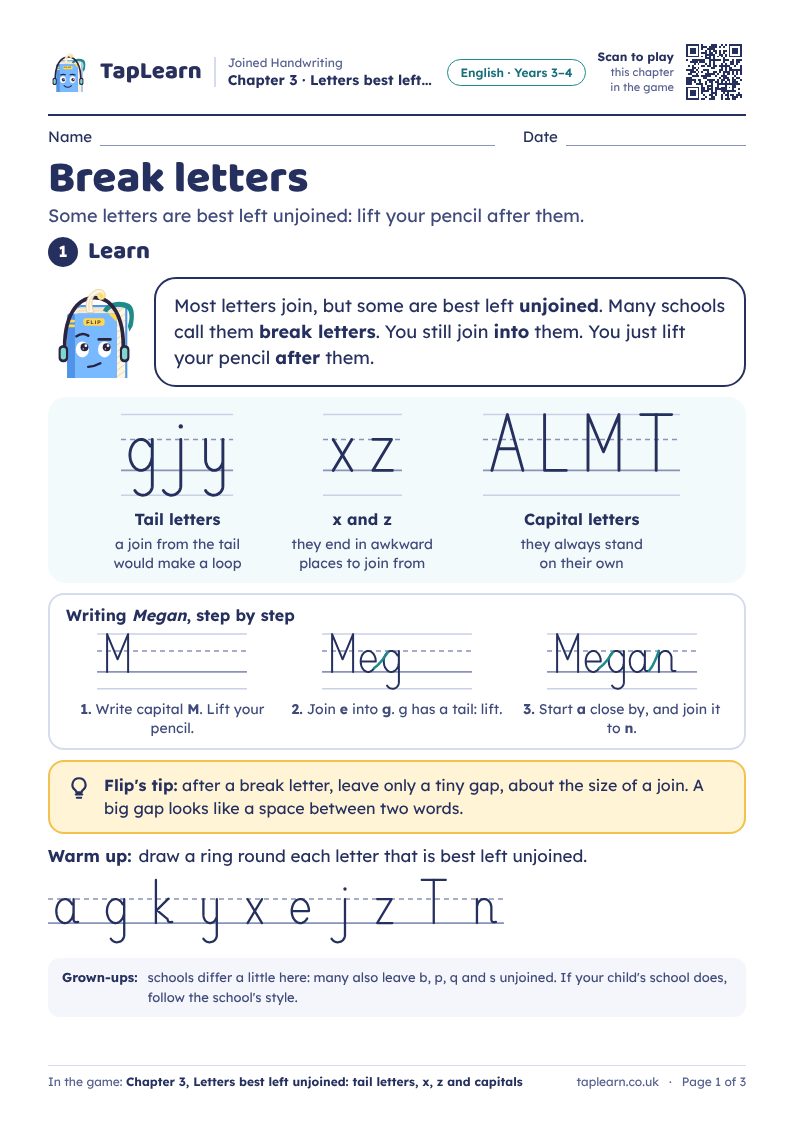
Break Letters is a printable break letters worksheet for Years 3 and 4 (ages 7 to 9) that teaches children which letters are best left unjoined, such as g, j, y, x, z and capitals, and to join into them but lift after them. It covers the Years 3 and 4 English statement to use the diagonal and horizontal strokes needed to join letters and understand which letters are best left unjoined.
This worksheet is for members
Membership opens every chapter of every game and every worksheet, for all your children.
See the plansAlready a member? Log in to print it.
Start with the free one: Diagonal joins (chapter 1).
Print it on A4, in colour or black and white. Do it after the chapter, or before it to see what your child already knows.
What's on the worksheet
Your child learns which letters are best left unjoined (the tail letters g, j and y, x and z, and capitals) while still joining into them. Includes a break-letter hunt in a book or cereal box and an answers sheet.
- Page 1 · Learn
- How break letters work, the name Megan written step by step with each lift, Flip's tip on keeping the gap tiny, and a ring-the-break-letters warm-up.
- Page 2 · Try it together
- Break-letter hunt: find words with g, j, y, x, z or a capital in a book or on a cereal box, then dot where the pencil lifts and write your name and jelly.
- Page 3 · Practise
- Decide whether letter pairs join, count the lifts inside words, find the mistake in each word, copy words with tiny gaps, and a challenge about dig.
- Answers sheet
- Every answer, mix-ups like joining capitals or breaking too much, and name game and clap-the-lifts ideas.
3 A4 pages and an answers sheet · about 25 minutes
Using it at home
- Schools differ here: many also leave b, p, q and s unjoined. If your child's school does, follow the school's style.
- A break letter at the end of a word needs no lift, so jelly has just one lift, after the j.
- Spell a word aloud and clap once at each place you'd lift your pencil.
Watch out for
- Joining on from g, j or y.
- Show how a join from the tail swings into a loop and makes the next letter hard to read.
- Joining capitals to the next letter.
- A capital always stands on its own.
- Breaking too much, lifting after letters that should join.
- Ask "Is this a break letter? If not, keep going."
Questions from the worksheet
- Should these two letters join? Write a tick if they join, or a cross if you lift your pencil.
- How many times do you lift your pencil inside each word? Write the number.
- Copy these words joined. Leave a tiny gap only after break letters.
- Sam says, "If a word has a g in it, you can't join the letters before the g either." Is he right? Think about the word dig.
The answers are on the answers sheet, for grown-ups.
National curriculum in England
This worksheet practises this statement from the Years 3–4 english programme of study:
- Use the diagonal and horizontal strokes that are needed to join letters and understand which letters, when adjacent to one another, are best left unjoined
In the classroom
- Play the name game: list class names and find the break letters in each one.
- Use Practise B as a whole-class count, with children holding up fingers for the number of lifts.
Questions and answers
What are break letters in handwriting?
Break letters are letters best left unjoined to the next letter, such as g, j, y, x, z and capitals. You still join into them, then lift your pencil.
Do you join capital letters?
No. A capital letter always stands on its own and isn't joined to the next letter.
How big should the gap after a break letter be?
Only tiny, about the size of a join. A big gap looks like a space between two words.
 TapLearn