Neat handwriting worksheet for Years 3–4: Even downstrokes
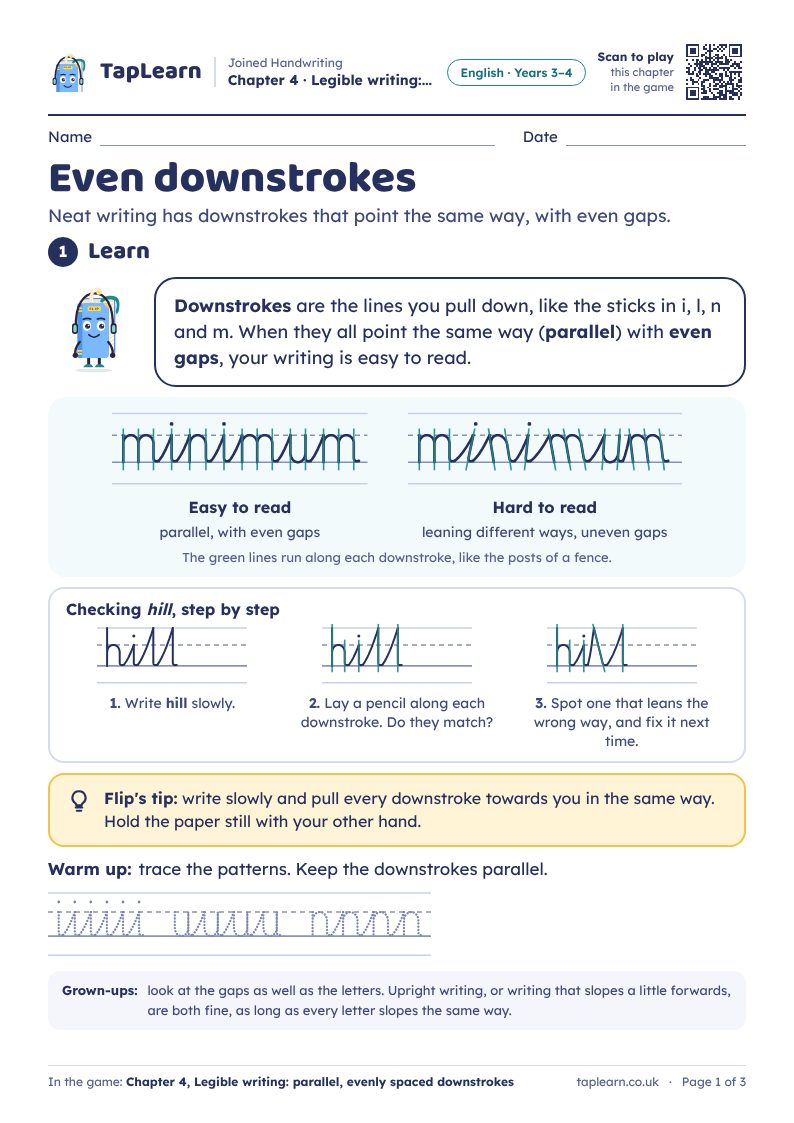
Even Downstrokes is a printable neat handwriting worksheet for Years 3 and 4 (ages 7 to 9) that teaches children to keep downstrokes parallel and evenly spaced so joined writing is easy to read. It covers the Years 3 and 4 English statement to increase the legibility, consistency and quality of handwriting.
This worksheet is for members
Membership opens every chapter of every game and every worksheet, for all your children.
See the plansAlready a member? Log in to print it.
Start with the free one: Diagonal joins (chapter 1).
Print it on A4, in colour or black and white. Do it after the chapter, or before it to see what your child already knows.
What's on the worksheet
Your child practises keeping downstrokes parallel and evenly spaced, so joined writing is easy to read. Includes a fence-post check with a ruler and coloured pencil, and an answers sheet.
- Page 1 · Learn
- What downstrokes are, parallel and leaning examples, three steps for checking hill with a pencil, Flip's tip on writing slowly, and a pattern warm-up.
- Page 2 · Try it together
- Fence-post check: write minimum and hill, rule a line along each downstroke like fence posts, check they lean the same way with even gaps, then write them again.
- Page 3 · Practise
- Tick the word that's easier to read, draw lines along downstrokes and ring the letter that leans wrong, write words neatly, copy a sentence, and a challenge.
- Answers sheet
- Every answer, notes on paper position for left-handers, mix-ups like rushing, and fence spotting and finger pattern ideas.
3 A4 pages and an answers sheet · about 25 minutes
Using it at home
- Upright writing, or writing that slopes a little forwards, are both fine, as long as every letter slopes the same way.
- In the fence-post check, ask what your child notices first and praise their neatest letter before choosing one to fix.
- If letters lean different ways, check the paper isn't sliding about.
Watch out for
- Letters leaning different ways.
- Check posture and paper: keep the paper still and tilted a little to suit the writing hand (left-handers usually tilt it the other way).
- Uneven gaps, often squashed letters near the end of a line.
- Encourage slowing down and leaving room.
- Rushing.
- Neatness comes first; speed grows with practice.
Questions from the worksheet
- Which word is easier to read? Tick it.
- Draw a line along each downstroke. Then ring the letter that leans the wrong way.
- Copy the sentence in joined writing. Then check it with a ruler.
- Ava says, "Some of my letters lean forwards and some lean backwards, but that's fine, because each letter is the right shape." Is she right? Why?
The answers are on the answers sheet, for grown-ups.
National curriculum in England
This worksheet practises this statement from the Years 3–4 english programme of study:
- Increase the legibility, consistency and quality of their handwriting
In the classroom
- Run the fence-post check as a self-assessment after a piece of writing, with children ruling lines on their own work.
- Display two versions of a word and discuss which is easier to read and why.
Questions and answers
What are downstrokes in handwriting?
Downstrokes are the lines you pull down, like the sticks in i, l, n and m.
Should handwriting slope or be upright?
Either is fine. What matters is that every letter leans the same way, so the downstrokes are parallel.
How can children check their handwriting is even?
Lay a pencil or ruler along each downstroke. The lines should point the same way, with similar gaps between them.
 TapLearn