Diagonal joins worksheet for Years 3–4
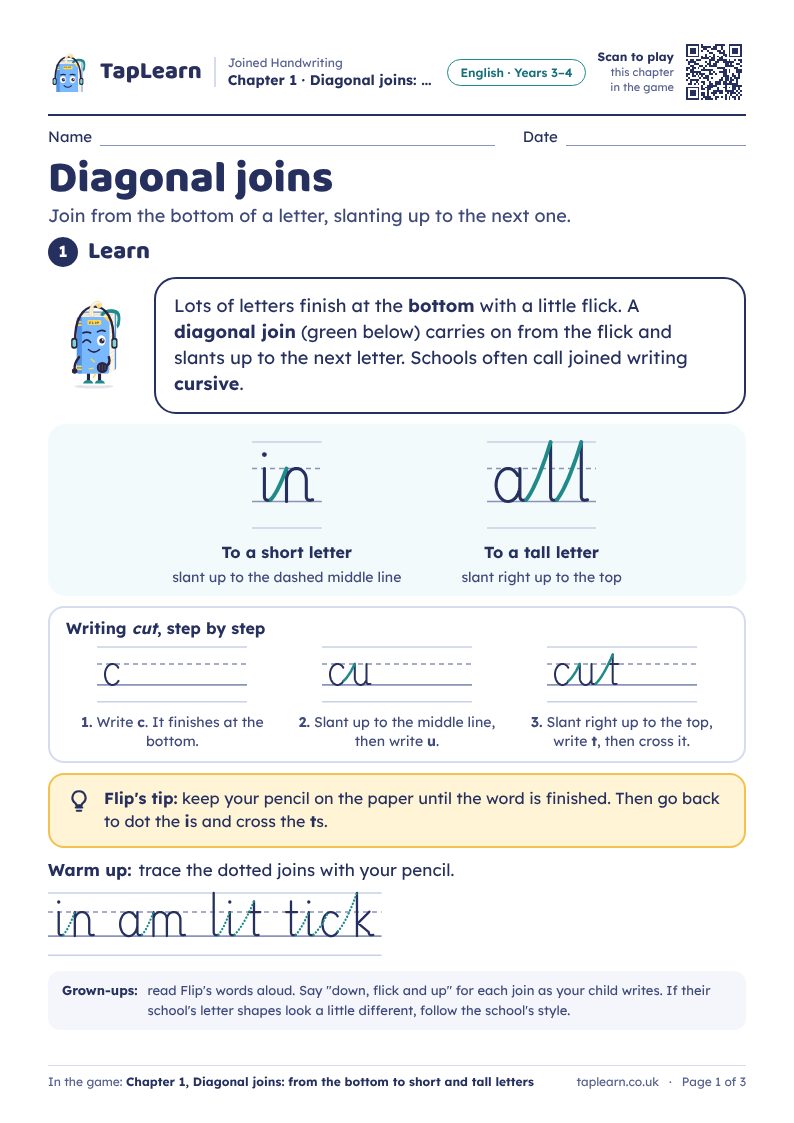
Diagonal Joins is a printable diagonal joins worksheet for Years 3 and 4 (ages 7 to 9) that teaches children to join from the bottom of a letter, slanting up to short letters and right to the top of tall ones. It covers the Years 3 and 4 English statement to use the diagonal and horizontal strokes needed to join letters and understand which letters are best left unjoined.
Free to print, no account needed.
▶ Play chapter 1 in the game · How the joined handwriting works
Print it on A4, in colour or black and white. Do it after the chapter, or before it to see what your child already knows.
What's on the worksheet
Your child practises diagonal joins: starting at the bottom of a letter and slanting up to short letters, and right to the top of tall ones, in words like in, cut and hill. Includes a salt-tray writing activity and an answers sheet.
- Page 1 · Learn
- What a diagonal join is, the word cut written step by step, Flip's tip on keeping the pencil down until the word is finished, and a trace-the-joins warm-up.
- Page 2 · Try it together
- Salt-tray joins: write letters big with a finger in a tray of salt or flour, carrying on from each flick into in, il and ill, then take turns writing hit, cut and lick.
- Page 3 · Practise
- Ring letters that finish at the bottom, draw missing joins, trace and write words, tick the word joined the right way, copy a sentence, and a challenge about Mia's hill.
- Answers sheet
- Every answer, mix-ups like flat joins or joins that stop halfway, and sky writing and back writing games.
3 A4 pages and an answers sheet · about 25 minutes
In the classroom
- Model diagonal joins large on the board, then let children practise in sand or salt trays before moving to paper.
- Play back writing in pairs: write a short joined word on a partner's back with a finger for them to guess.
Questions from the worksheet
- Draw a ring round each letter that finishes at the bottom.
- Trace each word. Then write it on the line, joined.
- Copy the sentence in joined writing.
- Mia writes hill. Her joins stop at the dashed line and bump into the middle of each l. Is that right? What should she do?
The answers are on the answers sheet, for grown-ups.
National curriculum in England
This worksheet practises this statement from the Years 3–4 english programme of study:
- Use the diagonal and horizontal strokes that are needed to join letters and understand which letters, when adjacent to one another, are best left unjoined
Using it at home
- Say "down, flick and up" for each join as your child writes. If their school's letter shapes look a little different, follow the school's style.
- In the salt tray, ask "Where does this letter finish? So where does the join start?" before each join, then try one word on paper.
- Write in and hill in the air with a straight arm, saying "down, flick and up".
Watch out for
- Flat joins from letters that finish at the bottom.
- Say "down, flick and up": the join slopes like a slide.
- Joins that stop halfway before l, h, k or t.
- Aim for the very top, then come back down the same line.
- Joining low into round letters like d.
- Round letters start like c, so the join goes to the top of the round part.
Questions and answers
What is a diagonal join in handwriting?
A diagonal join starts at the bottom of a letter, where it finishes with a flick, and slants up to the next letter.
How high should a join go before a tall letter?
Right up to the top of the tall letter, then the pencil comes straight back down. A join that stops halfway leaves a bump.
What do schools call joined writing?
Many schools call it cursive or joined handwriting. Letter shapes can differ a little from school to school.
 TapLearn