Variation in offspring worksheet for Year 6: Similar, not identical
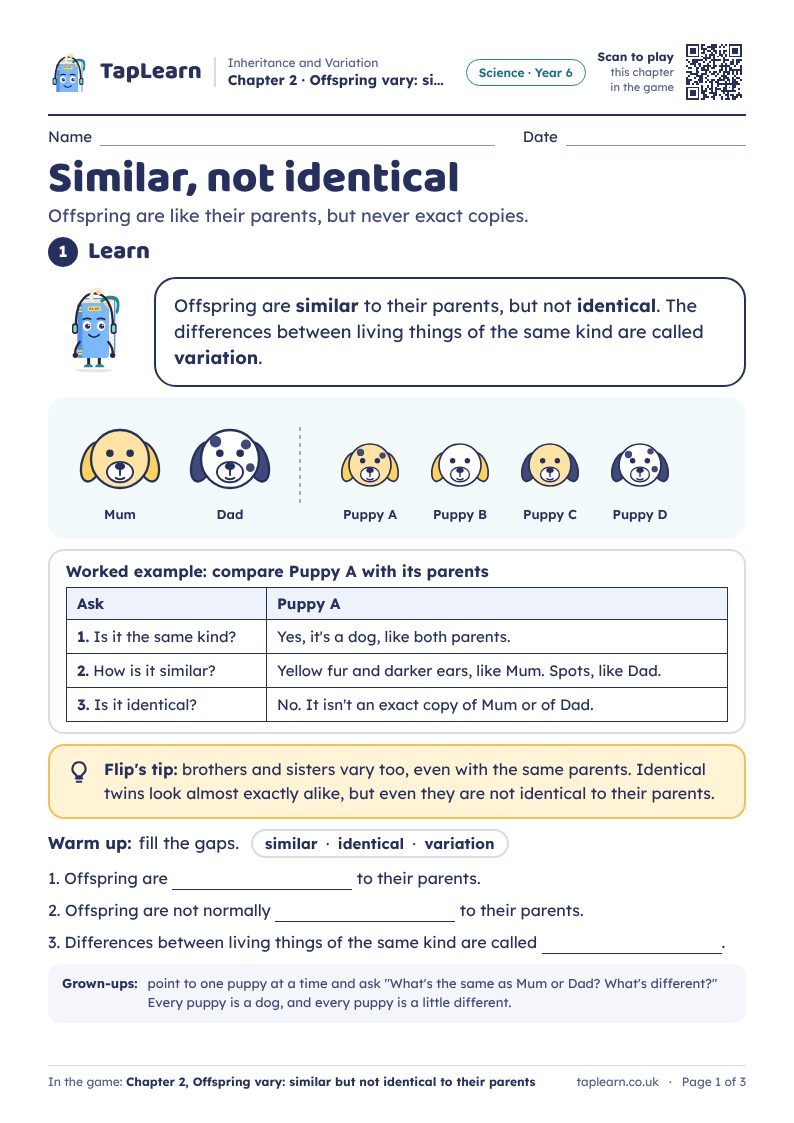
Similar, Not Identical is a printable variation worksheet for Year 6 (ages 10 to 11) that teaches children that offspring are similar to their parents but normally vary and are not identical to them. It supports the Year 6 national curriculum in England: recognise that living things produce offspring of the same kind, but normally offspring vary and are not identical to their parents.
This worksheet is for members
Membership opens every chapter of every game and every worksheet, for all your children.
See the plansAlready a member? Log in to print it.
Start with the free one: Parents and offspring (chapter 1).
Print it on A4, in colour or black and white. Do it after the chapter, or before it to see what your child already knows.
What's on the worksheet
Children learn that offspring are similar to their parents but normally vary and are not identical, comparing a family of puppies and a mother cat's kittens. With a bean-measuring activity and an answers sheet.
- Page 1 · Learn
- Two parent dogs and four different puppies, a worked example comparing one puppy with its parents, and a word-bank warm-up on similar, identical and variation.
- Page 2 · Try it together
- The bean line-up: measure 10 dried beans or chickpeas in millimetres, find the shortest and longest, and look for any two that are exactly the same.
- Pages 2–3 · Practise
- Write how three kittens are similar to and different from their mother, tick true or false, explain how siblings can have different hair, and describe a young animal you know.
- Answers sheet
- Every answer by page, what to watch out for (offspring as exact copies, siblings looking the same) and ideas to go further.
3 A4 pages and an answers sheet · about 30 minutes
Using it at home
- The bean line-up needs only a ruler and a handful of dried beans or chickpeas, and takes about 10 minutes. Let your child do the measuring.
- Point to one puppy at a time on page 1 and ask "What's the same as Mum or Dad? What's different?"
Watch out for
- Thinking offspring are exact copies of their parents.
- Look at the four puppies: every one is a dog, but each is a little different from both parents.
- Thinking brothers and sisters from the same parents look exactly alike.
- Ask your child to compare two siblings they know, or the puppies on page 1, and name the differences.
- Thinking offspring share nothing with their parents.
- Point out the features they do share, like a puppy's ears or a kitten's stripes.
Questions from the worksheet
- For each kitten, write one way it is similar to its mother and one way it is different.
- True or false: brothers and sisters with the same parents always look exactly alike.
- Mia and her brother Leo have the same parents. Mia has curly hair and Leo has straight hair. Is that possible? Explain.
- Ava says, "Twins are always identical to each other, and to their mum and dad." Is she right? Explain.
The answers are on the answers sheet, for grown-ups.
National curriculum in England
This worksheet practises this statement from the Year 6 science programme of study:
- Recognise that living things produce offspring of the same kind, but normally offspring vary and are not identical to their parents
Source: National curriculum in England: science programmes of study (DfE)
In the classroom
- Run the bean line-up in pairs and collect the class's measurements to show how much one kind of seed varies.
- Use the twins Challenge as a class discussion about identical and non-identical twins.
Questions and answers
What is variation in Year 6 science?
Variation means the differences between living things of the same kind. Offspring vary: they are similar to their parents but not identical to them or to each other.
Why don't offspring look exactly like their parents?
Offspring are similar to their parents but normally vary, so they are never exact copies. Even brothers and sisters with the same parents look different.
Are identical twins identical to their parents?
No. Identical twins look almost exactly like each other, but they are not identical to their parents. Non-identical twins can look as different as any brother and sister.
 TapLearn