Inherited and acquired characteristics worksheet for Year 6: Inherited or not?
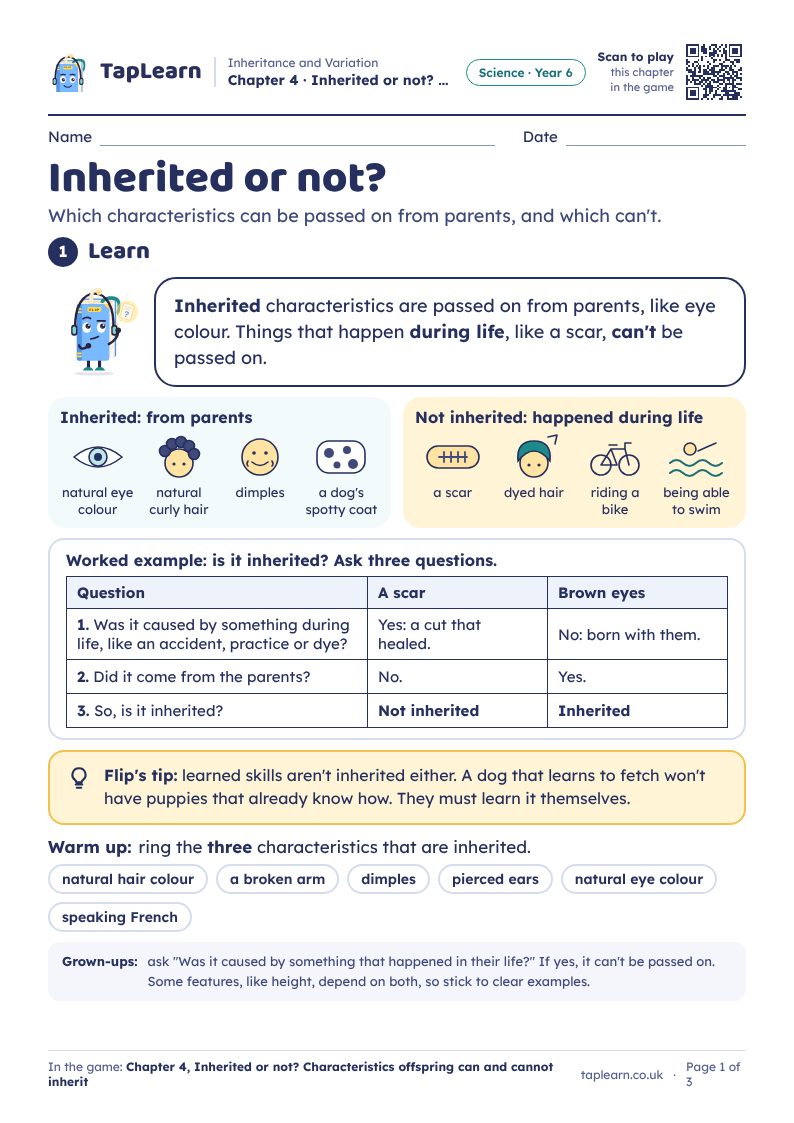
Inherited or Not? is a printable worksheet on inherited and acquired characteristics for Year 6 (ages 10 to 11) that teaches children to tell inherited features, like eye colour, from ones that are not, like scars or learned skills. It supports the Year 6 national curriculum in England: recognise that living things produce offspring of the same kind, but normally offspring vary and are not identical to their parents.
This worksheet is for members
Membership opens every chapter of every game and every worksheet, for all your children.
See the plansAlready a member? Log in to print it.
Start with the free one: Parents and offspring (chapter 1).
Print it on A4, in colour or black and white. Do it after the chapter, or before it to see what your child already knows.
What's on the worksheet
Children sort characteristics that are inherited, like eye colour, from ones that are not, like scars, dyed hair or learned skills, using three simple questions. With a card-sorting activity and an answers sheet.
- Page 1 · Learn
- Pictures sort inherited features (eye colour, curly hair, dimples, a spotty coat) from ones that happen during life (a scar, dyed hair, riding a bike, swimming), then three questions test a scar and brown eyes.
- Page 2 · Try it together
- The great sort: write 12 characteristics on scraps of paper and take turns sorting them into Inherited and Not inherited piles, explaining each choice.
- Pages 2–3 · Practise
- Tick inherited or not, explain whether a dog's puppies can sit untaught and whether a trimmed hedge's seeds grow into balls, explain dyed hair, and give your own examples.
- Answers sheet
- Every answer by page, what to watch out for (scars or skills passed on, eye colour seen as not inherited) and ideas to go further.
3 A4 pages and an answers sheet · about 30 minutes
Using it at home
- Do the great sort after page 1: it takes about 10 minutes and works well as a back-and-forth with a grown-up.
- When your child isn't sure, ask "Was it caused by something that happened during their life?" If so, it isn't inherited.
Watch out for
- Thinking things that happen during life, like scars or learned skills, can be passed on.
- Ask "Did it happen during their life?" A scar comes from a cut and a skill from practice, so neither can be inherited.
- Thinking features you are born with, like eye colour, are not inherited.
- Explain that features you're born with come from your parents: that is what inherited means.
Questions from the worksheet
- Inherited or not? A zebra's stripes; a horse that has been taught to jump fences; a person's natural straight hair; a tree branch broken off in a storm.
- A dog has learned to sit when she is told. Will her puppies know how to sit without being taught? Why?
- A gardener trims a hedge into a ball shape. Will plants grown from its seeds be ball-shaped? Why?
- Mia's mum dyed her hair purple. Mia's natural hair is brown, like her dad's. Explain why Mia's hair isn't purple.
- Leo says if he builds big muscles at the gym, his children will be born with big muscles too. Is he right? Explain.
The answers are on the answers sheet, for grown-ups.
National curriculum in England
This worksheet practises this statement from the Year 6 science programme of study:
- Recognise that living things produce offspring of the same kind, but normally offspring vary and are not identical to their parents
Source: National curriculum in England: science programmes of study (DfE)
In the classroom
- Use the great sort as a group card-sort, then share the hardest cards, such as the trimmed hedge, with the class.
- Leo's gym Challenge makes a good exit question on acquired characteristics.
Questions and answers
What is the difference between inherited and acquired characteristics?
Inherited characteristics come from your parents, like natural eye colour. Acquired characteristics happen during life, like a scar, dyed hair or a skill, and cannot be passed on.
Can a scar be inherited?
No. A scar comes from an injury during life, so it cannot be passed on to offspring.
Can learned skills be inherited?
No. Skills like swimming, riding a bike or a dog's tricks are learned during life. Offspring have to learn them for themselves.
 TapLearn