Inherited characteristics worksheet for Year 6: A mix from both parents
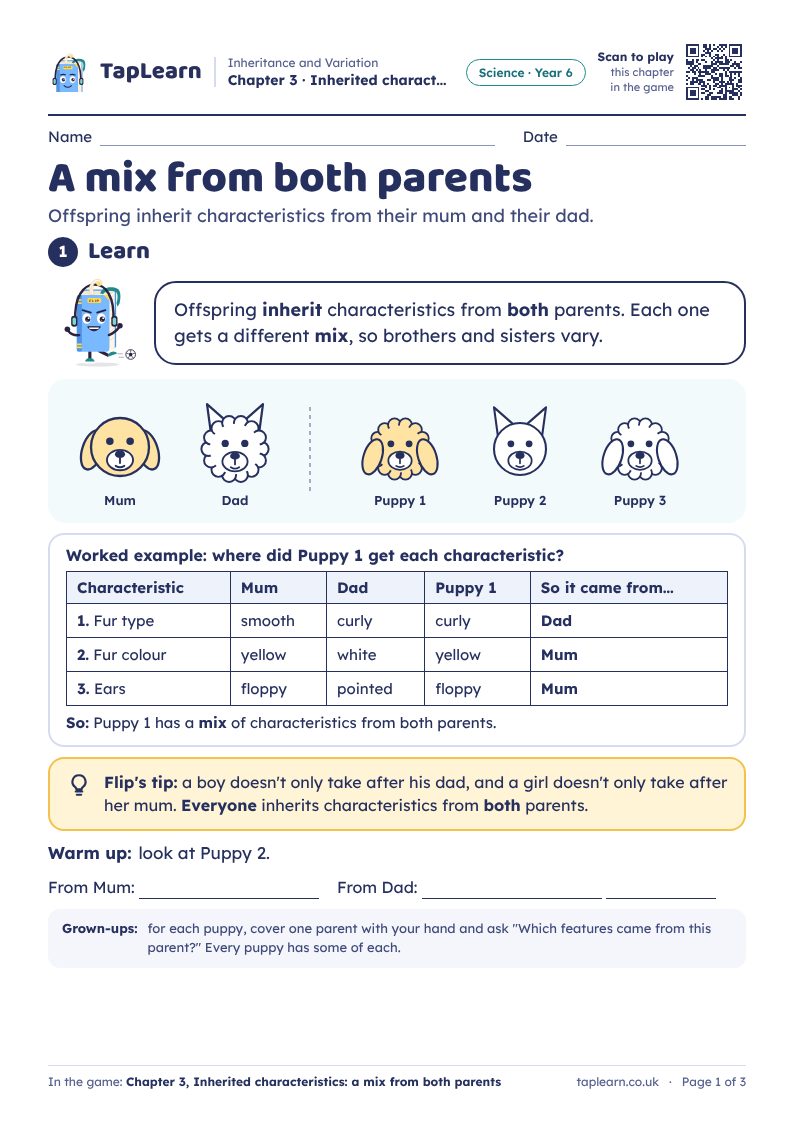
A Mix from Both Parents is a printable inherited characteristics worksheet for Year 6 (ages 10 to 11) that teaches children how offspring inherit characteristics from both parents, so each one is a different mix. It supports the Year 6 national curriculum in England: recognise that living things produce offspring of the same kind, but normally offspring vary and are not identical to their parents.
This worksheet is for members
Membership opens every chapter of every game and every worksheet, for all your children.
See the plansAlready a member? Log in to print it.
Start with the free one: Parents and offspring (chapter 1).
Print it on A4, in colour or black and white. Do it after the chapter, or before it to see what your child already knows.
What's on the worksheet
Children learn how offspring inherit characteristics from both parents, so each one is a different mix, using puppies and a family's hair and eyes. With a coin-toss puppy activity and an answers sheet.
- Page 1 · Learn
- Two parent dogs and three puppies, a worked example tracing a puppy's fur type, colour and ears to each parent, and a warm-up on a second puppy.
- Page 2 · Try it together
- Coin-toss puppies: toss a coin for each characteristic (heads from Mum, tails from Dad), record and draw two puppies, then compare their mixes.
- Pages 2–3 · Practise
- Work out what Leo and Mia inherited from each parent, tick true or false, ring every puppy that could be in a litter, and explain why siblings differ.
- Answers sheet
- Every answer by page, what to watch out for (sons only like dads, everything from one parent) and ideas to go further.
3 A4 pages and an answers sheet · about 30 minutes
Using it at home
- Coin-toss puppies takes about 10 minutes with one coin. Let your child toss and draw; the fun is comparing two very different puppies.
- Cover one parent dog on page 1 with your hand and ask "Which features came from this parent?"
Watch out for
- Thinking sons only take after fathers and daughters only take after mothers.
- Use the family on page 2: Leo, a boy, has his mum's curly hair, and Mia, a girl, has her dad's straight hair.
- Thinking all of an offspring's characteristics come from one parent.
- Go back to the worked example: Puppy 1 has curly fur from Dad and yellow fur and floppy ears from Mum.
Questions from the worksheet
- Read about this family. Fill in which characteristics Leo and Mia inherited from Mum and from Dad.
- True or false: boys only inherit characteristics from their dads.
- A mum dog has long, spotty fur. A dad dog has short, plain fur. Ring every one that could be born in their litter.
- Leo and Mia have the same parents. Why don't they look exactly alike?
- Sam says, "I'm a boy, so I only take after my dad." Is he right? Explain.
The answers are on the answers sheet, for grown-ups.
National curriculum in England
This worksheet practises this statement from the Year 6 science programme of study:
- Recognise that living things produce offspring of the same kind, but normally offspring vary and are not identical to their parents
Source: National curriculum in England: science programmes of study (DfE)
In the classroom
- Run coin-toss puppies in pairs and display the drawings to show how many different mixes two parents can produce.
- Use the Leo and Mia family table as a quick check, then Sam's Challenge as a talk-partner question.
Questions and answers
What does inherit mean in science?
To inherit a characteristic means to get it from your parents. Offspring inherit characteristics, such as fur colour or hair type, from both parents.
Do boys only take after their dads?
No. Everyone inherits characteristics from both parents, so a boy can have his mum's hair or eyes and a girl can take after her dad.
Why are brothers and sisters different?
Each child inherits a different mix of characteristics from the same two parents, so brothers and sisters vary.
 TapLearn