Offspring of the same kind worksheet for Year 6: Parents and offspring
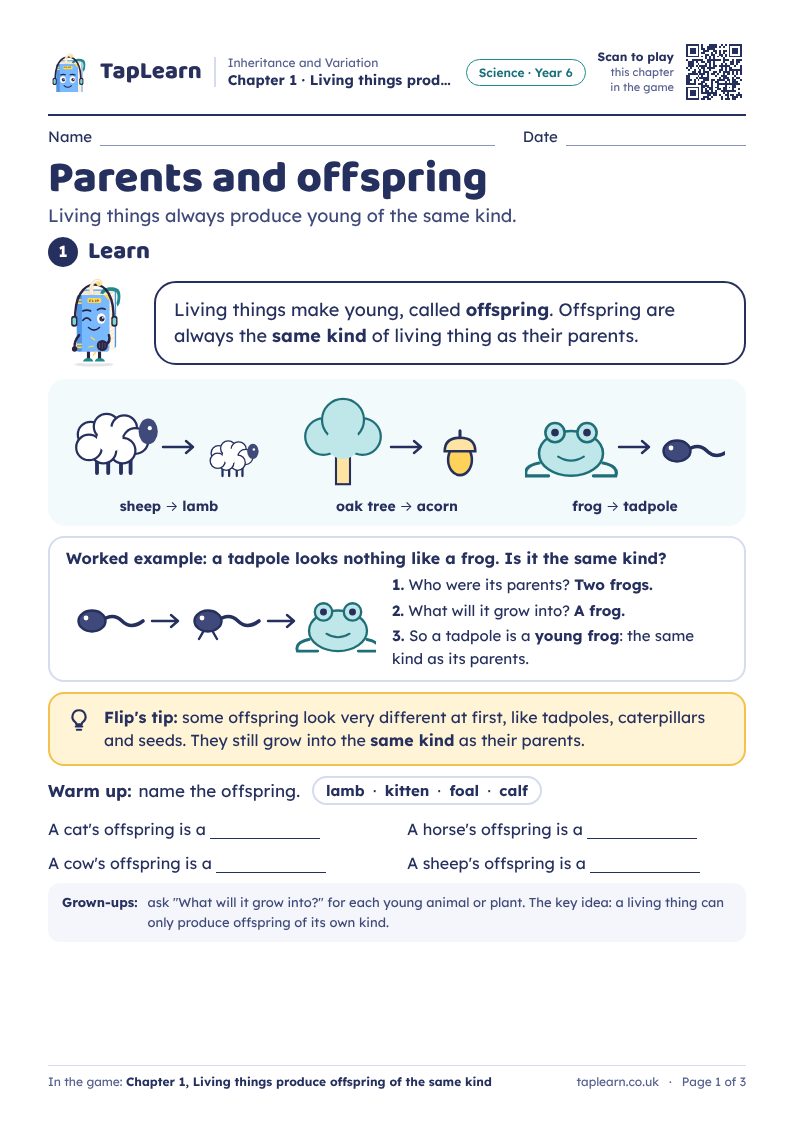
Parents and Offspring is a printable inheritance worksheet for Year 6 (ages 10 to 11) that teaches children that living things produce offspring of the same kind, even when the young look different at first, like tadpoles. It supports the Year 6 national curriculum in England: recognise that living things produce offspring of the same kind, but normally offspring vary and are not identical to their parents.
Free to print, no account needed.
Print it on A4, in colour or black and white. Do it after the chapter, or before it to see what your child already knows.
What's on the worksheet
Children learn that living things always produce offspring of the same kind, including young that look different at first, like tadpoles, caterpillars and acorns. With a parent-and-young pairs game and an answers sheet.
- Page 1 · Learn
- Pictures pair a sheep and lamb, an oak tree and acorn, and a frog and tadpole, then a worked example shows why a tadpole is a young frog. A warm-up names offspring.
- Page 2 · Try it together
- Parent and young pairs: write 12 names on scraps of paper, turn them over two at a time to find parent and young pairs, and record whether each young looks like its parent.
- Pages 2–3 · Practise
- Match parents to offspring, ring what a frog, butterfly, horse chestnut tree and swan can produce, fill the gaps and explain why a cat can't have a puppy.
- Answers sheet
- Every answer by page, what to watch out for (young that look different, like tadpoles, seen as another animal) and ideas to go further.
3 A4 pages and an answers sheet · about 30 minutes
Using it at home
- Play the pairs game first: it takes about 10 minutes and gets your child naming young animals and plants before the practice.
- For each young animal or plant, ask "What will it grow into?" so your child links young that look different to their parents.
Watch out for
- Thinking a living thing could produce offspring of a different kind.
- Ask "What kind of animal were its parents?" Living things only produce offspring of their own kind.
- Thinking young that look different, like tadpoles or caterpillars, are a different kind of living thing.
- Follow the life cycle: ask what the young grows into. A tadpole becomes a frog, so it is a young frog.
Questions from the worksheet
- Match each parent to its offspring: hen, cow, sunflower, duck, dog.
- Ring the offspring each parent can produce. A horse chestnut tree: an acorn, a pine cone or a conker?
- Could a cat ever give birth to a puppy? Explain your answer.
- Name an animal or plant whose young look very different from the parents at first. What do the young grow into?
- Sam finds a tadpole in a pond. He says it's a kind of fish because it lives in water and swims with a tail. Is he right? Explain.
The answers are on the answers sheet, for grown-ups.
National curriculum in England
This worksheet practises this statement from the Year 6 science programme of study:
- Recognise that living things produce offspring of the same kind, but normally offspring vary and are not identical to their parents
Source: National curriculum in England: science programmes of study (DfE)
In the classroom
- Use the pairs game as a starter in small groups, then the ring-the-offspring questions as a mini-whiteboard check.
- The tadpole Challenge works as a talk-partner question to tackle the idea that young that look different are another animal.
Questions and answers
What are offspring?
Offspring are the young that living things produce. A lamb is the offspring of a sheep, and an acorn can grow into a new oak tree.
Is a tadpole a fish?
No. A tadpole is a young frog. It lives in water and has a tail at first, but it grows legs and becomes a frog, the same kind as its parents.
Do plants produce offspring of the same kind?
Yes. A plant's seeds grow into the same kind of plant: a conker grows into a horse chestnut tree and a sunflower seed into a sunflower.
 TapLearn