Sentence openers worksheet for Year 3: Sentence starts
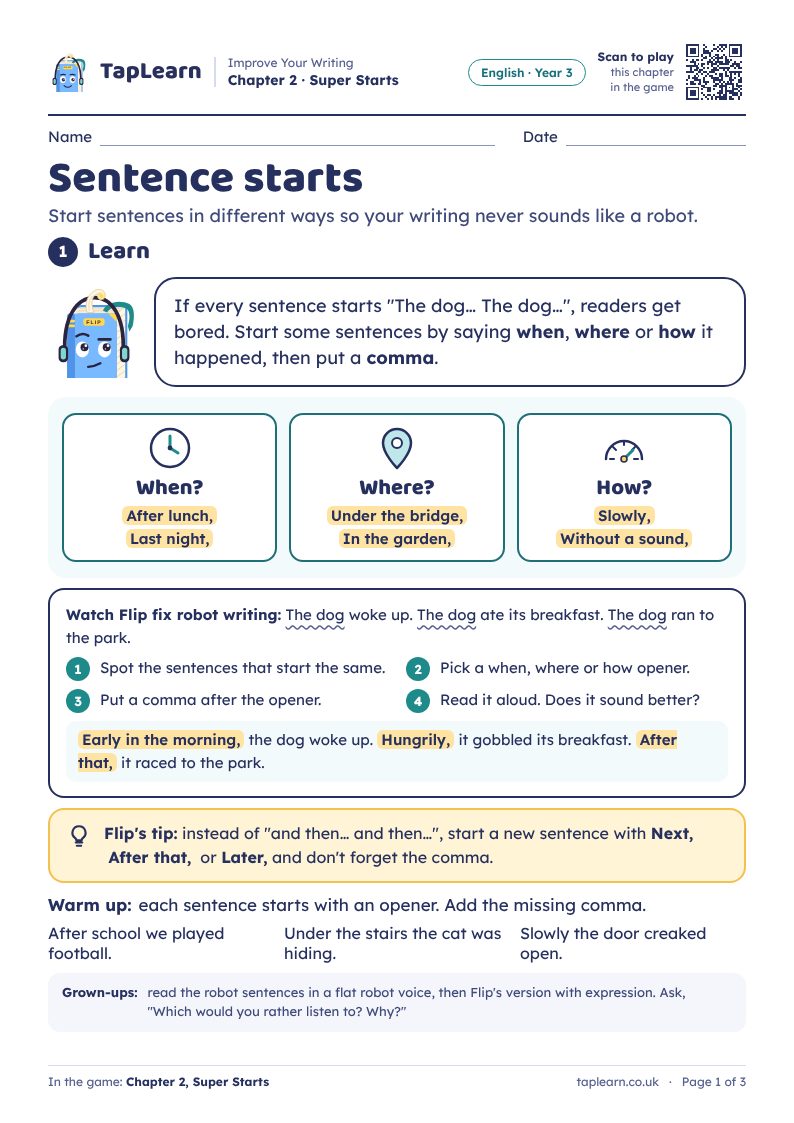
Sentence Starts is a printable sentence openers worksheet for Year 3 (ages 7 to 8) that teaches children to start some sentences with a when, where or how opener followed by a comma, like "After lunch," or "Slowly,". Children sort openers, write their own and rewrite robot writing without "and then".
This worksheet is for members
Membership opens every chapter of every game and every worksheet, for all your children.
See the plansAlready a member? Log in to print it.
Start with the free one: Wow words (chapter 1).
Print it on A4, in colour or black and white. Do it after the chapter, or before it to see what your child already knows.
What's on the worksheet
Your child starts sentences in different ways with when, where and how openers and a comma, instead of "The dog... and then...". Includes a my-day-my-way activity and an answers sheet.
- Page 1 · Learn
- When, where and how openers with examples, a worked example fixing robot writing about a dog, Flip's tip to swap "and then" for Next or After that, and an add-the-comma warm-up.
- Page 2 · Try it together
- My day, my way: pick a when, where or how card and say a sentence about your day starting with that kind of opener, while the listener claps where the comma goes.
- Page 3 · Practise
- Sort openers into when, where and how, join openers to endings, write your own openers, rewrite robot writing about the beach, and a challenge about "Slowly,".
- Answers sheet
- Every answer, mix-ups like and then again and again, and story-relay and opener-spotting ideas.
3 A4 pages and an answers sheet · about 25 minutes
In the classroom
- Spot openers with commas in a class reader and sort them into when, where and how.
- Use the warm-up as a mini-whiteboard comma check.
Questions from the worksheet
- Sort the openers into when, where and how: At bedtime, Behind the shed, Carefully, Last Saturday, Across the river, Quietly.
- Write your own opener for each sentence. Don't forget the comma: (When?) ___ the owl began to hoot.
- Rewrite this robot writing with different starts and no "and then": We went to the beach and then we built a sandcastle and then we ate our lunch.
- Leo says the opener "Slowly," tells us when something happened. Is he right? Which question does it answer?
The answers are on the answers sheet, for grown-ups.
Using it at home
- Read the robot sentences in a flat robot voice, then Flip's version with expression. Ask, "Which would you rather listen to?"
- If your child gets stuck, give a starter like "After breakfast,", "At school," or "Quickly,".
- Tell a story one sentence each, with every sentence starting with a new opener.
Watch out for
- Starting every sentence the same way.
- Read just the first word of each sentence aloud: the repeats jump out.
- Using "and then" again and again.
- Stop with a full stop and start the next sentence with "Next," or "After that,".
- Mixing up when, where and how openers.
- Ask which question the opener answers. Many how openers end in -ly.
Questions and answers
What are sentence openers?
Sentence openers are words or phrases at the start of a sentence that say when, where or how something happened, like "After lunch," or "Slowly,".
Do sentence openers need a comma?
Yes. Put a comma after a when, where or how opener: "Under the bridge, a troll was waiting."
How can children stop using "and then"?
End the sentence with a full stop and start the next one with an opener like Next, After that or Later.
 TapLearn