Sentence length worksheet for Year 3: Short and long
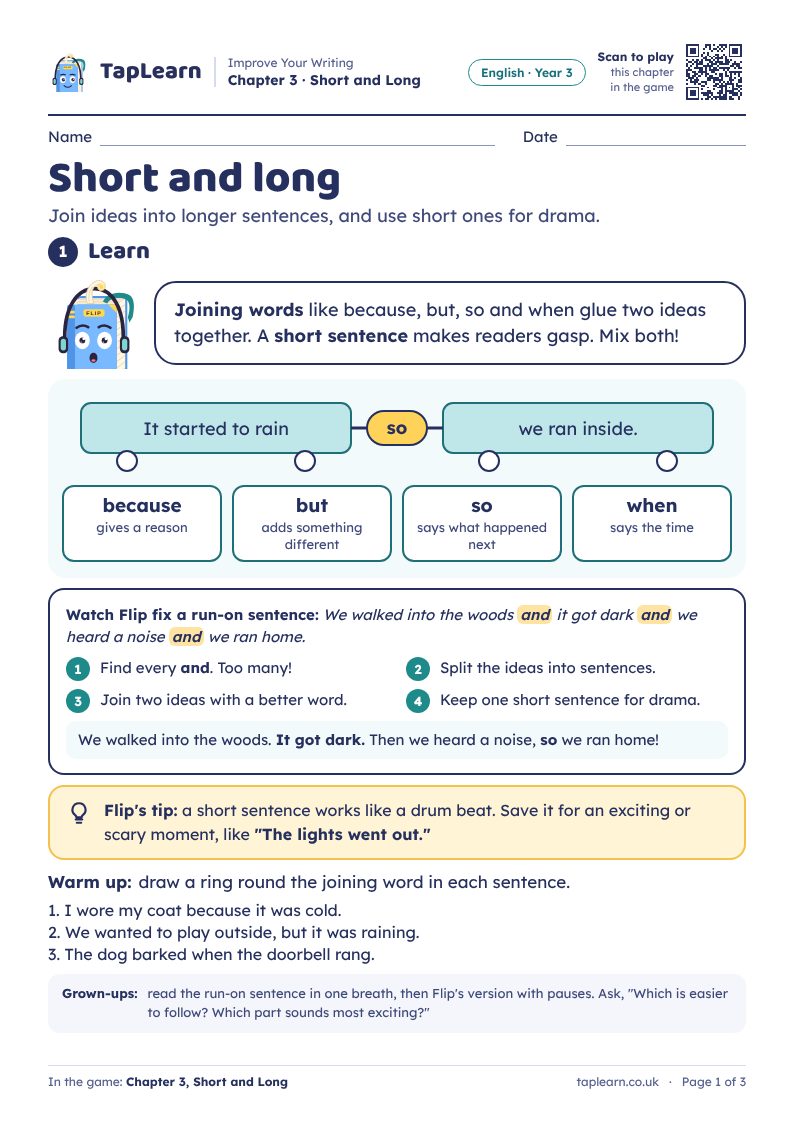
Short and Long is a printable sentence length worksheet for Year 3 (ages 7 to 8) that teaches children to join ideas with because, but, so and when, and to save a short sentence for an exciting moment. Children choose joining words, split a run-on sentence and finish a spooky story with a short sentence.
This worksheet is for members
Membership opens every chapter of every game and every worksheet, for all your children.
See the plansAlready a member? Log in to print it.
Start with the free one: Wow words (chapter 1).
Print it on A4, in colour or black and white. Do it after the chapter, or before it to see what your child already knows.
What's on the worksheet
Your child joins ideas with because, but, so and when, splits up run-on sentences, and uses short sentences for drama. Includes a stretch-it-snap-it activity and an answers sheet.
- Page 1 · Learn
- Four joining words and what they do, a worked example fixing a run-on sentence about the woods, Flip's tip that a short sentence works like a drum beat, and a warm-up.
- Page 2 · Try it together
- Stretch it, snap it!: pick a joining word card and stretch a short sentence with it, then hunt in a story book for a short, dramatic sentence and make up a spooky one.
- Page 3 · Practise
- Choose the joining word for each gap, split a run-on sentence, tick the version with more excitement, join pairs of sentences, and a challenge about because.
- Answers sheet
- Every answer, mix-ups like a joining word that doesn't fit, and because-but-so and drama-spotting ideas.
3 A4 pages and an answers sheet · about 25 minutes
In the classroom
- Read a tense passage from a class book aloud and spot the short, dramatic sentences.
- Display a run-on sentence and have pairs split and rejoin it.
Questions from the worksheet
- Choose a joining word for each gap, using each once: because, but, so, when. I was hungry, ___ I made a sandwich. We wanted to swim, ___ the pool was closed.
- This sentence runs on and on! Split it into shorter sentences: Sam opened the box and there was a puppy inside and it licked his face and Sam laughed.
- Join each pair into one sentence, using because, but, so or when: It was my birthday. I had a party.
- Mia wrote: "I wanted to play outside because it was raining." Does her joining word make sense? Which word would work better, and why?
The answers are on the answers sheet, for grown-ups.
Using it at home
- Read the run-on sentence in one breath, then Flip's version with pauses. Ask, "Which is easier to follow?"
- In stretch it, snap it, try a joining word that doesn't fit, like "The cat jumped but a dog barked", and ask which word would work.
- Say a sentence starter like "I love the park..." and finish it three ways, with because, but and so.
Watch out for
- Choosing a joining word that doesn't fit.
- Read it aloud and ask, "Does that make sense?"
- Run-on sentences full of "and".
- Count the "and"s. If there are more than one, look for places to put a full stop.
- Using a long sentence at the exciting moment.
- Show how short sentences in books make you hold your breath.
Questions and answers
What is a run-on sentence?
A run-on sentence keeps going with lots of "and"s, like "We walked and it got dark and we heard a noise". Split it into shorter sentences.
Why use short sentences in a story?
A short sentence works like a drum beat. It builds excitement at a scary or exciting moment, like "The lights went out."
What do because, but, so and when do?
They join two ideas. Because gives a reason, but adds something different, so says what happened next, and when says the time.
 TapLearn