Proofreading worksheet for Year 3: Bug hunt
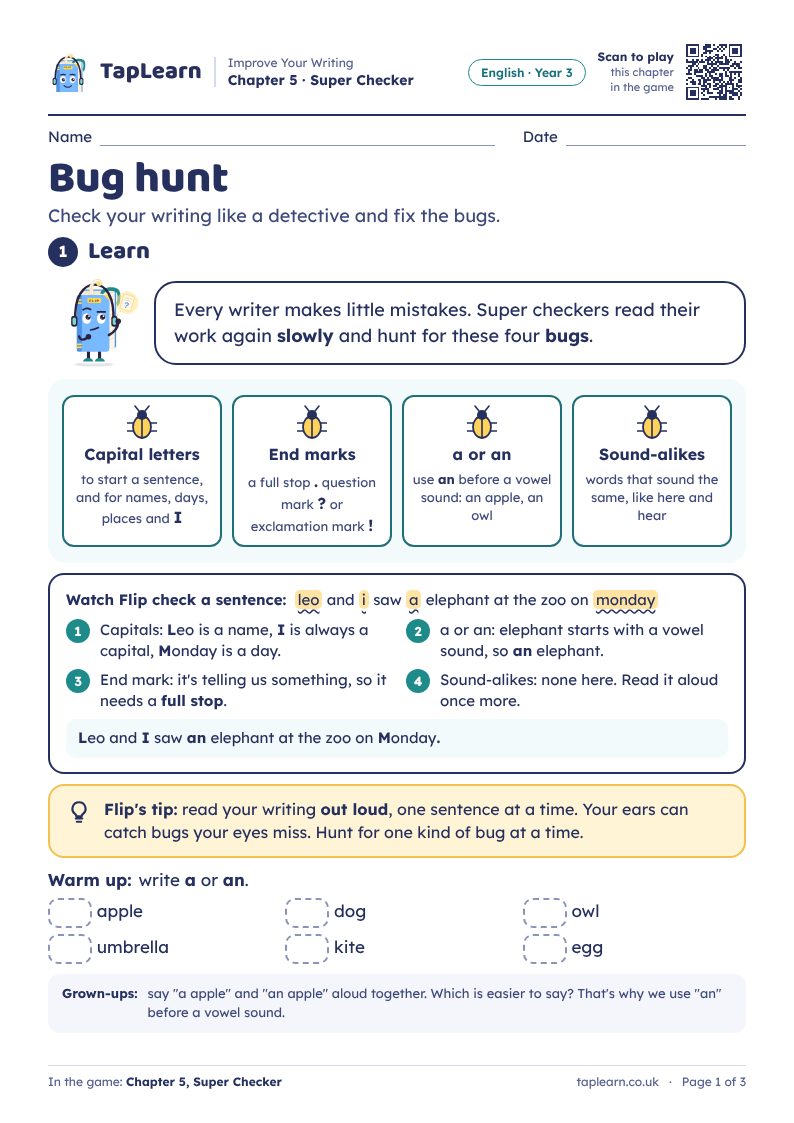
Bug Hunt is a printable proofreading worksheet for Year 3 (ages 7 to 8) that teaches children to read their writing aloud and hunt for four bugs: capital letters, end marks, a or an, and sound-alike words. Children ring missing capitals, add end marks, choose between here and hear, and fix a sentence with 6 bugs.
This worksheet is for members
Membership opens every chapter of every game and every worksheet, for all your children.
See the plansAlready a member? Log in to print it.
Start with the free one: Wow words (chapter 1).
Print it on A4, in colour or black and white. Do it after the chapter, or before it to see what your child already knows.
What's on the worksheet
Your child checks writing for capital letters, end marks, a or an, and sound-alike words like here and hear. Includes a bug hunters activity and an answers sheet.
- Page 1 · Learn
- Four kinds of bug with examples, a worked example checking "leo and i saw a elephant at the zoo on monday", Flip's tip to read aloud one sentence at a time, and an a-or-an warm-up.
- Page 2 · Try it together
- Bug hunters: the grown-up writes a short note with 4 hidden bugs, the child reads it aloud and puts a marker on each bug, then you fix them together. Swap and hide bugs for the grown-up.
- Page 3 · Practise
- Ring letters that should be capitals, add end marks, ring the right sound-alike word, fix a sentence with 6 bugs, and a challenge about "an banana".
- Answers sheet
- Every answer, mix-ups like here and hear, and spot-the-capital and a-or-an ideas.
3 A4 pages and an answers sheet · about 25 minutes
In the classroom
- Display a short paragraph with hidden bugs and have pairs hunt for one kind of bug at a time.
- Use the warm-up as a quick-fire a-or-an round.
Questions from the worksheet
- Draw a ring round every letter that should be a capital: on friday, mia and i went to london.
- Add the end mark: Where is my other shoe. Watch out for that car. Can I help you with that.
- Draw a ring round the right sound-alike word: I can (here / hear) the birds singing. The (plain / plane) flew over our house.
- This sentence has 6 bugs. Write it out correctly: on tuesday ava ate a orange and it was grate
- Leo wrote "an banana". He says it's an because banana has lots of a's in it. Is he right? How do you know whether to use a or an?
The answers are on the answers sheet, for grown-ups.
Using it at home
- Say "a apple" and "an apple" aloud together. Which is easier to say? That's why we use an before a vowel sound.
- To start bug hunters, try a note like "Dear Gran, can I come for tea on sunday? I will bring a orange cake. See you their".
- Take turns naming things in the room with a or an in front: an orange, a lamp, an armchair.
Watch out for
- Missing capitals for names, days, months, places and I.
- Ask, "Is it the name of a person, place or day?"
- Writing "a apple".
- Say both aloud: "an apple" is easier to say before a vowel sound.
- Mixing up sound-alikes like here and hear.
- A handy clue: you hear with your ear, and ear is inside the word.
Questions and answers
What should Year 3 children check in their writing?
Capital letters, end marks (full stop, question mark or exclamation mark), a or an, and sound-alike words like here and hear.
When do you use an instead of a?
Use an before a word that starts with a vowel sound, like an apple or an owl. It's the first sound that matters, so it's a banana.
What are homophones?
Homophones are words that sound the same but have different spellings and meanings, like here and hear, or plain and plane.
 TapLearn