Descriptive writing worksheet for Year 3: Painting with words
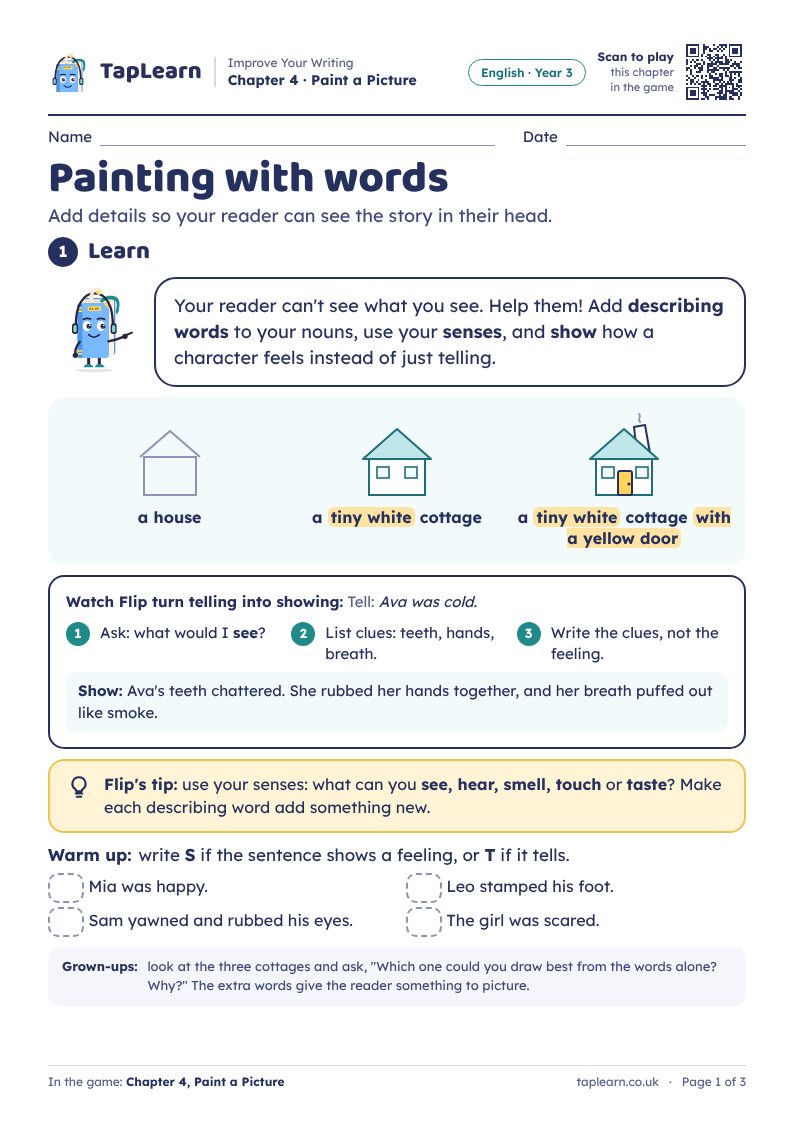
Painting with Words is a printable descriptive writing worksheet for Year 3 (ages 7 to 8) that teaches children to grow nouns with describing words and a "with" detail, use their senses, and show a feeling instead of telling it. Children match details to senses, grow three nouns and rewrite telling sentences so they show.
This worksheet is for members
Membership opens every chapter of every game and every worksheet, for all your children.
See the plansAlready a member? Log in to print it.
Start with the free one: Wow words (chapter 1).
Print it on A4, in colour or black and white. Do it after the chapter, or before it to see what your child already knows.
What's on the worksheet
Your child adds describing details, sense words and show-don't-tell clues so readers can picture a story. Includes a Show me! acting game and an answers sheet.
- Page 1 · Learn
- A house growing into a tiny white cottage with a yellow door, a worked example turning "Ava was cold" into showing, Flip's tip on the senses, and a show-or-tell warm-up.
- Page 2 · Try it together
- Show me!: pick a feeling like cold, scared or proud, act it out without words while the other person says what they see, guess the feeling, and write the clues.
- Page 3 · Practise
- Match details to senses, grow nouns with two describing words and a with detail, rewrite telling sentences to show, cross out a detail that doesn't fit, and a challenge.
- Answers sheet
- Every answer, mix-ups like piling up words that mean the same, and five-senses-walk and guess-my-object ideas.
3 A4 pages and an answers sheet · about 25 minutes
In the classroom
- Play Show me! as a drama starter with feeling cards.
- Play guess my object: describe something in the room with two describing words and a with detail.
Questions from the worksheet
- Draw a line from each detail to the sense it uses: the crunch of dry leaves, the smell of hot toast, a soft, fluffy blanket.
- Grow each noun. Add two describing words, then a detail starting with with: a ___ dragon with ___.
- Show, don't tell. Rewrite each sentence so it shows the feeling: Mia was excited. The boy was tired.
- Ava is writing about a snowy winter morning. Cross out the detail that doesn't fit: frost on the windows, breath like clouds, hot, sandy beach, crunchy footsteps.
- Sam wrote: "The big, huge, giant elephant walked past." He says more describing words always make writing better. Is he right?
The answers are on the answers sheet, for grown-ups.
Using it at home
- Look at the three cottages and ask, "Which one could you draw from the words alone? Why?"
- In Show me!, ask about faces, hands, feet and voices, then turn one row into a sentence together.
- On a walk, name one thing for each sense and make it into a describing sentence.
Watch out for
- Telling, not showing, like "she was sad".
- Ask, "What would I see her do? What would her face look like?"
- Piling up words that mean the same, like "big, huge, giant".
- Ask, "What else could you say about it: colour, feel, sound?"
- Adding details that don't fit the scene.
- Ask, "Would I really find that there?"
Questions and answers
What does show, don't tell mean?
It means showing how a character feels through what they do, like "Ava's teeth chattered", instead of telling us "Ava was cold".
How can children add detail to their writing?
Add describing words to nouns, a detail starting with with, and things you can see, hear, smell, touch or taste.
Do more describing words make writing better?
Not always. Each describing word should add something new. "Big, huge, giant" all mean the same thing.
 TapLearn