Formal and informal vocabulary worksheet for Year 6: Posh word swaps
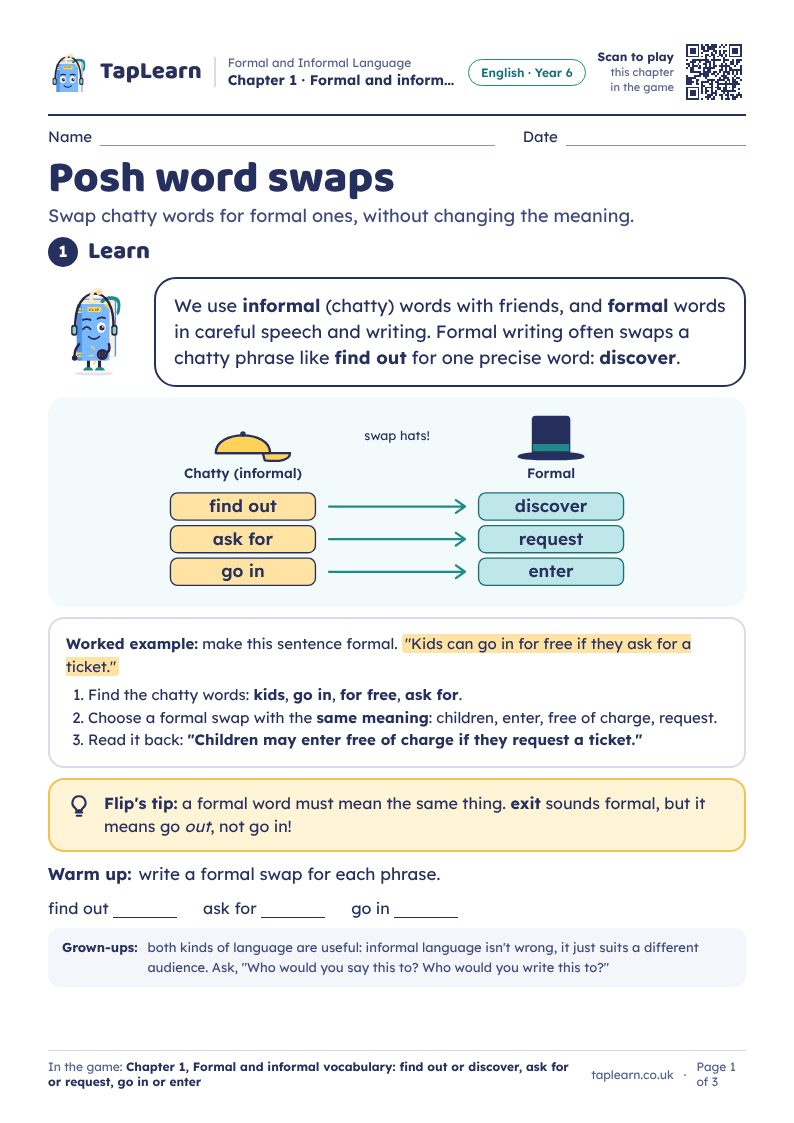
Posh Word Swaps is a printable formal and informal vocabulary worksheet for Year 6 (ages 10 to 11) that teaches children to swap chatty phrases like find out and go in for formal words like discover and enter without changing the meaning. It covers the Year 6 statement on the difference between vocabulary typical of informal speech and vocabulary for formal speech and writing.
Free to print, no account needed.
Print it on A4, in colour or black and white. Do it after the chapter, or before it to see what your child already knows.
What's on the worksheet
Your child swaps chatty phrases and slang for formal words with the same meaning, such as find out to discover and ask for to request. Includes a Posh or Chatty word game and an answers sheet.
- Page 1 · Learn
- Chatty and formal pairs like find out and discover, a worked example making a sentence about tickets formal, Flip's tip that exit doesn't mean go in, and a warm-up.
- Page 2 · Try it together
- Posh or Chatty?: write eight chatty phrases like ask for and put off on paper, take turns to pick one and give a formal swap, check it in a sentence, then write your swaps.
- Page 3 · Practise
- Match chatty phrases to formal swaps, ring the formal word that keeps the meaning, swap slang like loads of and kids, rewrite two sentences formally, and a challenge about a museum sign.
- Answers sheet
- Every answer, mix-ups like thinking awesome is formal, and Posh-or-Chatty and sign-spotting ideas.
3 A4 pages and an answers sheet · about 25 minutes
Using it at home
- Both kinds of language are useful: informal isn't wrong, it just suits a different audience. Ask, "Who would you say this to? Who would you write this to?"
- In Posh or Chatty, there can be more than one good swap (get can be receive or obtain), so ask which one fits the sentence.
- Spot the formal words on signs and notices when you're out (enter, prohibited, assistance).
Watch out for
- Keeping chatty two-word phrases like find out.
- Ask, "Is there one word that means the same?"
- Thinking slang is formal, like awesome, loads or kids.
- Ask, "Would a news reader say this?"
- Changing the meaning with a formal-sounding word, like exit for enter.
- Read the new sentence aloud to check.
Questions from the worksheet
- Draw a line from each chatty phrase to its formal swap: find out, ask for, go in, help, need, say sorry, put off, give back.
- Ring the formal word that keeps the meaning: Visitors should go in / enter / exit through the main gate.
- These slang words are not formal. Write a formal word for each: loads of, kids, awesome, stuff.
- Rewrite each sentence formally: Loads of kids went in early and got awesome seats.
- Leo's sign should welcome visitors into the museum. He writes: "Visitors, please exit through the front door." Is his formal word right?
The answers are on the answers sheet, for grown-ups.
National curriculum in England
This worksheet practises these statements from the Year 6 english programme of study:
- Word: the difference between vocabulary typical of informal speech and vocabulary appropriate for formal speech and writing
- Develop their understanding of the concepts set out in English appendix 2 by: recognising vocabulary and structures that are appropriate for formal speech and writing, including subjunctive forms (Years 5–6 english)
In the classroom
- Play Posh or Chatty as a starter with phrase cards.
- Use Practise D for pairs to rewrite, then compare formal versions.
Questions and answers
What is formal vocabulary?
Formal vocabulary is the more precise wording used in careful speech and writing, like discover instead of find out and request instead of ask for.
Is informal language wrong?
No. Informal language suits chatting with friends and family; formal language suits letters, reports and speeches.
What are examples of informal and formal words?
Find out and discover, ask for and request, go in and enter, help and assist, put off and postpone, say sorry and apologise.
 TapLearn