Subject verb agreement worksheet for Year 6: The formal editor
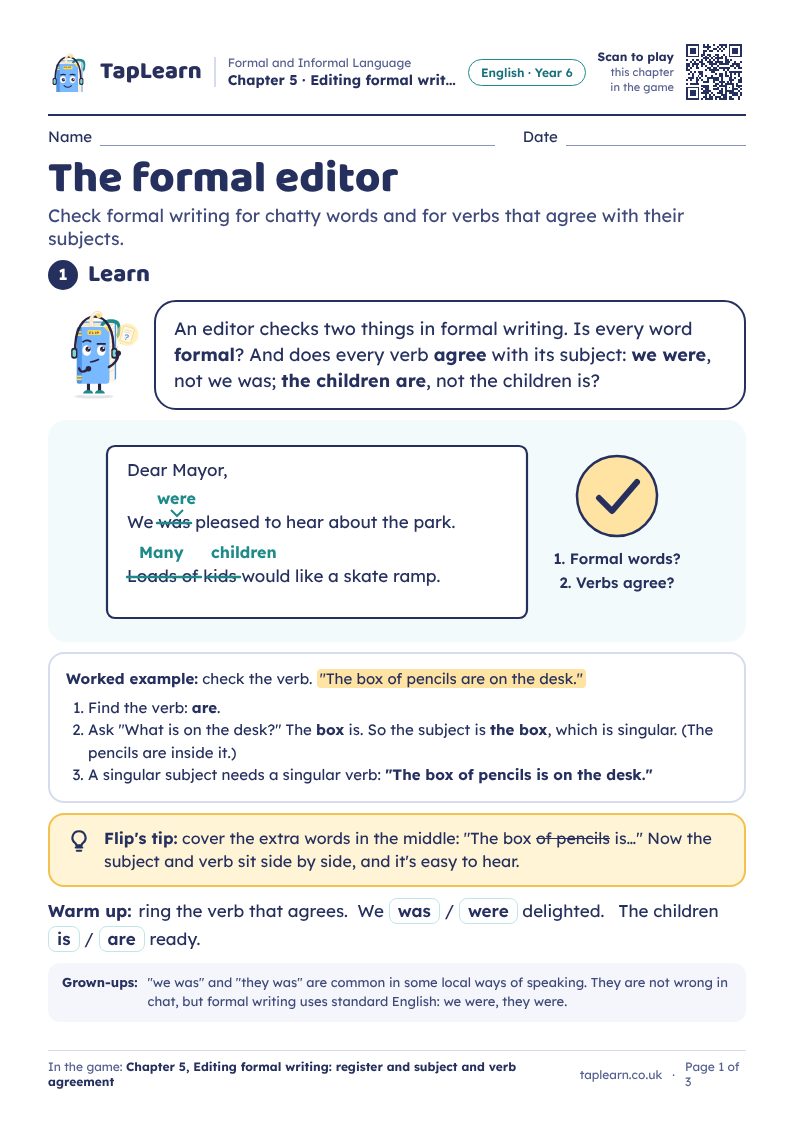
The Formal Editor is a printable subject verb agreement worksheet for Year 6 (ages 10 to 11) that teaches children to check formal writing for chatty words and for verbs that agree with their subjects, like we were and the box of pencils is. It covers the statement on editing by ensuring subject and verb agreement and choosing the appropriate register.
This worksheet is for members
Membership opens every chapter of every game and every worksheet, for all your children.
See the plansAlready a member? Log in to print it.
Start with the free one: Posh word swaps (chapter 1).
Print it on A4, in colour or black and white. Do it after the chapter, or before it to see what your child already knows.
What's on the worksheet
Your child edits writing so it is formal and every subject agrees with its verb, such as we were and the box of pencils is. Includes a be-the-editor hidden-mistakes game and an answers sheet.
- Page 1 · Learn
- What an editor checks, a marked-up letter to the Mayor, a worked example fixing "The box of pencils are on the desk", Flip's cover-the-middle tip, and a warm-up.
- Page 2 · Try it together
- Be the editor: the grown-up writes a short note to a pretend Mayor with three hidden mistakes like we was or loads of, the child rings and fixes them, then they swap.
- Page 3 · Practise
- Ring the verb that agrees, underline the subject and correct sentences, edit a formal letter with six mistakes, and a challenge about the box of pencils.
- Answers sheet
- Every answer, mix-ups like matching the verb to the nearest word, and spot-the-slip and cover-up ideas.
3 A4 pages and an answers sheet · about 30 minutes
Using it at home
- "We was" and "they was" are common in some local ways of speaking. They aren't wrong in chat, but formal writing uses standard English: we were.
- If your child misses a mistake in be the editor, tell them how many are left rather than where it is.
- Say "The box of crayons…" and your child finishes with is or are.
Watch out for
- Writing we was or they was in formal writing.
- Say both aloud: "we were, they were".
- Matching the verb to the nearest word, as in the box of pencils are.
- Ask, "What or who is doing it?" Cover the words in the middle.
- Missing a chatty word when checking.
- Read through twice: once for words, once for verbs.
Questions from the worksheet
- Ring the verb that agrees with the subject: They was / were late for the train. The list of names is / are on the door. Each of the pupils has / have a book.
- Underline the subject. If the verb doesn't agree, write the sentence correctly: The bag of apples were heavy. The players in the team was tired.
- Edit this formal letter. Ring 6 mistakes (chatty words and verbs that don't agree), then write it correctly: "We was delighted to find out about the new park…"
- Sam says, "The box of pencils are on the table is right, because pencils is plural." Is Sam right? Explain.
The answers are on the answers sheet, for grown-ups.
National curriculum in England
This worksheet practises these statements from the Years 5–6 english programme of study:
- Develop their understanding of the concepts set out in English appendix 2 by: recognising vocabulary and structures that are appropriate for formal speech and writing, including subjunctive forms
- Select and use appropriate registers for effective communication (Years 1–6 english)
- Evaluate and edit by: ensuring correct subject and verb agreement when using singular and plural, distinguishing between the language of speech and writing and choosing the appropriate register
In the classroom
- Use Practise C as a whole-class editing task on the board.
- Play spot the slip as a starter: say "The dogs was barking" and pupils correct it.
Questions and answers
What is subject-verb agreement?
Subject-verb agreement means the verb matches its subject: singular with singular (the box is) and plural with plural (the children are).
Is it the box of pencils is or are?
It's the box of pencils is. The subject is the box, which is singular; the pencils are just inside it.
Is we was wrong?
We was is heard in some local speech, but formal writing uses standard English: we were.
 TapLearn