Formal and informal register worksheet for Year 6: Right words, right audience
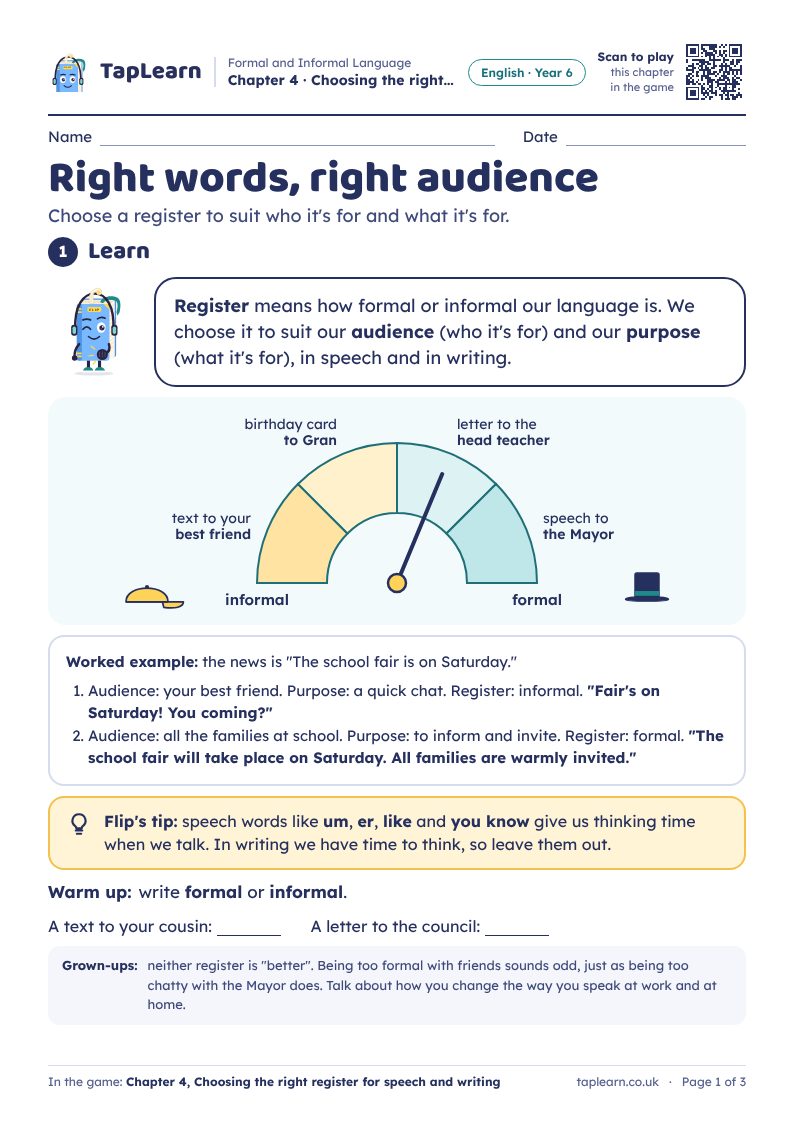
Right Words, Right Audience is a printable formal and informal register worksheet for Year 6 (ages 10 to 11) that teaches children to choose how formal to be for who a piece is for and what it is for, in speech and writing. It covers the statements on selecting and using appropriate registers, and distinguishing between the language of speech and writing.
This worksheet is for members
Membership opens every chapter of every game and every worksheet, for all your children.
See the plansAlready a member? Log in to print it.
Start with the free one: Posh word swaps (chapter 1).
Print it on A4, in colour or black and white. Do it after the chapter, or before it to see what your child already knows.
What's on the worksheet
Your child chooses a formal or informal register to suit the audience and purpose, and keeps speech words like um and you know out of writing. Includes a same-news-two-ways speaking activity and an answers sheet.
- Page 1 · Learn
- What register means, a scale from a text to a friend to a speech to the Mayor, a worked example saying the same news two ways, Flip's tip on speech fillers, and a warm-up.
- Page 2 · Try it together
- Same news, two ways: pick news like a lost cat or a cake sale, say it as a chatty voice message to a friend, then as a formal radio announcement, and write the words that changed.
- Page 3 · Practise
- Ring formal or informal for each situation, cross out speech words and rewrite, choose the message that suits the audience, write two messages about a lost dog, and a challenge.
- Answers sheet
- Every answer, mix-ups like being too formal with friends, and register-dial and announcer ideas.
3 A4 pages and an answers sheet · about 25 minutes
Using it at home
- Neither register is "better". Talk about how you change the way you speak at work and at home.
- In same news, two ways, listen for greetings, short forms, slang and fillers, then swap roles.
- Read out tonight's dinner as a chatty friend, then as a formal news reader.
Watch out for
- Using chatty language for an important audience, like the Mayor or a head teacher.
- Ask, "Who will read this?"
- Using very formal language with friends and family.
- Informal is right here: too formal sounds stiff.
- Leaving speech words like um, like and you know in writing.
- Read the writing aloud and listen for them.
Questions from the worksheet
- Which register suits each one? Ring formal or informal: a chat with your best friend, a letter to the local council, a report for the school website.
- Mia wrote down what she said. Cross out the speech words, then write it carefully: "Um, the museum was, like, really interesting, you know…"
- Your dog is lost. Write two messages about it: a text to your friend and a notice for the village hall.
- Mia's thank-you note to her best friend begins: "Dear Ava, I am writing to express my sincere gratitude for the gift you kindly provided." Is this the right register? Why?
The answers are on the answers sheet, for grown-ups.
National curriculum in England
This worksheet practises these statements from the Years 1–6 english programme of study:
- Select and use appropriate registers for effective communication
- Evaluate and edit by: ensuring correct subject and verb agreement when using singular and plural, distinguishing between the language of speech and writing and choosing the appropriate register (Years 5–6 english)
In the classroom
- Play register dial: name a person (a dentist, a baby cousin) and pupils show how formal to be on a 1 to 5 scale.
- Use Practise C to discuss what makes each message suit its audience.
Questions and answers
What does register mean in English?
Register means how formal or informal our language is. We choose it to suit the audience (who it's for) and the purpose (what it's for).
How do you choose the right register?
Think about who will read or hear it and why. A text to a friend can be chatty; a letter to the council should be formal.
Why do speech words like um stay out of writing?
Um, er and you know give us thinking time when we talk. In writing we have time to think, so they aren't needed.
 TapLearn