Question tags worksheet for Year 6: Tag, you're chatty!
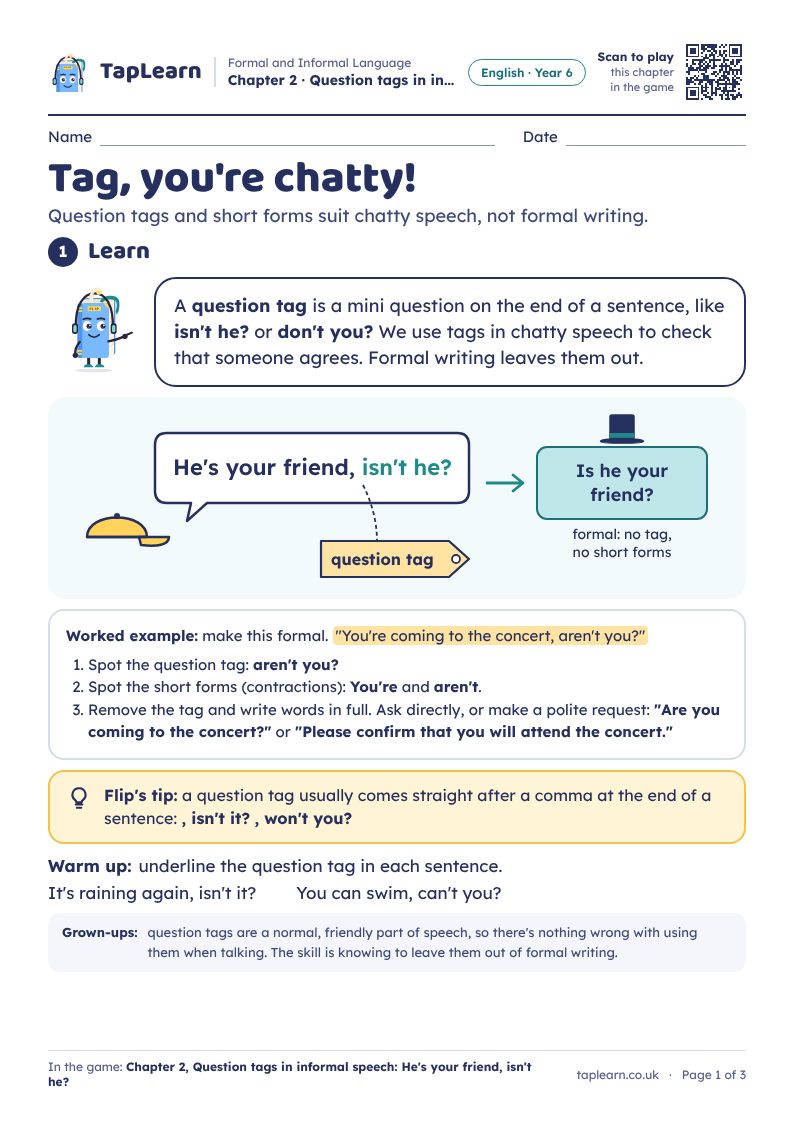
Tag, You're Chatty! is a printable question tags worksheet for Year 6 (ages 10 to 11) that teaches children to spot a question tag like isn't he? and rewrite a sentence formally with no tag and no short forms. It covers the Year 6 statement on the difference between structures typical of informal speech and structures for formal speech and writing.
This worksheet is for members
Membership opens every chapter of every game and every worksheet, for all your children.
See the plansAlready a member? Log in to print it.
Start with the free one: Posh word swaps (chapter 1).
Print it on A4, in colour or black and white. Do it after the chapter, or before it to see what your child already knows.
What's on the worksheet
Your child spots question tags like isn't he? and short forms like don't in chatty speech, and rewrites sentences formally without them. Includes a tag hunt while watching TV or chatting and an answers sheet.
- Page 1 · Learn
- What a question tag is, a worked example making "You're coming to the concert, aren't you?" formal, Flip's tip that a tag follows a comma, and an underline-the-tag warm-up.
- Page 2 · Try it together
- Tag hunt: listen to five minutes of a chatty TV show or talk about your day, write each question tag you hear, then write how a formal letter would say it.
- Page 3 · Practise
- Underline question tags, write a tag to finish chatty sentences, tick chatty or formal, rewrite sentences with no tag or short forms, and a challenge about a letter to the head teacher.
- Answers sheet
- Every answer, mix-ups like keeping won't you? in formal writing, and tag-spotting and tag ping-pong ideas.
3 A4 pages and an answers sheet · about 25 minutes
Using it at home
- Question tags are a normal, friendly part of speech. The skill is knowing to leave them out of formal writing.
- If the TV is quiet on tags, use some on purpose in conversation ("You've got homework, haven't you?") and see if your child spots them.
- Play tag ping-pong: one person says a statement ("It's sunny") and the other adds the tag ("isn't it?").
Watch out for
- Not noticing the tag.
- Look for a comma near the end followed by a short question.
- Keeping a tag like won't you? in formal writing.
- Turn it into a direct question or a polite request.
- Using short forms like don't, it's and we'll in formal writing.
- Write them in full: do not, it is, we will.
Questions from the worksheet
- Underline the question tag in each sentence: She can play the piano, can't she? We won't be late, will we? He likes football, doesn't he?
- Write a question tag to finish each chatty sentence: You like pizza, ___? She isn't ready yet, ___?
- Rewrite each sentence formally, with no question tag and no short forms: You'll come to the meeting, won't you?
- Ava's formal letter to the head teacher ends: "We'd love a new library, wouldn't we?" Is this right for a formal letter? How would you change it?
The answers are on the answers sheet, for grown-ups.
National curriculum in England
This worksheet practises these statements from the Years 5–6 english programme of study:
- Develop their understanding of the concepts set out in English appendix 2 by: recognising vocabulary and structures that are appropriate for formal speech and writing, including subjunctive forms
- Sentence: the difference between structures typical of informal speech and structures appropriate for formal speech and writing (Year 6 english)
In the classroom
- Use Practise C as a chatty-or-formal card sort.
- Have pairs rewrite chatty sentences from Practise D as lines in a formal letter.
Questions and answers
What is a question tag?
A question tag is a mini question on the end of a sentence, like isn't he? or don't you?, used in chatty speech to check someone agrees.
Why don't question tags belong in formal writing?
They are a feature of informal speech. Formal writing asks directly or makes a polite request instead.
How do you make a sentence with a question tag formal?
Remove the tag and write short forms in full: "You're coming, aren't you?" becomes "Are you coming?" or "Please confirm that you will attend."
 TapLearn