Prime numbers worksheet for Year 6: Prime or not?
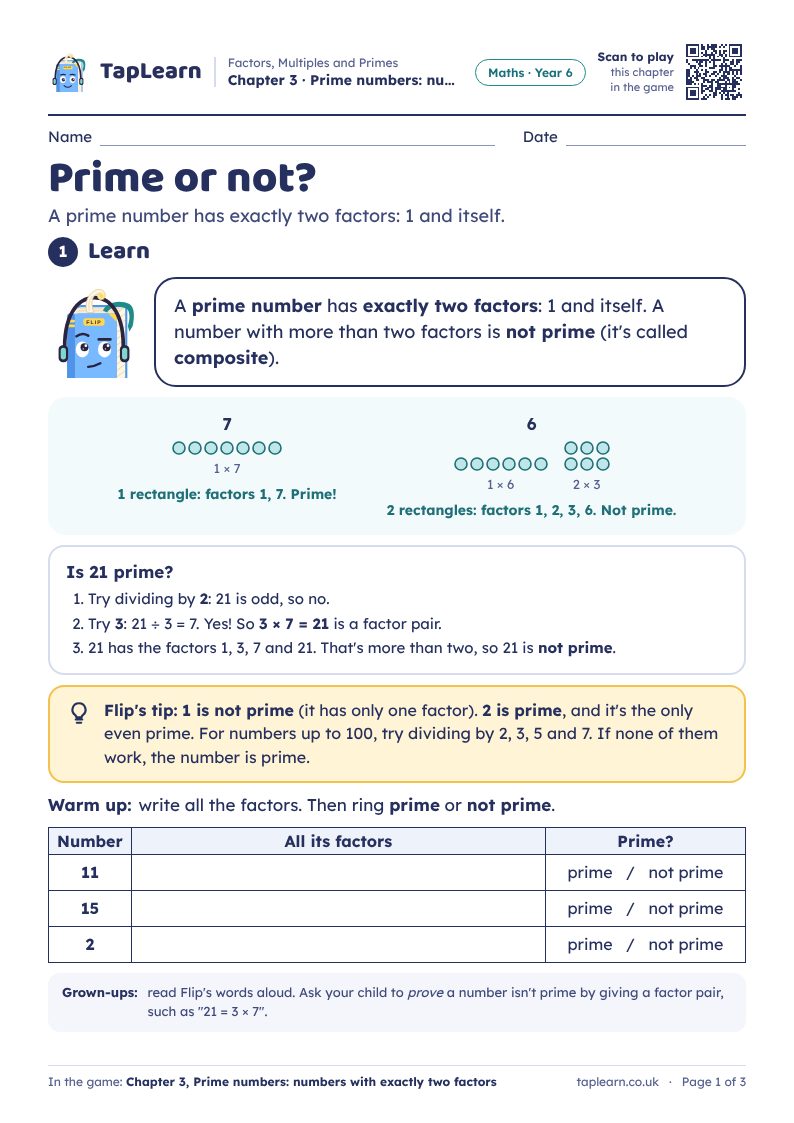
Prime or Not? is a printable prime numbers worksheet for Year 6 (ages 10 to 11) that teaches children that a prime has exactly two factors, that 1 is not prime and 2 is, and to prove a number isn't prime with a factor pair. It covers the Year 6 maths statement on identifying common factors, common multiples and prime numbers.
This worksheet is for members
Membership opens every chapter of every game and every worksheet, for all your children.
See the plansAlready a member? Log in to print it.
Start with the free one: Common factors (chapter 1).
Print it on A4, in colour or black and white. Do it after the chapter, or before it to see what your child already knows.
What's on the worksheet
Your child learns why a prime has exactly two factors and 1 is not prime, finds every prime to 100 with the Sieve of Eratosthenes, and proves numbers are not prime. Includes a prime hunt at home and an answers sheet.
- Page 1 · Learn
- Button rectangles showing 7 is prime and 6 is not, a worked example proving 21 is not prime, Flip's tip on 1, 2 and dividing by 2, 3, 5 and 7, and a factors warm-up.
- Page 2 · Try it together
- Prime hunt at home: find 5 numbers under 100 on a calendar, clock or book, try dividing by 2, 3, 5 and 7, and write a factor pair as proof or mark the number prime.
- Page 3 · Practise
- The Sieve of Eratosthenes on a 100 square, prime or not with proof, true or false, two primes that add up to 24, numbers ending in 5, and a challenge about 9.
- Answers sheet
- Every answer, mix-ups like thinking 1 is prime, and prime-or-not and prime-birthday ideas.
3 A4 pages and an answers sheet · about 35 minutes
Using it at home
- Ask your child to prove a number isn't prime by giving a factor pair, such as "21 = 3 x 7".
- The sieve takes time: let your child cross out one times table at a time and take a break after the multiples of 3.
- On your next walk, look at house numbers: "Prime or not? Can you prove it?"
Watch out for
- Thinking 1 is prime.
- A prime needs exactly two different factors. 1 has only one, so it isn't prime.
- Thinking every odd number is prime.
- Ask for a factor pair: 9 = 3 x 3, 21 = 3 x 7, 91 = 7 x 13.
- Thinking 2 isn't prime because it's even.
- Its only factors are 1 and 2, so it's prime: the only even one.
Questions from the worksheet
- Prime or not? If it isn't prime, prove it with a factor pair: 27, 29, 51, 53, 57, 91.
- True or false? 1 is a prime number. 2 is a prime number. Every odd number is prime. Every prime number except 2 is odd.
- Find two prime numbers that add up to 24. Can you find more than one way?
- 25, 35 and 45 all end in 5, and none of them is prime. Is every number ending in 5 not prime? Explain.
- Mia says, "9 is prime because it's an odd number." Is she right? How would you convince her?
The answers are on the answers sheet, for grown-ups.
National curriculum in England
This worksheet practises this statement from the Year 6 maths programme of study:
- Identify common factors, common multiples and prime numbers
Source: National curriculum in England: mathematics programmes of study (DfE)
In the classroom
- Do the Sieve of Eratosthenes together on a large 100 square, with groups crossing out different times tables.
- Play prime or not? as a starter: call out a number under 50 and pupils show prime or a factor pair.
Questions and answers
What is a prime number?
A prime number has exactly two factors: 1 and itself. 7 is prime because its only factors are 1 and 7.
Is 1 a prime number?
No. 1 has only one factor, and a prime needs exactly two, so 1 is not prime.
How do you check if a number up to 100 is prime?
Try dividing it by 2, 3, 5 and 7. If none of them divide exactly, the number is prime.
 TapLearn