Common factors worksheet for Year 6
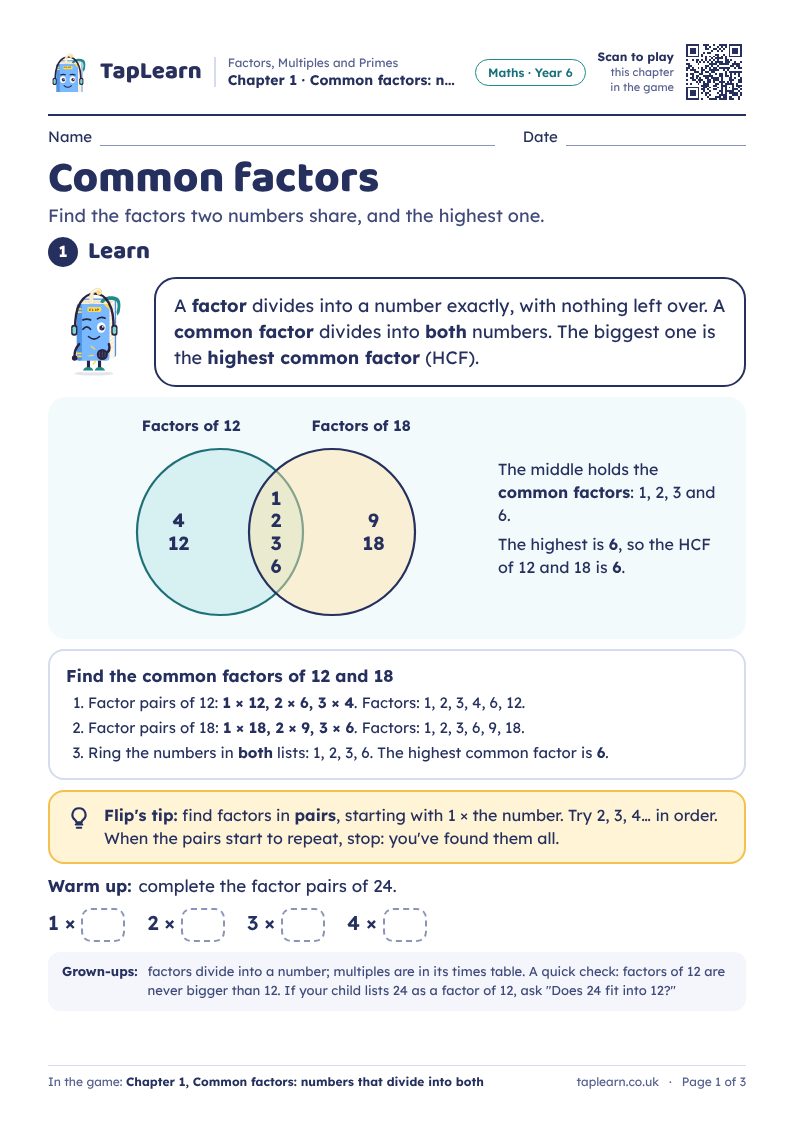
Common Factors is a printable common factors worksheet for Year 6 (ages 10 to 11) that teaches children to list factors in pairs, ring those two numbers share and find the highest common factor, such as 6 for 12 and 18. It covers the Year 6 maths statement on identifying common factors, common multiples and prime numbers.
Free to print, no account needed.
Print it on A4, in colour or black and white. Do it after the chapter, or before it to see what your child already knows.
What's on the worksheet
Your child finds factor pairs without missing any, spots the common factors of two numbers and finds the highest common factor, using a Venn diagram. Includes a button-rectangles activity and an answers sheet.
- Page 1 · Learn
- A Venn diagram of the factors of 12 and 18, a worked example finding their common factors, Flip's tip to work in pairs and stop when they repeat, and a factor-pairs-of-24 warm-up.
- Page 2 · Try it together
- Button rectangles: make every rectangle you can with 12 buttons, then with 18, write the factor pairs, and find the row lengths that work for both.
- Page 3 · Practise
- Ring the factors of 16, find the HCF of five pairs, a Venn diagram for 20 and 30, true or false, make up a pair with an HCF of 5, and a challenge.
- Answers sheet
- Every answer, mix-ups like confusing factors and multiples, and sharing-out and factor ping-pong ideas.
3 A4 pages and an answers sheet · about 30 minutes
Using it at home
- A quick check: factors of 12 are never bigger than 12. If your child lists 24, ask "Does 24 fit into 12?"
- In button rectangles, let your child build every rectangle before writing anything, including a single line for 1 x 12.
- Afterwards, pick two numbers from 10 to 30 from a calendar or number plate and find their common factors together.
Watch out for
- Mixing up factors and multiples.
- Factors of 12 fit into 12 (1, 2, 3...). Multiples of 12 are in its times table (12, 24, 36...).
- Missing factors by listing at random.
- Work in pairs from 1 upwards and stop when the pairs repeat.
- Including factors of only one number.
- Check each one: "Does it divide into the first number? And the second?"
Questions from the worksheet
- Draw a ring round every factor of 16: 1, 2, 3, 4, 5, 6, 8, 10, 12, 16, 32.
- Find the highest common factor of each pair: 8 and 12, 15 and 25, 14 and 21, 16 and 24, 9 and 10.
- True or false? 4 is a factor of 20. 20 is a factor of 4. 1 is a factor of every whole number. The HCF of 6 and 12 is 12.
- Write two numbers that have a highest common factor of 5. Explain how you know.
- Ava says the common factors of 12 and 18 are 1, 2, 3, 4, 6 and 9. Is she right? Which numbers should she take out, and why?
The answers are on the answers sheet, for grown-ups.
National curriculum in England
This worksheet practises this statement from the Year 6 maths programme of study:
- Identify common factors, common multiples and prime numbers
Source: National curriculum in England: mathematics programmes of study (DfE)
In the classroom
- Use the warm-up as a mini-whiteboard starter on the factor pairs of 24.
- Play factor ping-pong in pairs: take turns naming a factor of 36 until one runs out.
Questions and answers
What is a common factor?
A common factor is a number that divides exactly into two or more numbers. 1, 2, 3 and 6 are the common factors of 12 and 18.
How do you find the highest common factor?
List the factors of both numbers in pairs, ring the ones in both lists, and pick the biggest. The HCF of 12 and 18 is 6.
What is the difference between factors and multiples?
Factors divide into a number, so they are never bigger than it. Multiples are in its times table, so they get bigger.
 TapLearn