Common denominators worksheet for Year 6: Same-size pieces
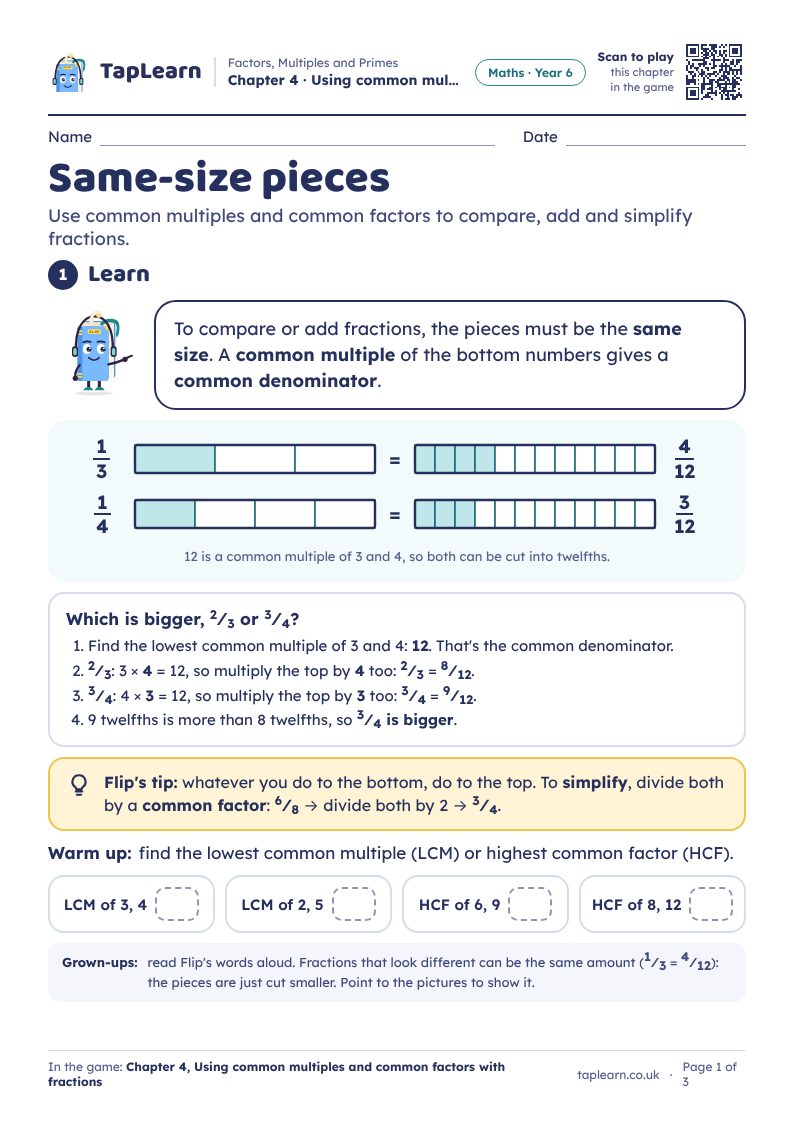
Same-Size Pieces is a printable common denominators worksheet for Year 6 (ages 10 to 11) that teaches children to use the lowest common multiple as a common denominator to compare and add fractions, and the highest common factor to simplify. It covers the Year 6 maths statement on identifying common factors, common multiples and prime numbers.
This worksheet is for members
Membership opens every chapter of every game and every worksheet, for all your children.
See the plansAlready a member? Log in to print it.
Start with the free one: Common factors (chapter 1).
Print it on A4, in colour or black and white. Do it after the chapter, or before it to see what your child already knows.
What's on the worksheet
Your child uses a common multiple to find a common denominator, then compares and adds fractions, and uses a common factor to simplify them. Includes a paper-strip folding activity and an answers sheet.
- Page 1 · Learn
- Thirds and quarters both cut into twelfths, a worked example showing 3/4 is bigger than 2/3, Flip's tip on doing the same to top and bottom, and an LCM and HCF warm-up.
- Page 2 · Try it together
- Fold the strips: fold one paper strip into thirds and one into quarters, shade 2/3 and 3/4, then fold both into twelfths to see which is more.
- Page 3 · Practise
- Write pairs with a common denominator, compare four pairs, simplify five fractions by their HCF, add three pairs, and a challenge about adding tops and bottoms.
- Answers sheet
- Every answer, mix-ups like adding the denominators, and pizza-question and simplify-it ideas.
3 A4 pages and an answers sheet · about 30 minutes
Using it at home
- Point to the pictures to show that fractions that look different can be the same amount: 1/3 = 4/12, the pieces are just cut smaller.
- In fold the strips, roughly equal parts are fine. Ask "Why did both strips end up with 12 parts?"
- If your child changes only the bottom number, say "Whatever you do to the bottom, do to the top."
Watch out for
- Adding the denominators to get a common denominator, like 3 + 4 = 7.
- Use a common multiple: 12 is in the 3 and 4 times tables; 7 isn't.
- Changing only the bottom number, like 1/3 = 1/12.
- If the bottom is multiplied by 4, the top must be too: 4/12.
- Dividing the top and bottom by different numbers when simplifying.
- Use the same common factor for both, or the fraction changes size.
Questions from the worksheet
- Write each pair with a common denominator: 1/2 and 1/3, 3/4 and 1/6, 2/5 and 1/2.
- Write less than, greater than or equal to. Find a common denominator first: 2/3 and 3/5, 3/8 and 1/3, 5/6 and 7/8, 2/4 and 3/6.
- Simplify. Divide the top and the bottom by their highest common factor: 6/9, 10/15, 12/16, 8/20, 18/24.
- Add. Use a common denominator: 1/3 + 1/4, 1/2 + 1/5, 2/3 + 1/6.
- Sam says 1/3 + 1/4 = 2/7. Is Sam right? Hint: is 2/7 more or less than 1/3 on its own?
The answers are on the answers sheet, for grown-ups.
National curriculum in England
This worksheet practises this statement from the Year 6 maths programme of study:
- Identify common factors, common multiples and prime numbers
Source: National curriculum in England: mathematics programmes of study (DfE)
In the classroom
- Use the warm-up to recap LCM and HCF from earlier chapters before the fractions work.
- Pose the pizza question to the class: would you rather have 2/3 or 3/4 of a pizza? Pupils prove it with twelfths.
Questions and answers
How do you find a common denominator?
Find a common multiple of the denominators, usually the lowest. For 2/3 and 3/4, 12 is the lowest common multiple, so the fractions become 8/12 and 9/12.
How do common factors help simplify fractions?
Divide the top and bottom by their highest common factor. 18/24 divided by 6 is 3/4.
Why can't you add the denominators?
The denominator shows the size of the pieces. 1/3 + 1/4 can't be 2/7, because 2/7 is less than 1/3 on its own.
 TapLearn