Common multiples worksheet for Year 6: Where tables meet
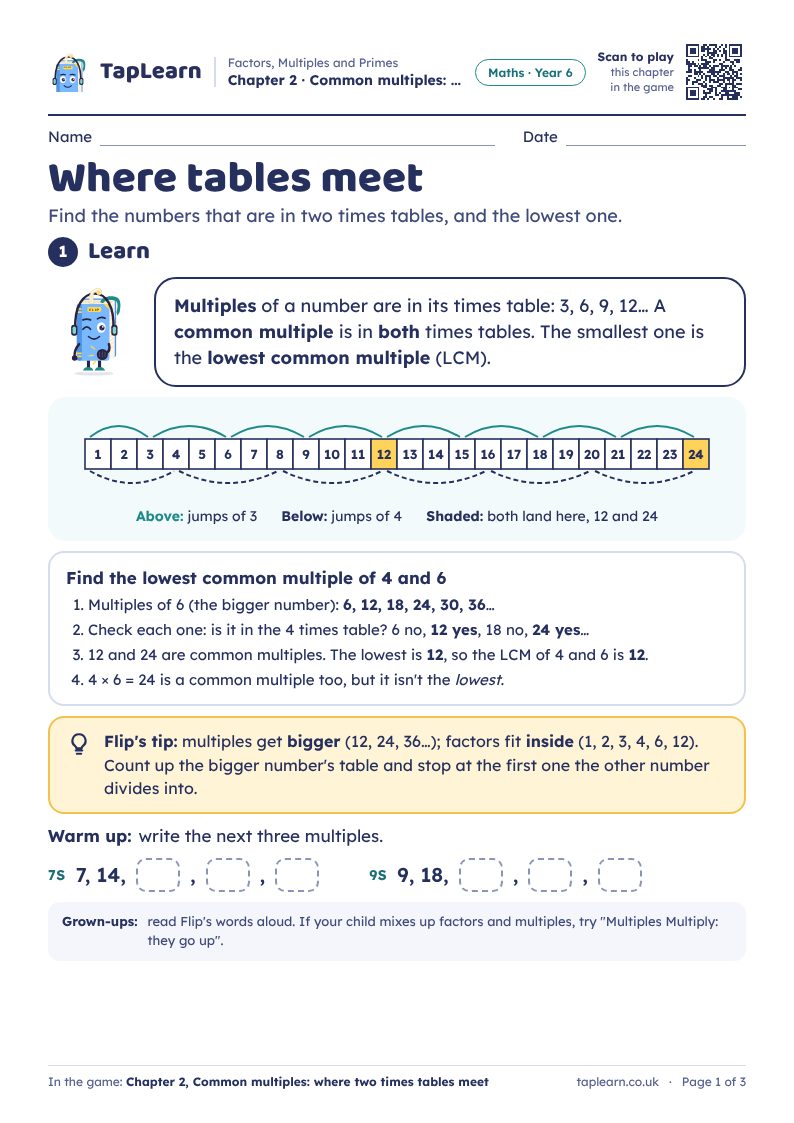
Where Tables Meet is a printable common multiples worksheet for Year 6 (ages 10 to 11) that teaches children to count up the bigger number's times table and stop at the first number the other divides into, finding the lowest common multiple. It covers the Year 6 maths statement on identifying common factors, common multiples and prime numbers.
This worksheet is for members
Membership opens every chapter of every game and every worksheet, for all your children.
See the plansAlready a member? Log in to print it.
Start with the free one: Common factors (chapter 1).
Print it on A4, in colour or black and white. Do it after the chapter, or before it to see what your child already knows.
What's on the worksheet
Your child finds common multiples of two numbers and the lowest common multiple, and uses them to solve problems. Includes a clap-and-tap rhythm activity and an answers sheet.
- Page 1 · Learn
- A number line with jumps of 3 and 4 meeting at 12 and 24, a worked example finding the LCM of 4 and 6, Flip's tip on multiples and factors, and a next-three-multiples warm-up.
- Page 2 · Try it together
- Clap and tap: count to 24 together while the child claps on every 3rd number and the grown-up taps on every 4th, then write down when you sound together.
- Page 3 · Practise
- Ring multiples of 4 and cross multiples of 6 on a 1 to 40 grid, find six LCMs, rolls-and-burgers and bus problems, true or false, and a challenge about multiplying.
- Answers sheet
- Every answer, mix-ups like adding the two numbers, and fizz-buzz and stairs ideas.
3 A4 pages and an answers sheet · about 30 minutes
Using it at home
- If your child mixes up factors and multiples, try "Multiples Multiply: they go up".
- In clap and tap, count slowly. For 4 and 6, ask "Is the first time together 4 x 6 = 24?" before you try it.
- Ask your child to check each LCM is in both times tables before moving on.
Watch out for
- Mixing up factors and multiples.
- Multiples of 6 are 6, 12, 18... (they get bigger). Factors of 6 are 1, 2, 3, 6 (they fit inside).
- Always multiplying the two numbers.
- That gives a common multiple, but it's only the lowest when the numbers share no factor except 1, like 3 and 5.
- Adding the numbers, like saying the LCM of 3 and 5 is 8.
- 8 isn't in either times table. Check the answer is in both tables.
Questions from the worksheet
- Find the lowest common multiple of each pair: 2 and 3, 3 and 5, 4 and 10, 6 and 8, 5 and 10, 6 and 9.
- Rolls come in packs of 6. Burgers come in packs of 8. What is the smallest number of each you can buy to have the same number of rolls and burgers?
- Two buses leave the bus stop at 9:00. One comes back every 10 minutes, the other every 15 minutes. When are they next at the stop together?
- True or false? 24 is a common multiple of 4 and 6. The LCM of 4 and 6 is 24. The LCM of 3 and 5 is 8.
- Leo says, "The lowest common multiple of 6 and 8 is 48, because 6 x 8 = 48." Is he right? Explain.
The answers are on the answers sheet, for grown-ups.
National curriculum in England
This worksheet practises this statement from the Year 6 maths programme of study:
- Identify common factors, common multiples and prime numbers
Source: National curriculum in England: mathematics programmes of study (DfE)
In the classroom
- Play fizz buzz round the class with multiples of 3 and 5, asking when the first fizz buzz comes.
- Use Leo's challenge for a pairs discussion on when multiplying gives the lowest common multiple.
Questions and answers
What is a common multiple?
A common multiple is a number that is in two or more times tables. 12 and 24 are common multiples of 4 and 6.
How do you find the lowest common multiple?
Count up the bigger number's times table and stop at the first number the other number divides into. For 4 and 6, it is 12.
Is the lowest common multiple always the two numbers multiplied?
No. Multiplying gives a common multiple, but it is only the lowest when the numbers share no factor except 1. The LCM of 6 and 8 is 24, not 48.
 TapLearn