Oesophagus and swallowing worksheet for Year 4: Swallowing food
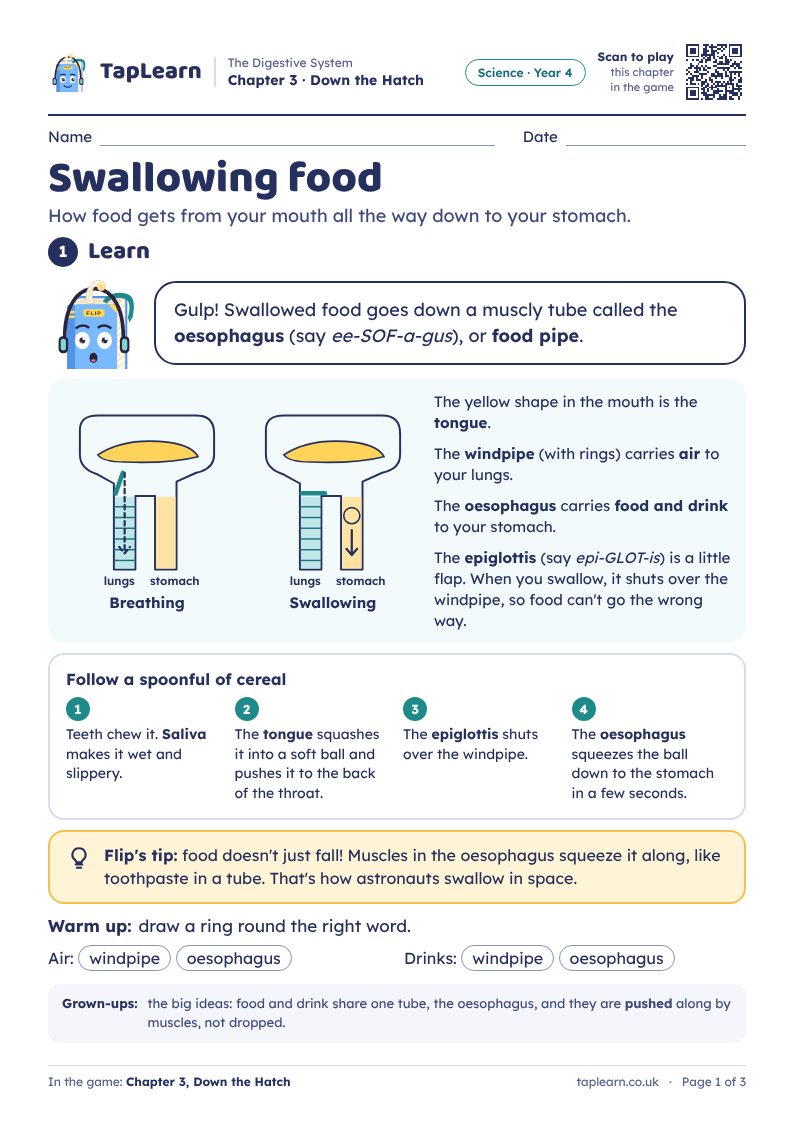
Swallowing Food is a printable worksheet for Year 4 (ages 8 to 9) on the oesophagus, teaching children how saliva, the tongue and the epiglottis help us swallow and how muscles squeeze food down to the stomach. It supports the Year 4 science national curriculum statement: describe the simple functions of the basic parts of the digestive system in humans.
This worksheet is for members
Membership opens every chapter of every game and every worksheet, for all your children.
See the plansAlready a member? Log in to print it.
Start with the free one: Teeth and their jobs (chapter 1).
Print it on A4, in colour or black and white. Do it after the chapter, or before it to see what your child already knows.
What's on the worksheet
Find out how saliva and the tongue help us swallow, how the epiglottis keeps food out of the windpipe and how the oesophagus squeezes food down to the stomach. With a ball-and-tights activity, and answers.
- Page 1 · Learn
- A diagram of the tongue, windpipe, oesophagus and epiglottis, and a spoonful of cereal followed from chewing to the stomach. Warm-up: windpipe or oesophagus?
- Page 2 · Try it together
- Squeeze it down: feel your throat as you swallow water, then squeeze a tennis ball along a leg of old tights, flat and then uphill, like the oesophagus.
- Page 3 · Practise
- Label the tongue, epiglottis, windpipe and oesophagus, number the steps of swallowing an apple, ring the right words, why not to talk with food in your mouth, and Leo's challenge.
- Answers sheet
- All answers, three mix-ups to watch for, and feel-the-flap and slippery saliva ideas.
3 A4 pages and an answers sheet · about 25 minutes
In the classroom
- Demonstrate the ball-in-tights model at the front, then let pupils try in small groups.
- Mini-whiteboard check: name a part (epiglottis, oesophagus, windpipe) and pupils write its job.
Questions from the worksheet
- Number the steps 1 to 5 to show how Mia swallows a bite of apple.
- Is food squeezed or dropped down the oesophagus?
- Why do you think it is best not to talk or laugh with food in your mouth?
- Leo says, "Drinks go down one tube and food goes down another tube." Is he right? Explain.
The answers are on the answers sheet, for grown-ups.
National curriculum in England
This worksheet practises this statement from the Year 4 science programme of study:
- Describe the simple functions of the basic parts of the digestive system in humans
Source: National curriculum in England: science programmes of study (DfE)
Using it at home
- In the tights activity, hold the leg uphill so your child sees that squeezing, not gravity, moves food along.
- Try to swallow and say "ahh" at the same time together: you can't, because the windpipe shuts as you swallow.
Watch out for
- Thinking food and drink go down different tubes.
- There are two tubes in the throat, but one is for air; food and drink share the oesophagus.
- Mixing up the oesophagus and the windpipe.
- The windpipe has hard rings and goes to the lungs. Windpipe for air, food pipe for food.
- Thinking food just falls down.
- It is squeezed down by muscles: try the tights again, or talk about astronauts eating in space.
Questions and answers
What does the oesophagus do?
The oesophagus is a muscly tube, also called the food pipe, that carries food and drink from the throat to the stomach. Its muscles squeeze food along, so it doesn't just fall.
What is the epiglottis?
The epiglottis is a small flap at the top of the windpipe. When you swallow, it shuts over the windpipe so food goes down the oesophagus instead.
 TapLearn