What the stomach does worksheet for Year 4
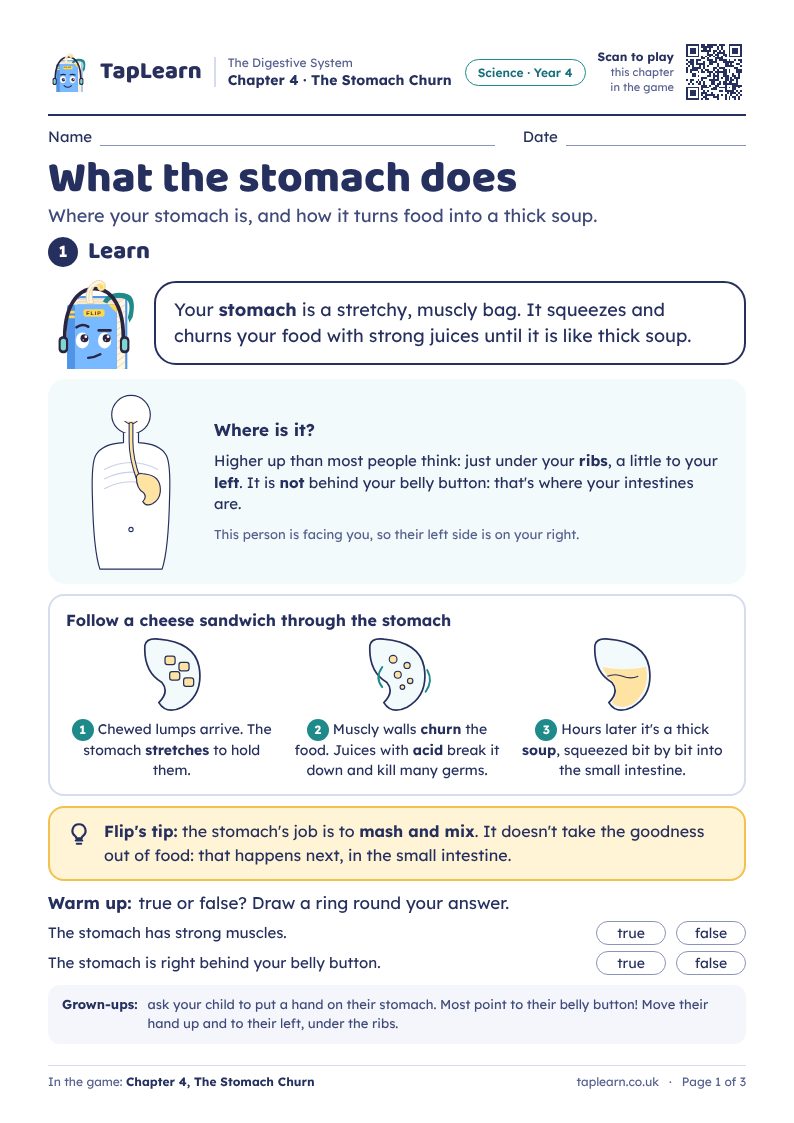
What the Stomach Does is a printable worksheet for Year 4 (ages 8 to 9) that teaches children where the stomach really is and how its muscly walls churn food with acid juices into a thick soup. It supports the Year 4 science national curriculum statement: describe the simple functions of the basic parts of the digestive system in humans.
This worksheet is for members
Membership opens every chapter of every game and every worksheet, for all your children.
See the plansAlready a member? Log in to print it.
Start with the free one: Teeth and their jobs (chapter 1).
Print it on A4, in colour or black and white. Do it after the chapter, or before it to see what your child already knows.
What's on the worksheet
Find where the stomach really is and how its stretchy, muscly walls churn food with strong juices into a thick soup. With a stomach-in-a-bag activity to try together, and answers.
- Page 1 · Learn
- Where the stomach sits, under the ribs on the left, and a cheese sandwich followed through it in three steps. Warm-up: true or false about the stomach.
- Page 2 · Try it together
- Stomach in a bag: put torn bread and water in a sealed food bag, squish it for a minute like the stomach's muscles, and draw it before and after.
- Page 3 · Practise
- Ring where the stomach is on a body, a word-box gap fill, tick stomach or intestines for four jobs, explain why the stomach needs muscles, and Ava's two-mistake challenge.
- Answers sheet
- All answers, three mix-ups to watch for, and tummy rumble and fist-size ideas.
3 A4 pages and an answers sheet · about 25 minutes
In the classroom
- Do the stomach-in-a-bag in pairs, then discuss what a real stomach adds that water can't.
- Use the stomach or intestines table as a quick sorting starter.
Questions from the worksheet
- Whose job is it? Tick stomach or intestines: churns food into a thick soup.
- Whose job is it? Passes goodness from food into the blood.
- Why does the stomach need strong muscles in its walls?
- Ava says, "My stomach is behind my belly button, and it takes all the goodness out of my food." She has made two mistakes. What are they?
The answers are on the answers sheet, for grown-ups.
National curriculum in England
This worksheet practises this statement from the Year 4 science programme of study:
- Describe the simple functions of the basic parts of the digestive system in humans
Source: National curriculum in England: science programmes of study (DfE)
Using it at home
- Ask your child to put a hand on their stomach: most point to their belly button, so move their hand up and to their left, under the ribs.
- Seal the bag tightly before squishing, and put it in the bin afterwards.
Watch out for
- Thinking the stomach is behind the belly button.
- The stomach sits higher up, mostly under the lower ribs on the left.
- Mixing up the stomach and the intestines.
- Stomach: mash and mix. Small intestine: take in the goodness. Large intestine: take out the water.
- Mixing up left and right on a diagram.
- A person facing you has their left on your right. Stand side by side to check.
Questions and answers
What does the stomach do in digestion?
The stomach is a stretchy, muscly bag that churns food and mixes it with juices containing acid. After a few hours the food becomes a thick soup that moves on to the small intestine.
Where is the stomach in the body?
The stomach is higher up than most people think, just under the ribs on the left. The area behind the belly button is where the intestines are.
 TapLearn