Types of teeth worksheet for Year 4: Teeth and their jobs
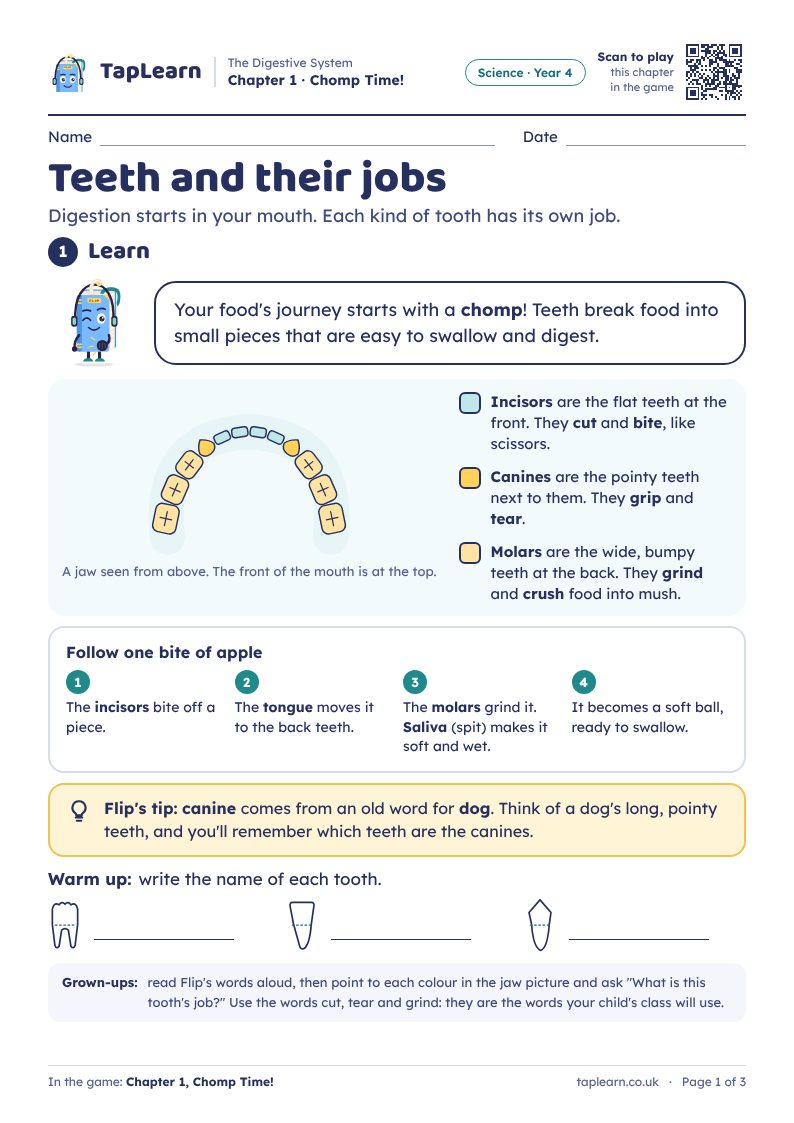
Teeth and Their Jobs is a printable types of teeth worksheet for Year 4 (ages 8 to 9) that teaches children to name incisors, canines and molars, say what each does, and compare a lion's teeth with a sheep's. It supports the Year 4 science national curriculum statement: describe the simple functions of the basic parts of the digestive system in humans.
Free to print, no account needed.
Print it on A4, in colour or black and white. Do it after the chapter, or before it to see what your child already knows.
What's on the worksheet
Name incisors, canines and molars, say what job each one does, and compare the teeth of meat-eaters and plant-eaters. With a mirror-and-apple tooth detectives activity, and answers.
- Page 1 · Learn
- A jaw picture showing incisors that cut, canines that tear and molars that grind, and one bite of apple followed from biting to swallowing. Warm-up: name each tooth.
- Page 2 · Try it together
- Tooth detectives: use a mirror to find and count your incisors, canines and molars, then bite and chew a slice of apple to feel which teeth do which job.
- Page 3 · Practise
- Name and count teeth in a jaw, choose which teeth do the work for four foods, match teeth to a lion, a sheep and a person, a word-box gap fill, and Ava's challenge.
- Answers sheet
- All answers, two points to watch for, and teatime tooth talk and animal teeth ideas.
3 A4 pages and an answers sheet · about 25 minutes
Using it at home
- Use the words cut, tear and grind when talking about each tooth: they are the words your child's class will use.
- Gaps and wobbly teeth are normal at this age, so just count what is there in the mirror.
Watch out for
- Mixing up which teeth cut, tear and grind.
- Link shape to job: a thin edge cuts like scissors, a point grips and tears, and a wide bumpy top grinds.
- Being confused by premolars in some books.
- Premolars sit between the canines and molars, and they grind food too.
Questions from the worksheet
- Which teeth do most of the work when grinding a mouthful of cereal?
- Which teeth do most of the work when tearing meat off a chicken leg?
- Whose teeth? Write lion (eats meat), sheep (eats plants) or person (eats both). How did you know which were the lion's teeth?
- Ava says, "My molars are the sharp, pointy teeth that tear my food." Is she right? Explain.
The answers are on the answers sheet, for grown-ups.
National curriculum in England
This worksheet practises this statement from the Year 4 science programme of study:
- Describe the simple functions of the basic parts of the digestive system in humans
Source: National curriculum in England: science programmes of study (DfE)
In the classroom
- Pupils use hand mirrors in pairs to count each type of tooth and compare results.
- Show pictures of animal skulls and ask pupils to decide meat-eater or plant-eater from the teeth.
Questions and answers
What are the three main types of teeth?
The three main types of teeth are incisors, canines and molars. Incisors cut and bite, canines grip and tear, and molars grind food into mush.
How are a meat-eater's teeth different from a plant-eater's?
Meat-eaters like lions have big, pointed canines for gripping and tearing meat. Plant-eaters like sheep have wide, flat teeth for grinding plants.
 TapLearn