Small and large intestine worksheet for Year 4: The intestines
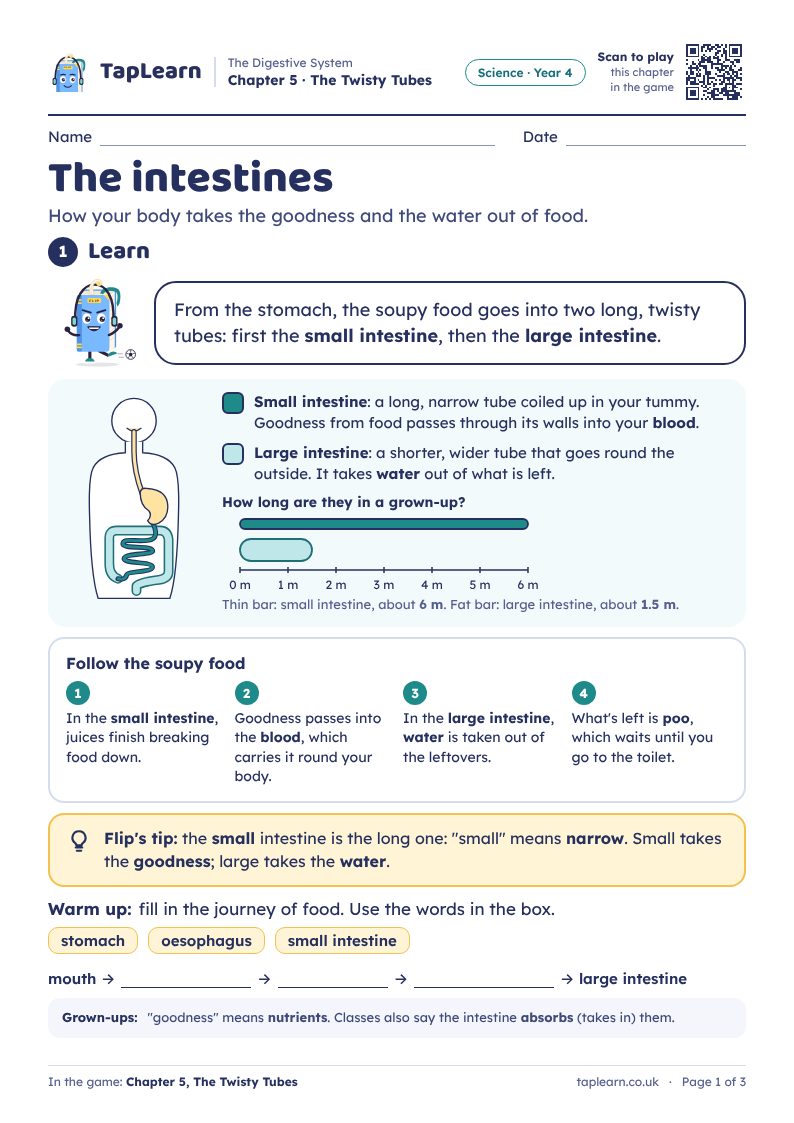
The Intestines is a printable worksheet for Year 4 (ages 8 to 9) on the small and large intestine, teaching children how one takes goodness from food into the blood and the other takes out water. It supports the Year 4 science national curriculum statement: describe the simple functions of the basic parts of the digestive system in humans.
This worksheet is for members
Membership opens every chapter of every game and every worksheet, for all your children.
See the plansAlready a member? Log in to print it.
Start with the free one: Teeth and their jobs (chapter 1).
Print it on A4, in colour or black and white. Do it after the chapter, or before it to see what your child already knows.
What's on the worksheet
Learn how the small intestine passes goodness from food into the blood and the large intestine takes water out of what is left, then follow food's whole journey. With a 6-metre string activity, and answers.
- Page 1 · Learn
- What each intestine does, a bar chart of their lengths in a grown-up, and the soupy food followed to the end. Warm-up: fill in the journey from mouth to large intestine.
- Page 2 · Try it together
- How long is it? Guess and then measure 6 metres of string along a hallway or garden, count your steps, and coil it into a shoebox to see how it fits.
- Page 3 · Practise
- Label parts of the digestive system, tick small or large intestine for five facts, join each part to its job, explain why the small intestine is so long, and Mia's challenge.
- Answers sheet
- All answers, three mix-ups to watch for, and where-is-my-lunch and tell-the-story ideas.
3 A4 pages and an answers sheet · about 25 minutes
In the classroom
- Lay out 6 m and 1.5 m of string along the classroom or corridor for pupils to compare.
- Plenary: pupils retell the whole journey of a meal from mouth to toilet, naming each part and its job.
Questions from the worksheet
- Small or large intestine? It takes water out of the leftovers.
- Join each part to its job: teeth, oesophagus, stomach, small intestine, large intestine.
- Why do you think the small intestine needs to be so long?
- Mia says, "Food turns into poo and drink turns into wee, so food and drink must go through different tubes." Is she right? Explain.
The answers are on the answers sheet, for grown-ups.
National curriculum in England
This worksheet practises this statement from the Year 4 science programme of study:
- Describe the simple functions of the basic parts of the digestive system in humans
Source: National curriculum in England: science programmes of study (DfE)
Using it at home
- Measure the string with a tape measure and let your child guess first: no cutting is needed.
- These lengths are for a grown-up; tell your child their own intestines are shorter but still coiled up tightly.
Watch out for
- Swapping the jobs of the two intestines.
- Small: long and thin, takes the goodness. Large: short and wide, takes the water.
- Thinking the small intestine is the short one.
- It is about four times longer: "small" means narrow.
- Thinking drinks have their own tube to become wee.
- Drink goes down the same tube as food; see the challenge answer.
Questions and answers
What does the small intestine do?
The small intestine finishes breaking food down, and goodness (nutrients) passes through its walls into the blood. In a grown-up it is about 6 metres long.
What does the large intestine do?
The large intestine takes water out of what is left after the small intestine. What remains is poo, which waits until you go to the toilet.
 TapLearn