Grammar terms worksheet for Year 4: Name that word
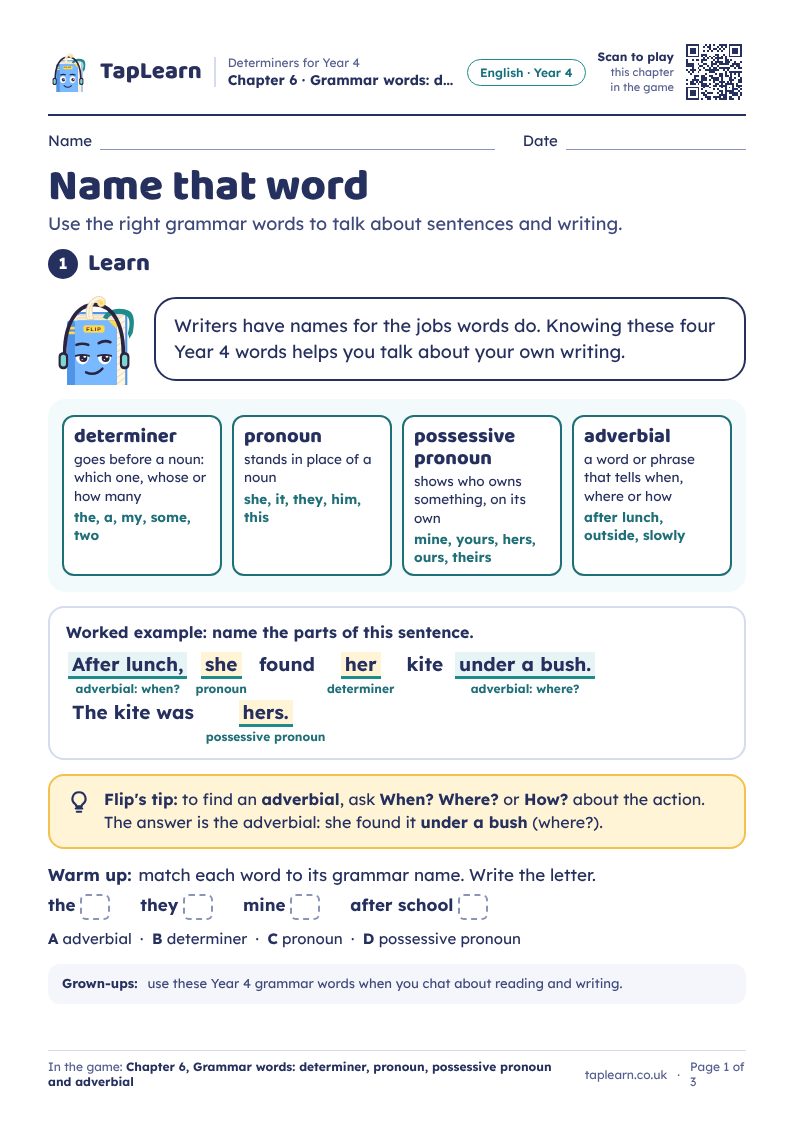
Name That Word is a printable grammar terms worksheet for Year 4 (ages 8 to 9) that teaches children to name determiners, pronouns, possessive pronouns and adverbials, finding an adverbial by asking when, where or how. It covers the Year 4 terminology determiner, pronoun, possessive pronoun and adverbial, and using grammar words when discussing writing and reading.
This worksheet is for members
Membership opens every chapter of every game and every worksheet, for all your children.
See the plansAlready a member? Log in to print it.
Start with the free one: Spot the determiner (chapter 1).
Print it on A4, in colour or black and white. Do it after the chapter, or before it to see what your child already knows.
What's on the worksheet
Your child uses the Year 4 grammar words determiner, pronoun, possessive pronoun and adverbial to talk about sentences and writing. Includes a grammar spotters activity and an answers sheet.
- Page 1 · Learn
- The four grammar words with examples, a worked example labelling "After lunch, she found her kite under a bush", Flip's tip on finding adverbials, and a matching warm-up.
- Page 2 · Try it together
- Grammar spotters: write the four grammar words on scraps of paper, read sentences together and put each scrap under a matching word, then add an adverbial to a sentence.
- Page 3 · Practise
- Write D, P or PP for underlined words, underline adverbials and say when, where or how, find one of each in a sentence, write your own labelled sentence, and a challenge.
- Answers sheet
- Every answer, mix-ups like adverbials of more than one word, and grammar I spy and adverbial add-on ideas.
3 A4 pages and an answers sheet · about 25 minutes
Using it at home
- Possessive pronouns are rarer in books, so you may need to make one up when hunting.
- There is a comma after an adverbial at the start of a sentence.
- Say a short sentence like "The dog barked." and take turns adding when, where or how.
Watch out for
- Mixing up the names.
- Determiner: before a noun. Pronoun: instead of a noun. Possessive pronoun: owning, on its own.
- Underlining only part of an adverbial, like "under".
- Underline the whole phrase that answers when, where or how.
- Thinking adverbials only come at the start.
- They can come at the end too: The birds sang in the morning.
Questions from the worksheet
- Name the underlined word. Write D, P or PP: Every seat was taken. They waited outside. The red umbrella is ours.
- Underline the adverbial. Does it tell you when, where or how? After tea, we played cards. The cat slept under the table.
- Read the sentence and find a determiner, a pronoun and an adverbial: Later, they shared their snacks in the garden.
- Ava says: "In 'The book is mine', mine is a determiner, because it shows who owns the book." Is she right? Explain.
The answers are on the answers sheet, for grown-ups.
National curriculum in England
This worksheet practises these statements from the Year 4 english programme of study:
- Terminology: determiner, pronoun, possessive pronoun, adverbial
- Use and understand the grammatical terminology in English appendix 2 accurately and appropriately when discussing their writing and reading (Years 3–4 english)
In the classroom
- Play grammar I spy with sentences on the board.
- Use Practise D as a writing task, with pupils labelling their own sentences.
Questions and answers
What is an adverbial?
An adverbial is a word or phrase that tells when, where or how something happens, like after lunch, outside or slowly.
What is the difference between a pronoun and a determiner?
A determiner goes before a noun (my book). A pronoun stands in place of a noun (she, it, they).
What Year 4 grammar words should children know?
Year 4 grammar terms include determiner, pronoun, possessive pronoun and adverbial.
 TapLearn