Quantifiers worksheet for Year 4: How many?
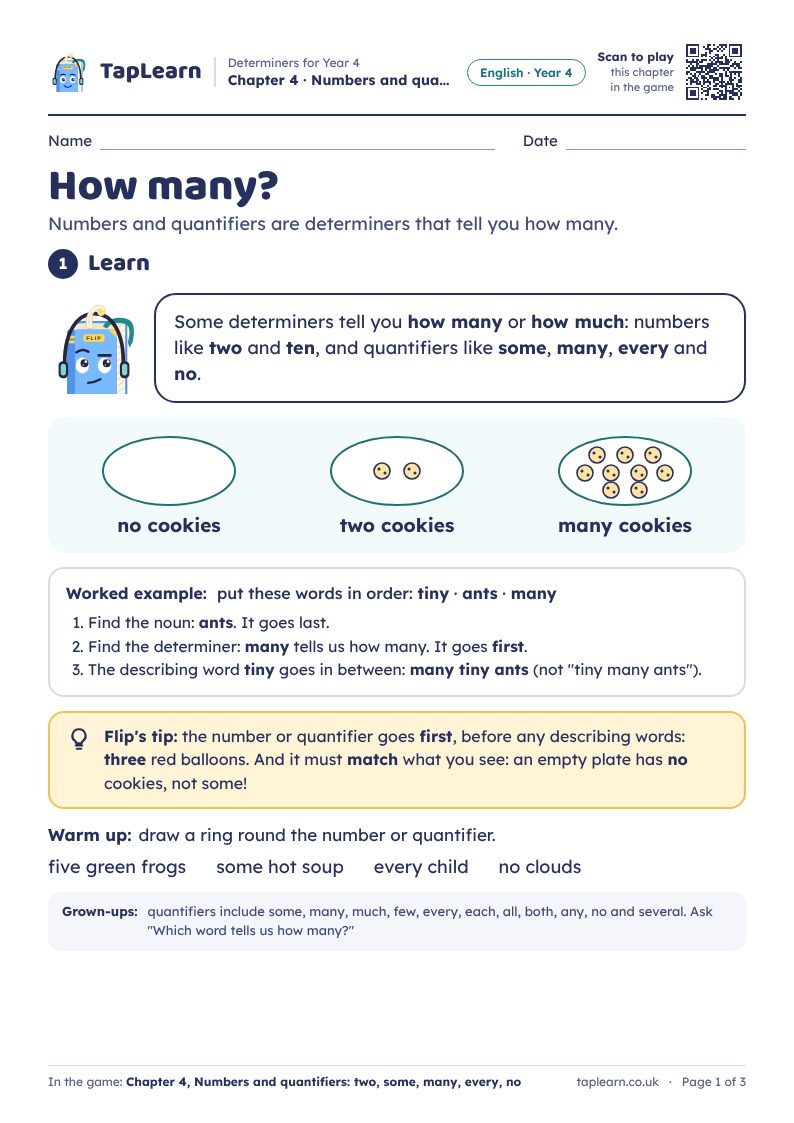
How Many? is a printable quantifiers worksheet for Year 4 (ages 8 to 9) that teaches children that numbers and words like some, many, every and no tell how many, go first in the phrase and must match the amount. It covers the Year 4 grammar terminology determiner.
This worksheet is for members
Membership opens every chapter of every game and every worksheet, for all your children.
See the plansAlready a member? Log in to print it.
Start with the free one: Spot the determiner (chapter 1).
Print it on A4, in colour or black and white. Do it after the chapter, or before it to see what your child already knows.
What's on the worksheet
Your child uses numbers and quantifiers like two, some, many, every and no to say how many, and puts them before any adjectives. Includes a snack-plate talk activity and an answers sheet.
- Page 1 · Learn
- No, two and many cookies, a worked example ordering "many tiny ants", Flip's tip that the quantifier must match what you see, and a ring-the-quantifier warm-up.
- Page 2 · Try it together
- Snack-plate talk: put a few grapes or bricks on a plate, describe them with a number, then a quantifier, try an every sentence, and finish with no when the plate is empty.
- Page 3 · Practise
- Match phrases to star pictures, fill gaps with no, every, two, some and many, put muddled phrases in order, write sentences about your kitchen, and a challenge.
- Answers sheet
- Every answer, mix-ups like a word that doesn't match the amount, and window-watch and true-or-false ideas.
3 A4 pages and an answers sheet · about 25 minutes
Using it at home
- Ask "Which word tells us how many?" whenever your child reads a phrase with a number or quantifier.
- In snack-plate talk, a few is a quantifier too, so try it if it comes up.
- Look out of the window and describe what you see: "two cars", "some birds", "no people".
Watch out for
- Choosing a word that doesn't match the amount, like many for an empty basket.
- Look again and ask "How many are really there?"
- Picking the describing word, like tiny in "many tiny ants".
- Ask "Which word tells us how many?"
- Putting the describing word first, like "tiny many ants".
- The number or quantifier leads the phrase.
Questions from the worksheet
- Use each word once: no, every, two, some, many. There are ___ clouds in the sky. It's bright and clear. ___ child in the class has a pencil.
- The words are in the wrong order. Write each one correctly: tiny many ants, red three balloons, fluffy two kittens.
- Look around your kitchen. Write one sentence with a number and one with a quantifier.
- Ava looked at an empty fruit bowl and wrote: "There are many apples in the bowl." Is she right? Which determiner should she use?
The answers are on the answers sheet, for grown-ups.
National curriculum in England
This worksheet practises this statement from the Year 4 english programme of study:
- Terminology: determiner, pronoun, possessive pronoun, adverbial
In the classroom
- Play true or false?: say a sentence about the classroom and pupils decide whether the determiner fits.
- Use Practise C to rebuild phrases with word cards.
Questions and answers
What is a quantifier?
A quantifier is a determiner that tells you how many or how much, like some, many, every or no.
Are numbers determiners?
Yes. Numbers like two and ten are determiners when they come before a noun: three red balloons.
Where does a quantifier go in a phrase?
It goes first, before any describing words: many tiny ants, not tiny many ants.
More worksheets from Determiners for Year 4: Ride the Determiner Express
- Chapter 1: Determiners worksheet: Spot the determiner Free
- Chapter 2: A, an and the worksheet: a, an or the? Members
- Chapter 3: Possessive determiners worksheet: Whose is it? Members
- Chapter 5: Possessive pronouns worksheet: my or mine? Members
- Chapter 6: Grammar terms worksheet: Name that word Members
 TapLearn