Determiners worksheet for Year 4: Spot the determiner
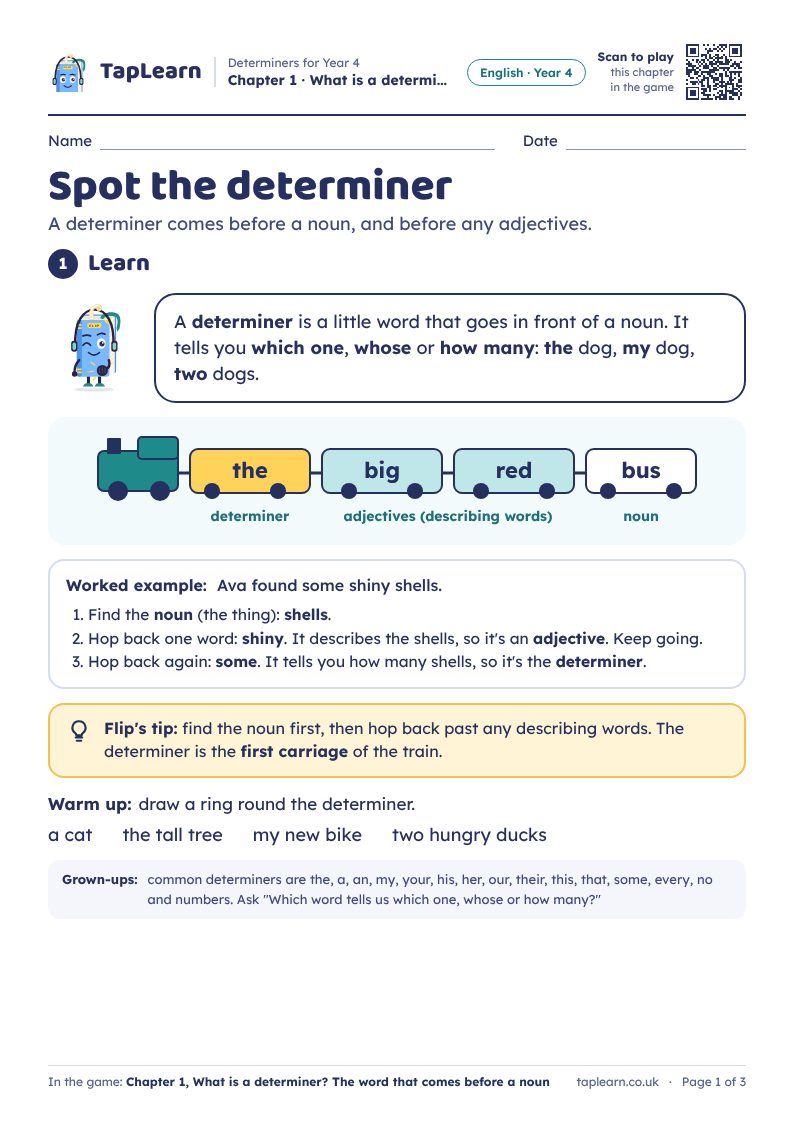
Spot the Determiner is a printable determiners worksheet for Year 4 (ages 8 to 9) that teaches children to find the noun, hop back past any describing words, and spot the determiner that tells which one, whose or how many. It covers the Year 4 terminology determiner, pronoun, possessive pronoun and adverbial, and using grammar words when discussing writing and reading.
Free to print, no account needed.
Print it on A4, in colour or black and white. Do it after the chapter, or before it to see what your child already knows.
What's on the worksheet
Your child finds the determiner before a noun, even with adjectives in between, like the big red bus. Includes a determiner hunt in a storybook and an answers sheet.
- Page 1 · Learn
- The big red bus labelled determiner, adjectives and noun, a worked example finding some in "Ava found some shiny shells", Flip's hop-back tip, and a ring-the-determiner warm-up.
- Page 2 · Try it together
- Determiner hunt: read sentences from any book, point to each noun, hop back to its determiner, and write the determiner, describing words and noun in a table.
- Page 3 · Practise
- Ring determiners in phrases, underline determiners and ring their nouns, put muddled phrases in order, build word trains about your home, and a challenge about big.
- Answers sheet
- Every answer, mix-ups like picking the noun, and swap-the-determiner and grow-the-train ideas.
3 A4 pages and an answers sheet · about 25 minutes
Using it at home
- Determiners include the, a, my, some and numbers. Ask "Which word tells us which one, whose or how many?"
- In the hunt, if your child picks a describing word, ask "Does it tell us which one, whose or how many?"
- Say "the cake", then take turns changing just the first word: my cake, some cake, every cake.
Watch out for
- Picking the describing word, like big in "the big dog".
- Ask "Does it tell us which one, whose or how many, or what it's like?"
- Picking the noun itself.
- The determiner is the word that goes before the noun.
- Putting the describing word first, like "big the dog".
- The determiner always leads the train.
Questions from the worksheet
- Draw a ring round the determiner in each phrase: an orange kite, every green leaf, three small ducks, our noisy neighbours.
- Underline each determiner. Draw a ring round the noun it goes with: The grumpy goat ate a sock.
- The words are in the wrong order. Write each one correctly: big the dog, red my bike, shiny some coins.
- Sam says the determiner in "the big dog" is big, because it comes just before the noun. Is he right? Explain.
The answers are on the answers sheet, for grown-ups.
National curriculum in England
This worksheet practises these statements from the Year 4 english programme of study:
- Terminology: determiner, pronoun, possessive pronoun, adverbial
- Use and understand the grammatical terminology in English appendix 2 accurately and appropriately when discussing their writing and reading (Years 3–4 english)
In the classroom
- Play grow the train round the class: start with "a hat" and add one describing word each.
- Use Practise A as a mini-whiteboard check.
Questions and answers
What is a determiner?
A determiner is a word that goes in front of a noun and tells you which one, whose or how many, like the, my, some or two.
Where does a determiner go?
A determiner comes before the noun and before any adjectives: the big red bus.
Is an adjective a determiner?
No. An adjective describes what a noun is like. In "the big dog", big is the adjective and the is the determiner.
 TapLearn