Possessive determiners worksheet for Year 4: Whose is it?
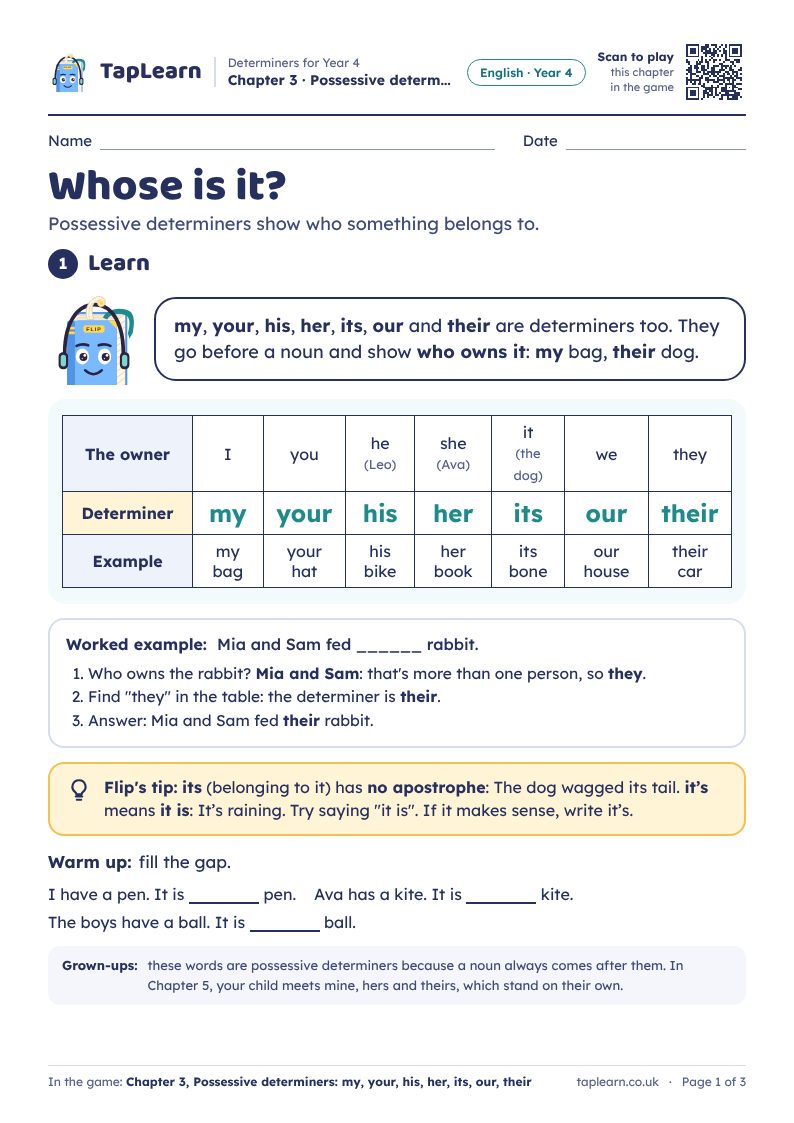
Whose Is It? is a printable possessive determiners worksheet for Year 4 (ages 8 to 9) that teaches children to match the determiner to the owner, so Mia and Sam fed their rabbit, and to write its with no apostrophe. It covers the Year 4 grammar terminology determiner.
This worksheet is for members
Membership opens every chapter of every game and every worksheet, for all your children.
See the plansAlready a member? Log in to print it.
Start with the free one: Spot the determiner (chapter 1).
Print it on A4, in colour or black and white. Do it after the chapter, or before it to see what your child already knows.
What's on the worksheet
Your child uses my, your, his, her, its, our and their to show who owns something, and tells its from it's. Includes a whose-is-this tidy-up game and an answers sheet.
- Page 1 · Learn
- A table matching owners to my, your, his, her, its, our and their, a worked example choosing their, Flip's tip on its and it's, and a fill-the-gap warm-up.
- Page 2 · Try it together
- Whose is this? Tidy-up: put shoes, cups or toys in a pile, the grown-up holds one up and asks whose it is, and the child answers with a full phrase like "It's her shoe."
- Page 3 · Practise
- Ring possessive determiners, write his, her or their, write its or it's, write sentences with our and their, and a challenge about "it's tail".
- Answers sheet
- Every answer, mix-ups like there for their, and whose-shoes and pet-talk ideas.
3 A4 pages and an answers sheet · about 25 minutes
Using it at home
- In Chapter 5, your child meets mine, hers and theirs, which stand on their own. For now, focus on words that go before a noun.
- In the tidy-up game, include something of the whole family (our...) and something of a pet (its...).
- At the front door, point at shoes and say whose they are: "his boots", "our wellies".
Watch out for
- Mixing up his, her and their.
- Ask "Who owns it? One boy, one girl, or more than one?"
- Writing it's for belonging.
- Use the "it is" test. My, his, her, its, our and their never have apostrophes.
- Writing there or they're instead of their.
- Their means belonging to them; it has "heir" inside and goes before a noun.
Questions from the worksheet
- Draw a ring round the possessive determiner: Ava brushed her hair. The cat licked its paw. Their garden has a pond.
- Write his, her or their: The girls rode ___ bikes to school. Dad and Grandad washed ___ cars.
- Write its or it's: ___ cold today. The bird built ___ nest. ___ time for bed.
- Leo wrote: "The puppy chased it's tail." Is he right? What would you tell him?
The answers are on the answers sheet, for grown-ups.
National curriculum in England
This worksheet practises this statement from the Year 4 english programme of study:
- Terminology: determiner, pronoun, possessive pronoun, adverbial
In the classroom
- Use Practise C as a quick its-or-it's check on mini whiteboards.
- Run the tidy-up game with lost property or classroom objects.
Questions and answers
What are possessive determiners?
Possessive determiners are my, your, his, her, its, our and their. They go before a noun and show who owns it: my bag, their dog.
What is the difference between its and it's?
Its means belonging to it (The dog wagged its tail). It's means it is (It's raining). Try saying "it is": if it makes sense, write it's.
Do possessive determiners have apostrophes?
No. My, his, her, its, our and their never have apostrophes.
 TapLearn