Adding and subtracting mixed numbers worksheet for Year 6: Mixed number sums
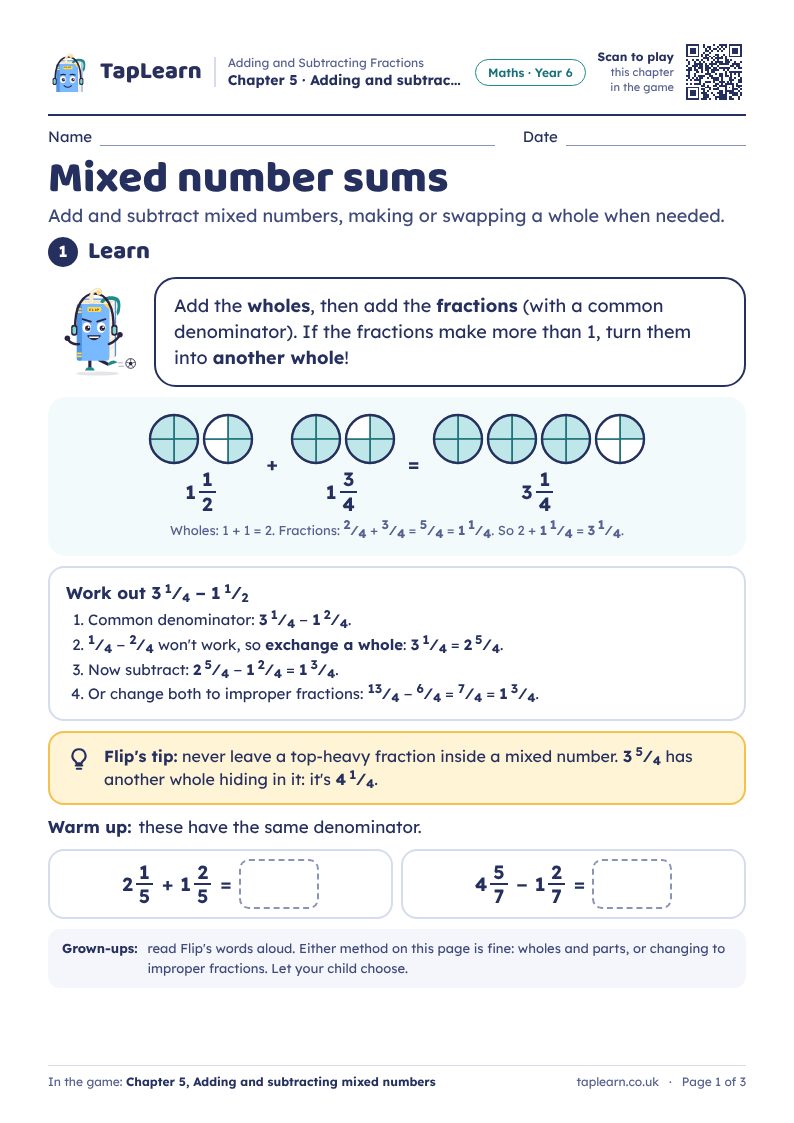
Mixed Number Sums is a printable adding and subtracting mixed numbers worksheet for Year 6 (ages 10 to 11) that teaches children to add the wholes and fractions separately and to exchange a whole when subtracting, like 3 1/4 - 1 1/2 = 1 3/4. It covers the Year 6 maths statement on adding and subtracting fractions with different denominators and mixed numbers, using the concept of equivalent fractions.
This worksheet is for members
Membership opens every chapter of every game and every worksheet, for all your children.
See the plansAlready a member? Log in to print it.
Start with the free one: Simplest form (chapter 1).
Print it on A4, in colour or black and white. Do it after the chapter, or before it to see what your child already knows.
What's on the worksheet
Your child adds and subtracts mixed numbers with different denominators, making a new whole or exchanging a whole when needed. Includes a paper wholes-and-quarters activity and an answers sheet.
- Page 1 · Learn
- A picture sum making a new whole, a worked example of 3 1/4 - 1 1/2 by exchanging a whole or using improper fractions, Flip's tip on top-heavy parts, and a warm-up.
- Page 2 · Try it together
- Wholes and quarters: tear paper sheets into quarters, build mixed numbers like 1 1/2 and 1 3/4, push them together to make wholes, and swap a whole for 4 quarters to take away.
- Page 3 · Practise
- Add with a common denominator, add where the fractions make another whole, subtract with exchanging, a walking word problem, and a challenge about swapping fractions round.
- Answers sheet
- Every answer with its working, mix-ups like leaving 3 5/4, and a film-times idea.
3 A4 pages and an answers sheet · about 25 minutes
Using it at home
- Either method on the sheet is fine: wholes and parts, or changing to improper fractions. Let your child choose the one that makes sense to them.
- In wholes and quarters, let your child do the swapping: one whole sheet for 4 quarters, before taking any away.
- When you next cook, measure 1 1/2 cups of water into a jug, then 1 3/4 more. Work out the total first, then check the jug.
Watch out for
- Forgetting the wholes, or adding them wrongly.
- Write the wholes sum first, then the fractions sum.
- Taking the smaller fraction from the bigger instead of exchanging.
- Ask "Is the first fraction big enough to take from?" If not, exchange a whole.
- Leaving a top-heavy part, like 3 5/4.
- Ask "Is there a whole hiding in 5/4?" So 3 5/4 = 4 1/4.
Questions from the worksheet
- Add. The fractions make more than 1, so make another whole: 1 2/3 + 1 1/2.
- Subtract. You'll need to exchange a whole: 3 1/3 - 1 1/2 and 5 1/4 - 2 2/3.
- Leo walked 1 3/4 km to the park, then 2 1/3 km home by a longer path. How far did he walk altogether? How much longer was the way home?
- Ava worked out 3 1/4 - 1 1/2 and got 2 1/4. She said, "I can't take 2/4 from 1/4, so I took 1/4 from 2/4 instead." Is she right?
The answers are on the answers sheet, for grown-ups.
National curriculum in England
This worksheet practises this statement from the Year 6 maths programme of study:
- Add and subtract fractions with different denominators and mixed numbers, using the concept of equivalent fractions
Source: National curriculum in England: mathematics programmes of study (DfE)
In the classroom
- Do wholes and quarters as a group activity with paper squares, recording each sum on a shared table.
- Show Ava's working on the board and ask pairs to explain why it's wrong and fix it.
Questions and answers
How do you add mixed numbers?
Add the wholes, then add the fractions using a common denominator. If the fractions make more than 1, turn them into another whole.
What does exchanging a whole mean with mixed numbers?
It means changing 1 whole into fraction pieces so you can subtract, like 3 1/4 = 2 5/4.
Can you change mixed numbers to improper fractions to subtract?
Yes. 3 1/4 - 1 1/2 = 13/4 - 6/4 = 7/4, which is 1 3/4.
More worksheets from Adding and Subtracting Fractions for Year 6: Bake with Pip the Penguin
- Chapter 1: Simplifying fractions worksheet: Simplest form Free
- Chapter 2: Common denominators worksheet: Matching denominators Members
- Chapter 3: Comparing and ordering fractions worksheet: Order the fractions Members
- Chapter 4: Adding and subtracting fractions worksheet: Different denominators Members
 TapLearn