Adding and subtracting fractions worksheet for Year 6: Different denominators
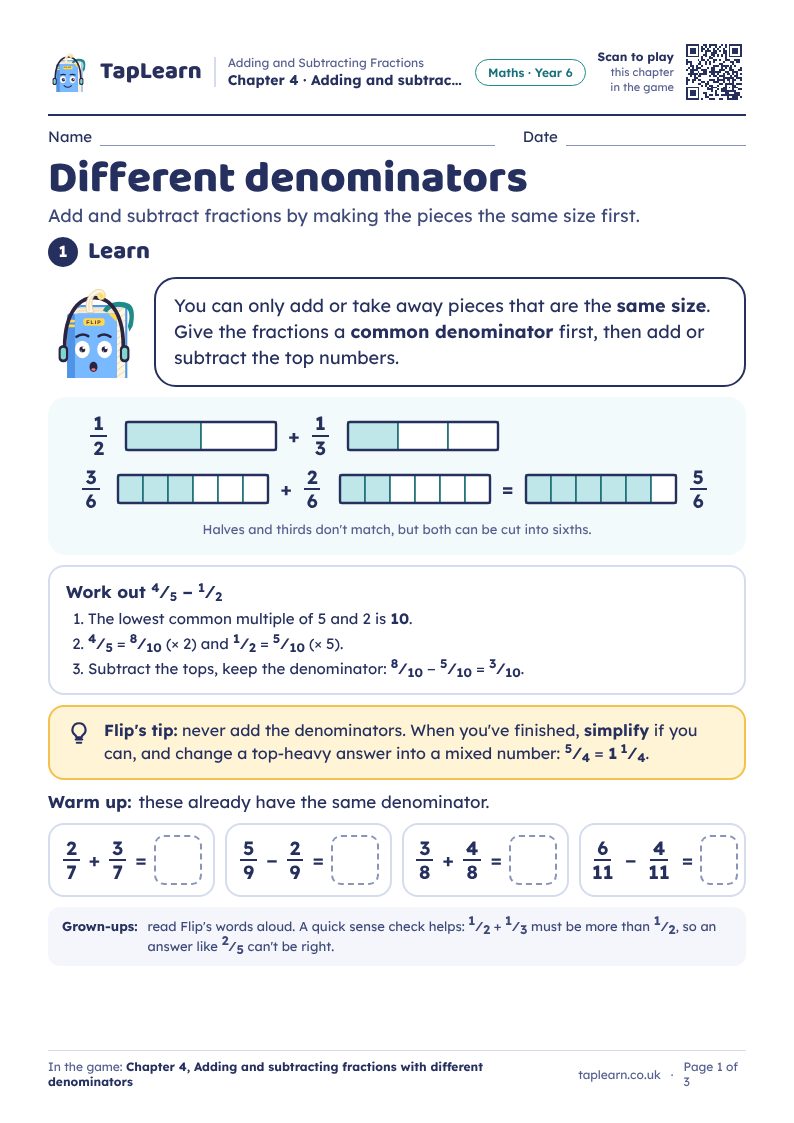
Different Denominators is a printable adding and subtracting fractions worksheet for Year 6 (ages 10 to 11) that teaches children to give fractions a common denominator before adding or subtracting the numerators, like 4/5 - 1/2 = 3/10. It covers the Year 6 maths statement on adding and subtracting fractions with different denominators and mixed numbers, using the concept of equivalent fractions.
This worksheet is for members
Membership opens every chapter of every game and every worksheet, for all your children.
See the plansAlready a member? Log in to print it.
Start with the free one: Simplest form (chapter 1).
Print it on A4, in colour or black and white. Do it after the chapter, or before it to see what your child already knows.
What's on the worksheet
Your child adds and subtracts fractions with different denominators by finding a common denominator first, then simplifies or writes the answer as a mixed number. Includes a paper-strip activity and an answers sheet.
- Page 1 · Learn
- Halves and thirds both cut into sixths, a worked example of 4/5 - 1/2 using tenths, Flip's tip never to add the denominators, and a same-denominator warm-up.
- Page 2 · Try it together
- Sixths strip: fold a paper strip into 6 equal parts and use counters to add and take away halves, thirds and sixths, then simplify each answer.
- Page 3 · Practise
- Fill in the steps, ten additions and subtractions to simplify or write as mixed numbers, flour and juice word problems, and a challenge about adding the denominators.
- Answers sheet
- Every answer with its working, mix-ups like adding the denominators, and time-fraction and guess-first ideas.
3 A4 pages and an answers sheet · about 25 minutes
Using it at home
- Ask for a quick guess before each sum: "Will the answer be more or less than 1?" It helps your child catch mistakes.
- Use the sixths strip to show why 1/2 + 1/3 can't be 2/5: count the counters in sixths together.
- Next time you bake, try 1/2 a cup plus 1/3 of a cup of flour: work out the total first (5/6 of a cup), then check.
Watch out for
- Adding the denominators too, like 1/2 + 1/3 = 2/5.
- The piece size doesn't change when you add. Make the denominators the same first.
- Adding the tops and keeping one denominator, like 1/2 + 1/3 = 2/3.
- Rewrite both fractions with a common denominator before adding.
- Changing the denominator but not the numerator, like 1/2 = 1/6.
- Multiply the top by the same number as the bottom: 1/2 = 3/6.
Questions from the worksheet
- Add or subtract. Simplify, or write as a mixed number, if you can: 1/3 + 1/4, 3/4 - 1/3, 5/6 - 1/4, 2/3 + 3/4.
- Ava used 3/4 of a bag of flour for bread and 1/6 of a bag for biscuits. What fraction of the bag did she use?
- A jug held 5/6 of a litre of juice. Leo poured out 1/3 of a litre. How much is left?
- Sam says 1/2 + 1/3 = 2/5. Is he right? Hint: is 2/5 more or less than 1/2?
The answers are on the answers sheet, for grown-ups.
National curriculum in England
This worksheet practises this statement from the Year 6 maths programme of study:
- Add and subtract fractions with different denominators and mixed numbers, using the concept of equivalent fractions
Source: National curriculum in England: mathematics programmes of study (DfE)
In the classroom
- Use Sam's challenge as a starter: vote right or wrong, then prove it with a sense check.
- Pair pupils for Practise B, with one working and one checking that answers are simplified.
Questions and answers
How do you add fractions with different denominators?
Find a common denominator, rewrite both fractions as equivalent fractions, then add the numerators. 1/2 + 1/3 = 3/6 + 2/6 = 5/6.
Why can't you add the denominators?
The denominator shows the size of the pieces, and adding doesn't change the size. 1/2 + 1/3 can't be 2/5, because 2/5 is less than 1/2.
What do you do with an answer like 5/4?
Change it into a mixed number. 5/4 is 4 quarters, which make 1 whole, plus 1 quarter, so 5/4 = 1 1/4.
More worksheets from Adding and Subtracting Fractions for Year 6: Bake with Pip the Penguin
- Chapter 1: Simplifying fractions worksheet: Simplest form Free
- Chapter 2: Common denominators worksheet: Matching denominators Members
- Chapter 3: Comparing and ordering fractions worksheet: Order the fractions Members
- Chapter 5: Adding and subtracting mixed numbers worksheet: Mixed number sums Members
 TapLearn