Common denominators worksheet for Year 6: Matching denominators
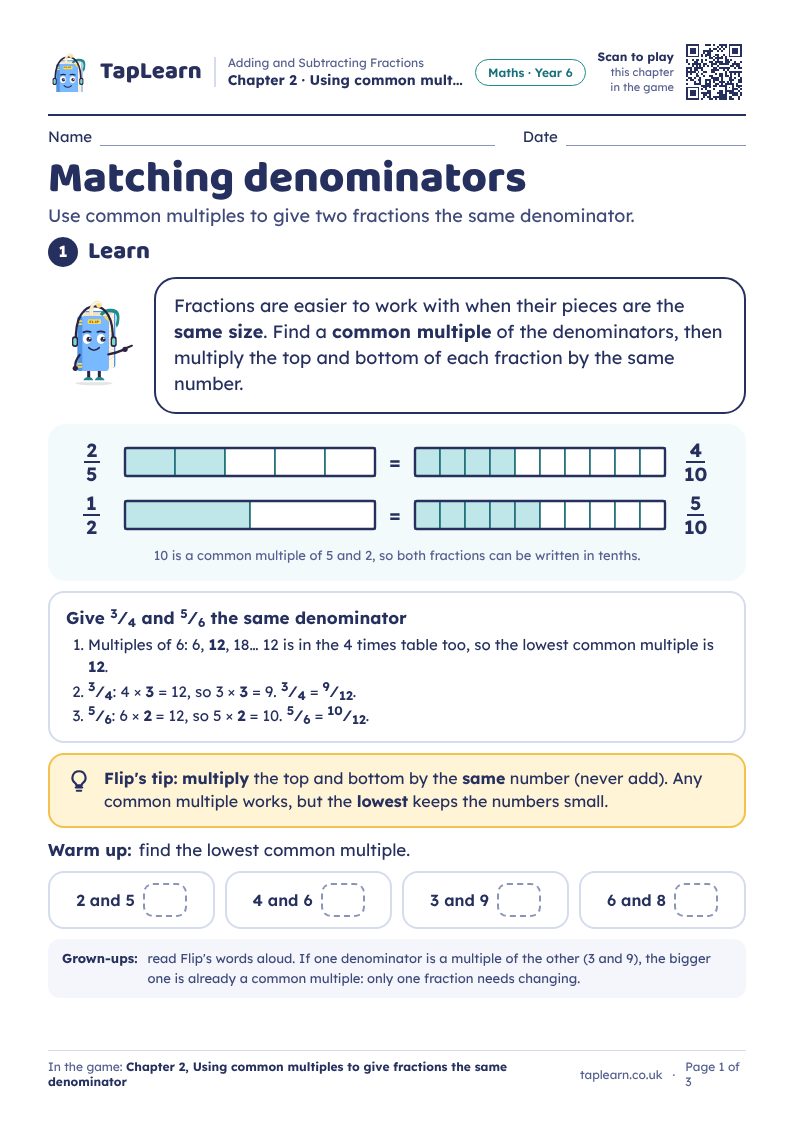
Matching Denominators is a printable common denominators worksheet for Year 6 (ages 10 to 11) that teaches children to find the lowest common multiple and rewrite two fractions with the same denominator, like 3/4 = 9/12 and 5/6 = 10/12. It covers the Year 6 maths statement on using common factors to simplify fractions and common multiples to express fractions in the same denomination.
This worksheet is for members
Membership opens every chapter of every game and every worksheet, for all your children.
See the plansAlready a member? Log in to print it.
Start with the free one: Simplest form (chapter 1).
Print it on A4, in colour or black and white. Do it after the chapter, or before it to see what your child already knows.
What's on the worksheet
Your child uses common multiples to give two fractions the same denominator, multiplying the top and bottom by the same number. Includes a twelve-treats sharing activity and an answers sheet.
- Page 1 · Learn
- Fifths and halves rewritten as tenths, a worked example giving 3/4 and 5/6 a denominator of 12, Flip's tip to multiply and never add, and a lowest-common-multiple warm-up.
- Page 2 · Try it together
- Twelve treats: lay out 12 buttons or pieces of pasta, split them into groups to write halves, thirds, quarters and sixths in twelfths, then decide whether 2/3 or 3/4 is more.
- Page 3 · Practise
- Fill in missing numbers, ring the possible common denominators, write four pairs with the same denominator, spot what Mia forgot, and a challenge about adding 2.
- Answers sheet
- Every answer, mix-ups like changing only the denominator, and egg-box and common-ground ideas.
3 A4 pages and an answers sheet · about 25 minutes
In the classroom
- Use twelve treats as a group activity with counters, recording each fraction in twelfths on a shared table.
- Run Sam's challenge in pairs: draw bars to show that 1/4 and 3/6 are not the same.
Questions from the worksheet
- Write each pair with the same denominator. Use the lowest common multiple: 1/2 and 3/5, 2/3 and 4/9, 3/4 and 1/6, 5/6 and 3/8.
- Mia wrote 2/3 = 2/9. What did she forget to do? Write the correct fraction.
- Sam says 1/4 = 3/6 because he added 2 to the top and 2 to the bottom. Is he right? How could you show him?
The answers are on the answers sheet, for grown-ups.
National curriculum in England
This worksheet practises this statement from the Year 6 maths programme of study:
- Use common factors to simplify fractions; use common multiples to express fractions in the same denomination
Source: National curriculum in England: mathematics programmes of study (DfE)
Using it at home
- Before the worksheet, check your child can find a common multiple by counting in both numbers aloud: "6, 12, 18... is 12 in the 4 times table too?"
- In twelve treats, ask "Why does 12 work for halves, thirds, quarters and sixths?" before your child fills in the last line.
- If one denominator is a multiple of the other, like 3 and 9, point out that only one fraction needs changing.
Watch out for
- Changing the denominator but not the numerator, like 2/3 = 2/9.
- Ask "What did you multiply the bottom by? Do the same to the top."
- Adding the same number to the top and bottom, like 1/4 = 3/6.
- Only multiplying (or dividing) both keeps the same amount: 1/4 = 2/8 = 3/12.
- Picking a number that isn't a common multiple, like 7 for thirds and quarters.
- Check the new denominator is in both times tables.
Questions and answers
What is a common denominator?
A common denominator is a number that both denominators divide into, so two fractions can be written with pieces the same size.
How do you find the lowest common denominator?
Find the lowest common multiple of the two denominators. For 3/4 and 5/6, it is 12, so they become 9/12 and 10/12.
Why multiply the top and bottom by the same number?
Multiplying both by the same number makes an equivalent fraction: the pieces are smaller but there are more of them, so the amount stays the same.
More worksheets from Adding and Subtracting Fractions for Year 6: Bake with Pip the Penguin
- Chapter 1: Simplifying fractions worksheet: Simplest form Free
- Chapter 3: Comparing and ordering fractions worksheet: Order the fractions Members
- Chapter 4: Adding and subtracting fractions worksheet: Different denominators Members
- Chapter 5: Adding and subtracting mixed numbers worksheet: Mixed number sums Members
 TapLearn