Comparing and ordering fractions worksheet for Year 6: Order the fractions
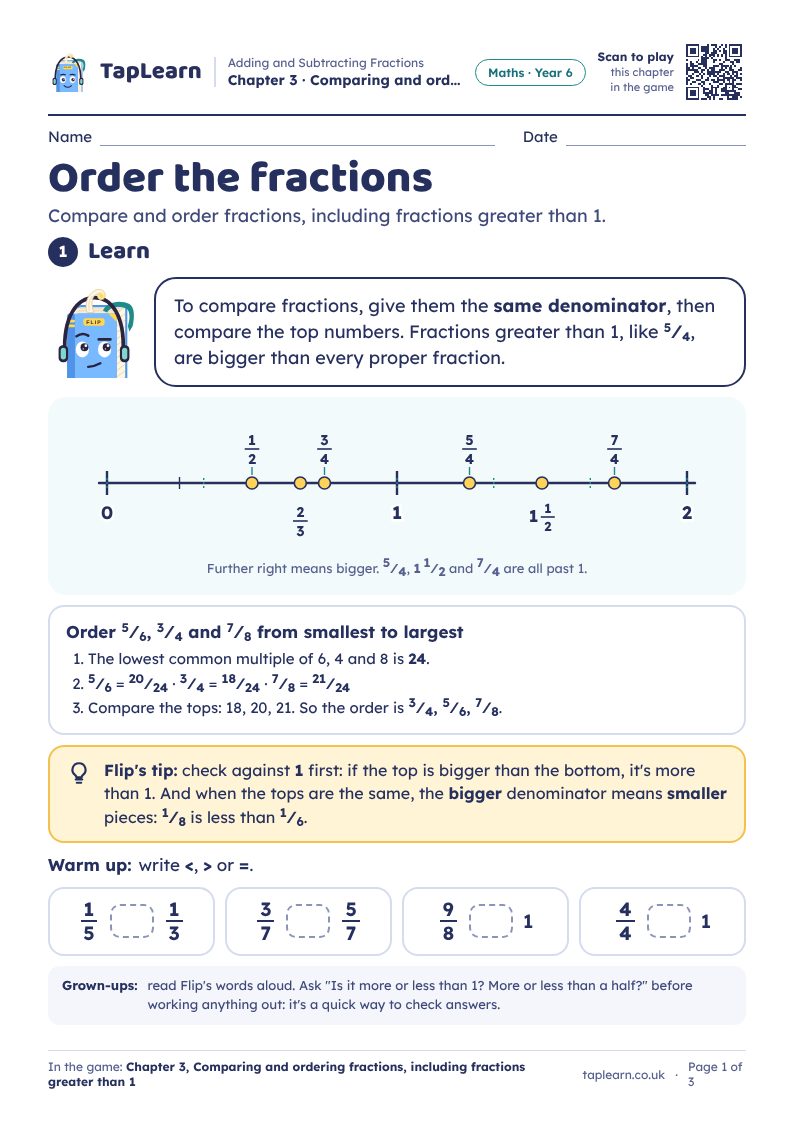
Order the Fractions is a printable comparing and ordering fractions worksheet for Year 6 (ages 10 to 11) that teaches children to give fractions a common denominator before comparing, and to spot fractions greater than 1 like 5/4. It covers the Year 6 maths statement on comparing and ordering fractions, including fractions greater than 1.
This worksheet is for members
Membership opens every chapter of every game and every worksheet, for all your children.
See the plansAlready a member? Log in to print it.
Start with the free one: Simplest form (chapter 1).
Print it on A4, in colour or black and white. Do it after the chapter, or before it to see what your child already knows.
What's on the worksheet
Your child compares and orders fractions with different denominators, including fractions greater than 1, using common denominators. Includes a fraction washing-line activity and an answers sheet.
- Page 1 · Learn
- A number line from 0 to 2 with fractions past 1, a worked example ordering 5/6, 3/4 and 7/8 using twenty-fourths, Flip's tip to check against 1 first, and a less-than or greater-than warm-up.
- Page 2 · Try it together
- Fraction washing line: mark 0, 1 and 2 on a string or ruler, take turns placing fraction cards like 3/4, 5/4 and 1 1/2, then check close ones with a common denominator.
- Page 3 · Practise
- Ring the bigger fraction, order three sets, true or false, find a fraction between two others, a running word problem, and a challenge about eighths and sixths.
- Answers sheet
- Every answer with the common denominator used, mix-ups like a bigger denominator meaning bigger, and bigger-or-smaller ideas.
3 A4 pages and an answers sheet · about 25 minutes
In the classroom
- Make a washing line across the classroom and have pupils peg fraction cards in order, explaining each choice.
- Use Practise C as a mini-whiteboard true-or-false check.
Questions from the worksheet
- Write each set in order, from smallest to largest: 3/4, 1/2, 3/8 and 5/6, 7/12, 2/3.
- True or false? 7/4 is less than 1.
- Write a fraction that is between 1/2 and 3/4. Show how you know.
- Ava ran 7/4 km. Leo ran 1 2/3 km. Who ran further? Show your working.
- Leo says, "1/8 is bigger than 1/6, because 8 is bigger than 6." Is he right? How could you show him with a drawing?
The answers are on the answers sheet, for grown-ups.
National curriculum in England
This worksheet practises this statement from the Year 6 maths programme of study:
- Compare and order fractions, including fractions > 1
Source: National curriculum in England: mathematics programmes of study (DfE)
Using it at home
- Before working anything out, ask "Is it more or less than 1? More or less than a half?" It's a quick way to check answers.
- On the washing line, 2/3 and 3/4 are close. Ask "How could we be sure which is bigger?" and let your child change them to twelfths.
- If your child is stuck on a fraction greater than 1, ask "How many quarters make 1 whole?"
Watch out for
- Thinking a bigger denominator means a bigger fraction.
- Use a pizza: shared by 8 people, each slice is smaller than shared by 6.
- Comparing only the tops when the bottoms are different, like 3/5 and 2/3.
- Make the denominators the same first, then compare the tops.
- Thinking 7/4 is less than 1.
- Ask "How many quarters make 1?" (4.) So 7 quarters is more than 1.
Questions and answers
How do you compare fractions with different denominators?
Give them the same denominator, then compare the numerators. 2/3 = 8/12 and 3/4 = 9/12, so 3/4 is bigger.
How do you know if a fraction is greater than 1?
A fraction is greater than 1 when its numerator is bigger than its denominator, like 5/4. These are called improper fractions.
Why is 1/8 smaller than 1/6?
The bigger the denominator, the more pieces the whole is cut into, so each piece is smaller.
More worksheets from Adding and Subtracting Fractions for Year 6: Bake with Pip the Penguin
- Chapter 1: Simplifying fractions worksheet: Simplest form Free
- Chapter 2: Common denominators worksheet: Matching denominators Members
- Chapter 4: Adding and subtracting fractions worksheet: Different denominators Members
- Chapter 5: Adding and subtracting mixed numbers worksheet: Mixed number sums Members
 TapLearn