When to use the passive worksheet for Year 6: Choosing the voice
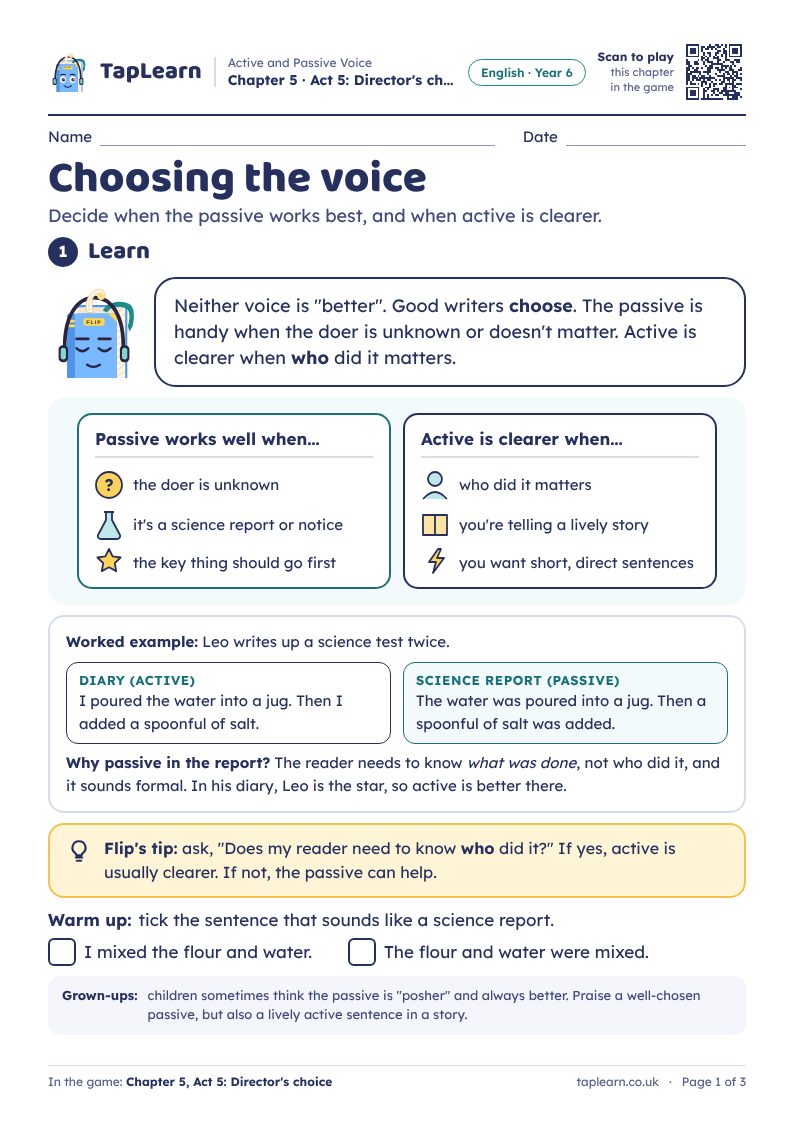
Choosing the Voice is a printable when to use the passive worksheet for Year 6 (ages 10 to 11) that teaches children to use the passive when the doer is unknown or doesn't matter, and active when who did it matters. It covers the Year 6 English statement on using the passive to affect the presentation of information in a sentence.
This worksheet is for members
Membership opens every chapter of every game and every worksheet, for all your children.
See the plansAlready a member? Log in to print it.
Start with the free one: Doers and receivers (chapter 1).
Print it on A4, in colour or black and white. Do it after the chapter, or before it to see what your child already knows.
What's on the worksheet
Your child decides when the passive works well (unknown doers, science reports, putting the key thing first) and when active is clearer. Includes a kitchen lab report to write together and an answers sheet.
- Page 1 · Learn
- When each voice works well, Leo's science test written as an active diary and a passive report, Flip's tip to ask if the reader needs to know who, and a warm-up.
- Page 2 · Try it together
- Kitchen lab report: stir a teaspoon of sugar or salt into cold water, describe it like a diary in the active, then rewrite each sentence like a scientist in the passive.
- Page 3 · Practise
- Match passive sentences to reasons, choose the better sentence for a story or a sign, rewrite diary sentences for a science report, fix a story with too many passives, and a challenge.
- Answers sheet
- Every answer, mix-ups like thinking the passive is always posher, and headline-hunt and story-switch ideas.
3 A4 pages and an answers sheet · about 25 minutes
Using it at home
- Praise a well-chosen passive, but also a lively active sentence in a story: neither voice is always better.
- Use cold water only for the kitchen lab report, and point out that in the report it doesn't matter who stirred.
- Read a news article together and spot passives. Ask why the writer left the doer out.
Watch out for
- Thinking the passive is always better or posher.
- Too many passives make writing slow and unclear. Ask "Does the reader need to know who?"
- Missing when the passive hides the doer on purpose.
- "Mistakes were made" avoids saying who made them. It's worth spotting in adverts and excuses.
Questions from the worksheet
- Why did the writer choose the passive? The window was broken last night. Dogs must be kept on a lead.
- Rewrite these diary sentences in the passive, for a science report: I measured the plant every day. We put the pots on the windowsill.
- This story uses the passive too much. Rewrite it in the active so it's clearer: The door was opened slowly by Ava. A strange noise was heard by her.
- Mia says: "The passive always makes writing better, because it sounds posher." Do you agree? Explain, with an example.
The answers are on the answers sheet, for grown-ups.
National curriculum in England
This worksheet practises these statements from the Years 5–6 english programme of study:
- Develop their understanding of the concepts set out in English appendix 2 by: using passive verbs to affect the presentation of information in a sentence
- Sentence: use of the passive to affect the presentation of information in a sentence (Year 6 english)
- Terminology: subject, object, active, passive, synonym, antonym, ellipsis, hyphen, colon, semi-colon, bullet points (Year 6 english)
In the classroom
- Run the kitchen lab report as a short science lesson, writing it up in both voices.
- Use Practise D as a shared editing task, rewriting the story in the active together.
Questions and answers
When should you use the passive voice?
Use the passive when the doer is unknown or doesn't matter, in science reports and notices, or to put the key thing first.
Why do science reports use the passive?
The reader needs to know what was done, not who did it, and anyone doing the test should get the same result. It also sounds formal.
Is the passive voice better than the active?
No. Neither is better. Active is usually clearer in stories and messages, like "Leo scored the goal!"
 TapLearn