Subject and object worksheet for Year 6: Doers and receivers
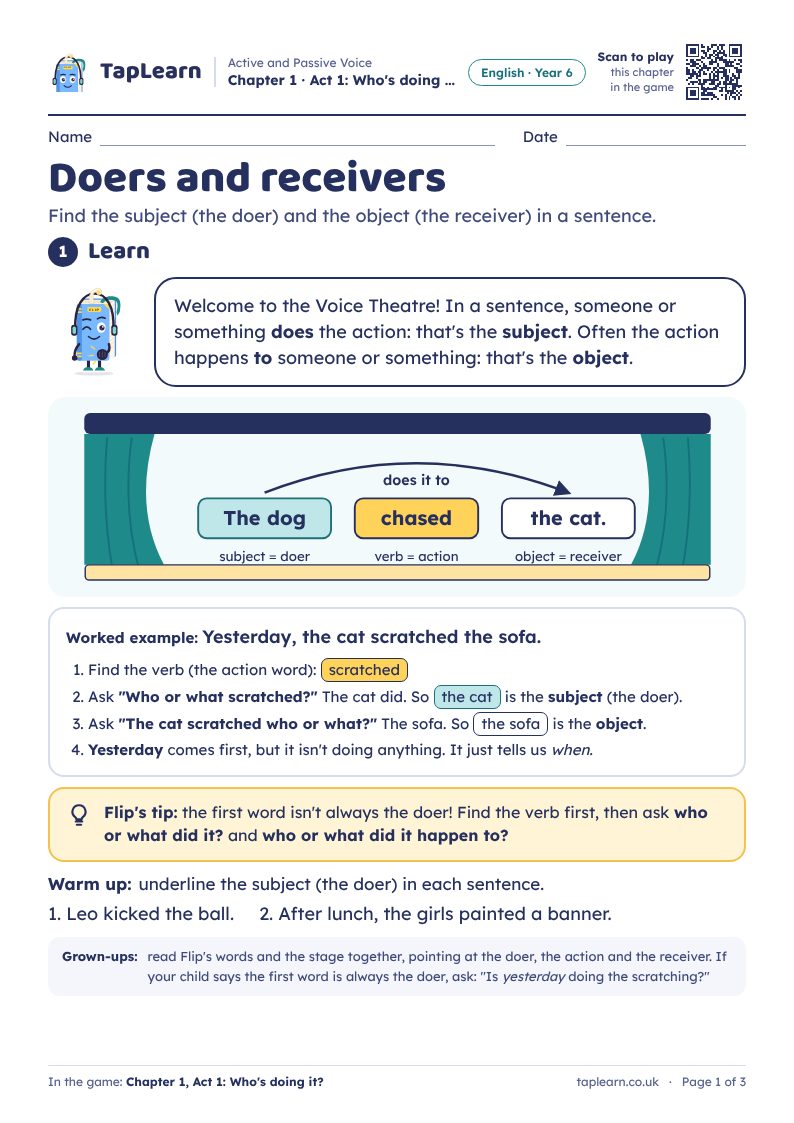
Doers and Receivers is a printable subject and object worksheet for Year 6 (ages 10 to 11) that teaches children to find the verb first, then ask who did it and who or what it happened to. It covers the Year 6 English terminology statement that includes subject, object, active and passive.
Free to print, no account needed.
Print it on A4, in colour or black and white. Do it after the chapter, or before it to see what your child already knows.
What's on the worksheet
Your child finds the subject (the doer) and the object (the receiver) in a sentence, even when it starts with a time or place word. Includes a toy theatre activity and an answers sheet.
- Page 1 · Learn
- The dog chased the cat labelled as subject, verb and object, a worked example for "Yesterday, the cat scratched the sofa", Flip's tip that the first word isn't always the doer, and a warm-up.
- Page 2 · Try it together
- Toy theatre: write DOER, ACTION and RECEIVER on scraps, make one toy do something to another, say the sentence and place each label, then swap the roles round.
- Page 3 · Practise
- Underline subjects and ring objects, find them in sentences that start with a time or place, swap subject and object to see if the meaning changes, write your own, and a challenge.
- Answers sheet
- Every answer, mix-ups like swapping roles, and doer-detectives and silly-swaps ideas.
3 A4 pages and an answers sheet · about 25 minutes
Using it at home
- If your child says the first word is always the doer, ask "Is yesterday doing the scratching?"
- In toy theatre, start one sentence with a time or place, like "On the sofa, the teddy hugged the spoon", and ask if the doer changed.
- While reading a bedtime story, ask "Who's doing it? Who's it happening to?"
Watch out for
- Thinking the first word is always the doer.
- Always find the verb first, then ask who or what did it.
- Mixing up who does it and who receives it.
- Act it out with toys: the one that moves is the doer. Swapping them changes the meaning.
- Looking for an object in sentences like "Mia laughed."
- Some verbs don't need a receiver, so these sentences can't be made passive later.
Questions from the worksheet
- Underline the subject (the doer). Draw a ring round the object (the receiver): In the garden, a bee stung Leo.
- These don't start with the doer. Write each subject and object: Last night, a storm damaged our fence.
- Swap the subject and the object. Does it still mean the same? The fox chased the hen.
- Sam says: "In This morning, my brother broke the window, the subject is This morning, because it comes first." Is Sam right? Explain how you know.
The answers are on the answers sheet, for grown-ups.
National curriculum in England
This worksheet practises these statements from the Years 5–6 english programme of study:
- Develop their understanding of the concepts set out in English appendix 2 by: using passive verbs to affect the presentation of information in a sentence
- Sentence: use of the passive to affect the presentation of information in a sentence (Year 6 english)
- Terminology: subject, object, active, passive, synonym, antonym, ellipsis, hyphen, colon, semi-colon, bullet points (Year 6 english)
In the classroom
- Act out sentences with children as doer and receiver, then swap roles to see the meaning change.
- Use Practise B as a mini-whiteboard check on sentences that don't start with the subject.
Questions and answers
What is the subject of a sentence?
The subject is who or what does the action. In "The dog chased the cat", the dog is the subject.
What is the object of a sentence?
The object is who or what the action happens to. In "The dog chased the cat", the cat is the object.
Is the subject always the first word?
No. In "Yesterday, the cat scratched the sofa", yesterday tells us when, and the cat is the subject.
 TapLearn