Active to passive worksheet for Year 6: Flipping to passive
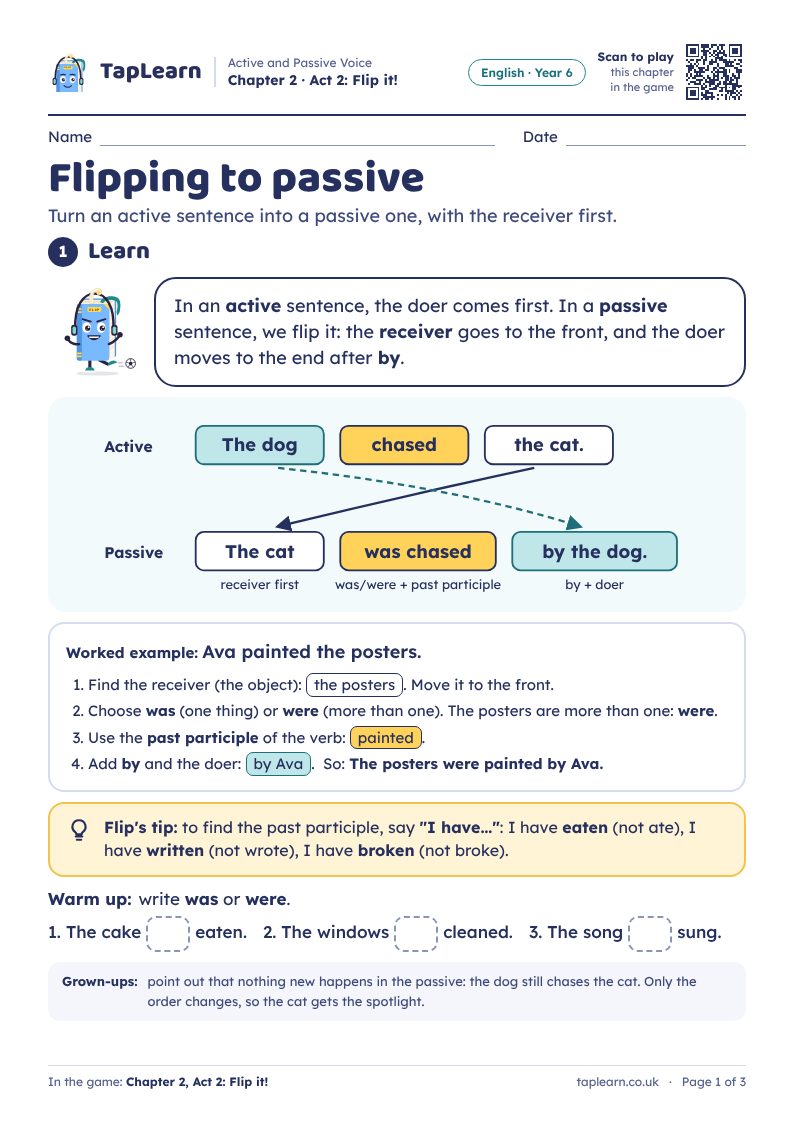
Flipping to Passive is a printable active to passive worksheet for Year 6 (ages 10 to 11) that teaches children to move the receiver to the front, add was or were with the past participle, and put the doer after by. It covers the Year 6 English statement on using the passive to affect the presentation of information in a sentence.
This worksheet is for members
Membership opens every chapter of every game and every worksheet, for all your children.
See the plansAlready a member? Log in to print it.
Start with the free one: Doers and receivers (chapter 1).
Print it on A4, in colour or black and white. Do it after the chapter, or before it to see what your child already knows.
What's on the worksheet
Your child turns active sentences into the passive: moving the receiver to the front, choosing was or were, using the past participle and adding by. Includes a flip-the-scene card activity and an answers sheet.
- Page 1 · Learn
- The dog chased the cat flipped into the passive, a worked example for "Ava painted the posters", Flip's tip to find the past participle by saying "I have…", and a was-or-were warm-up.
- Page 2 · Try it together
- Flip the scene: write the three parts of a toy sentence on scraps, add was and by cards, then move the receiver to the front and the doer to the end to read the passive.
- Page 3 · Practise
- Fill in past participles like eaten and written, ring was or were, rewrite active sentences in the passive, correct passive mistakes, and a challenge about was and were.
- Answers sheet
- Every answer, mix-ups like "was ate", and flip ping-pong and participle-pairs ideas.
3 A4 pages and an answers sheet · about 25 minutes
Using it at home
- Point out that nothing new happens in the passive: the dog still chases the cat. Only the order changes.
- In flip the scene, try a verb that changes, like threw: your child needs thrown, as in "The ball was thrown by the teddy."
- Play flip ping-pong: "Dad made dinner." "Dinner was made by Dad."
Watch out for
- Mixing up was and were.
- Look only at the receiver at the front: one thing takes was, more than one takes were.
- Writing "was ate" instead of "was eaten".
- The passive needs the past participle. Say "I have…" to find it: I have eaten.
- Forgetting to swap, so the meaning changes.
- "The dog was chased by the cat" keeps the dog first. The receiver must move to the front.
Questions from the worksheet
- Draw a ring round was or were: The letters (was / were) posted by Mia.
- Flip it! Rewrite each active sentence in the passive: Sam broke the vase. The storm flattened the tents.
- Each passive sentence has a mistake. Write it correctly: The cake was ate by the twins.
- Ava flips The boys washed the car into The car were washed by the boys. She says, "It's were because there are lots of boys." Is she right? Explain.
The answers are on the answers sheet, for grown-ups.
National curriculum in England
This worksheet practises these statements from the Years 5–6 english programme of study:
- Develop their understanding of the concepts set out in English appendix 2 by: using passive verbs to affect the presentation of information in a sentence
- Sentence: use of the passive to affect the presentation of information in a sentence (Year 6 english)
- Terminology: subject, object, active, passive, synonym, antonym, ellipsis, hyphen, colon, semi-colon, bullet points (Year 6 english)
In the classroom
- Use flip the scene with word cards in pairs, physically moving the cards to make the passive.
- Use Practise D as a find-the-mistake starter.
Questions and answers
How do you change an active sentence to passive?
Move the receiver to the front, add was or were with the past participle, then put by and the doer at the end: The cat was chased by the dog.
Is it was or were in a passive sentence?
It agrees with the word at the front. One thing takes was and more than one takes were: The car was washed by the boys.
What is a past participle?
It's the verb form that fits after "I have", like eaten, written or broken. The passive uses it after was or were.
 TapLearn