Active and passive voice worksheet for Year 6: Active or passive?
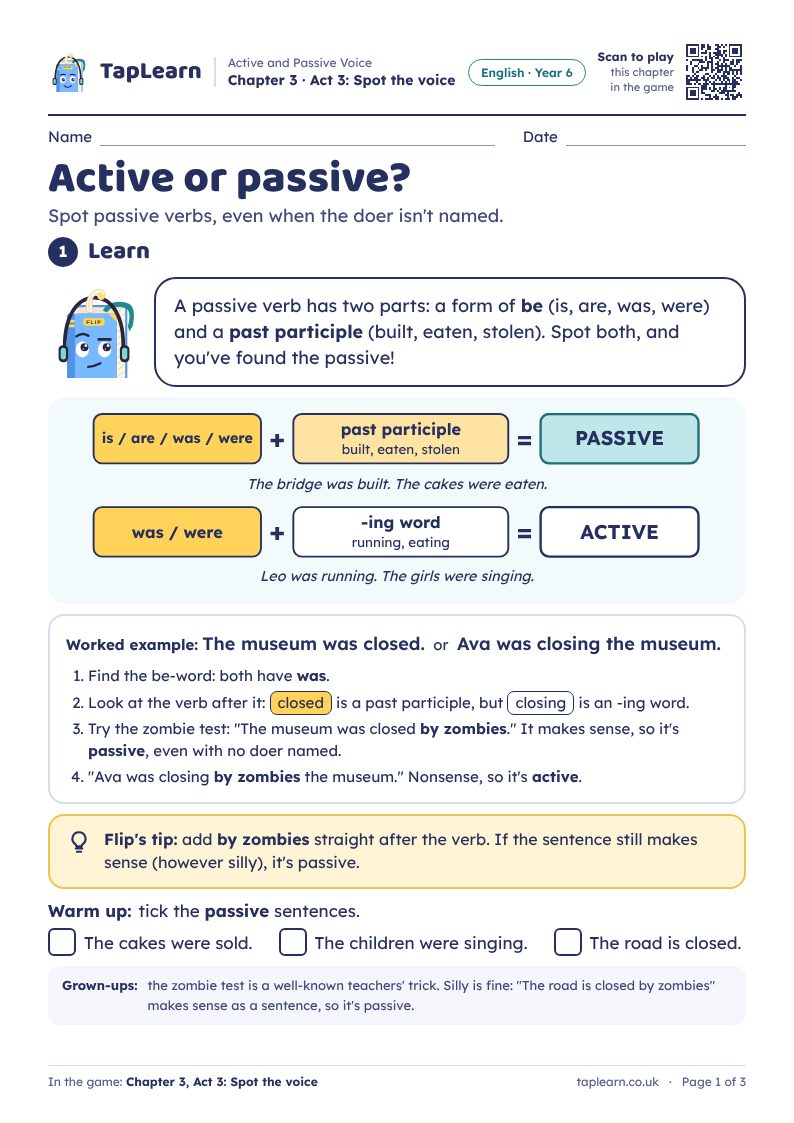
Active or Passive? is a printable active and passive voice worksheet for Year 6 (ages 10 to 11) that teaches children to spot a passive verb as is, are, was or were plus a past participle, and to use the "by zombies" test. It covers the Year 6 English statement on using the passive to affect the presentation of information in a sentence.
This worksheet is for members
Membership opens every chapter of every game and every worksheet, for all your children.
See the plansAlready a member? Log in to print it.
Start with the free one: Doers and receivers (chapter 1).
Print it on A4, in colour or black and white. Do it after the chapter, or before it to see what your child already knows.
What's on the worksheet
Your child tells active and passive sentences apart: spotting a be-word plus a past participle, finding passives with no doer and seeing why "was running" is active. Includes a zombie hunt at home and an answers sheet.
- Page 1 · Learn
- How a be-word plus a past participle makes the passive and a be-word plus an -ing word stays active, a worked example with the zombie test, Flip's tip, and a tick-the-passive warm-up.
- Page 2 · Try it together
- Zombie hunt: look through food packets, leaflets or a newspaper for verbs with is, are, was or were, add "by zombies" after each one, and decide if it's passive and whether the doer is named.
- Page 3 · Practise
- Ring active or passive, write the passive verb and doer, decide true or false about passive myths, write a passive sentence with no doer, and a challenge about the past tense.
- Answers sheet
- Every answer, mix-ups like thinking every passive needs by, and zombie-signs and thumbs-up ideas.
3 A4 pages and an answers sheet · about 25 minutes
Using it at home
- The zombie test is a well-known teachers' trick. Silly is fine: "The road is closed by zombies" still makes sense, so it's passive.
- In the zombie hunt, point out that labels often leave out the be-word: "Made in Wales" means "This is made in Wales".
- Say sentences aloud and let your child give a thumbs up for passive.
Watch out for
- Thinking "was running" is passive because it has "was".
- Check the next word: an -ing word means the subject is still doing it, so it's active.
- Thinking a passive must have "by…".
- Many passives leave the doer out: "The window was smashed." Use the zombie test.
- Thinking any past tense sentence is passive.
- "We watched a play" is past and active. Passive is about the verb, not when it happened.
Questions from the worksheet
- Is each sentence active or passive? The bridge was built in 1890. Leo was building a den. The dog was barking all night.
- Write the passive verb and the doer (or not named): Rubbish is collected on Tuesdays.
- True or false? A passive sentence must have "by…" in it. "Was running" is passive, because it has "was".
- Mia says: "Yesterday we watched a play is passive, because it's in the past." Is she right? Explain, and try the zombie test.
The answers are on the answers sheet, for grown-ups.
National curriculum in England
This worksheet practises these statements from the Years 5–6 english programme of study:
- Develop their understanding of the concepts set out in English appendix 2 by: using passive verbs to affect the presentation of information in a sentence
- Sentence: use of the passive to affect the presentation of information in a sentence (Year 6 english)
- Terminology: subject, object, active, passive, synonym, antonym, ellipsis, hyphen, colon, semi-colon, bullet points (Year 6 english)
In the classroom
- Run a zombie hunt with non-fiction books in pairs, recording passives in the table.
- Use the true-or-false statements in Practise C for a quick class vote.
Questions and answers
How do you spot a passive sentence?
Look for is, are, was or were followed by a past participle, like was built. If "by zombies" fits after the verb, it's passive.
Does a passive sentence always say who did it?
No. Many passives leave the doer out, like "The window was smashed."
Why is "was running" active?
Running is an -ing word, not a past participle, so the subject is still doing the action.
 TapLearn