Passive to active worksheet for Year 6: Back to active
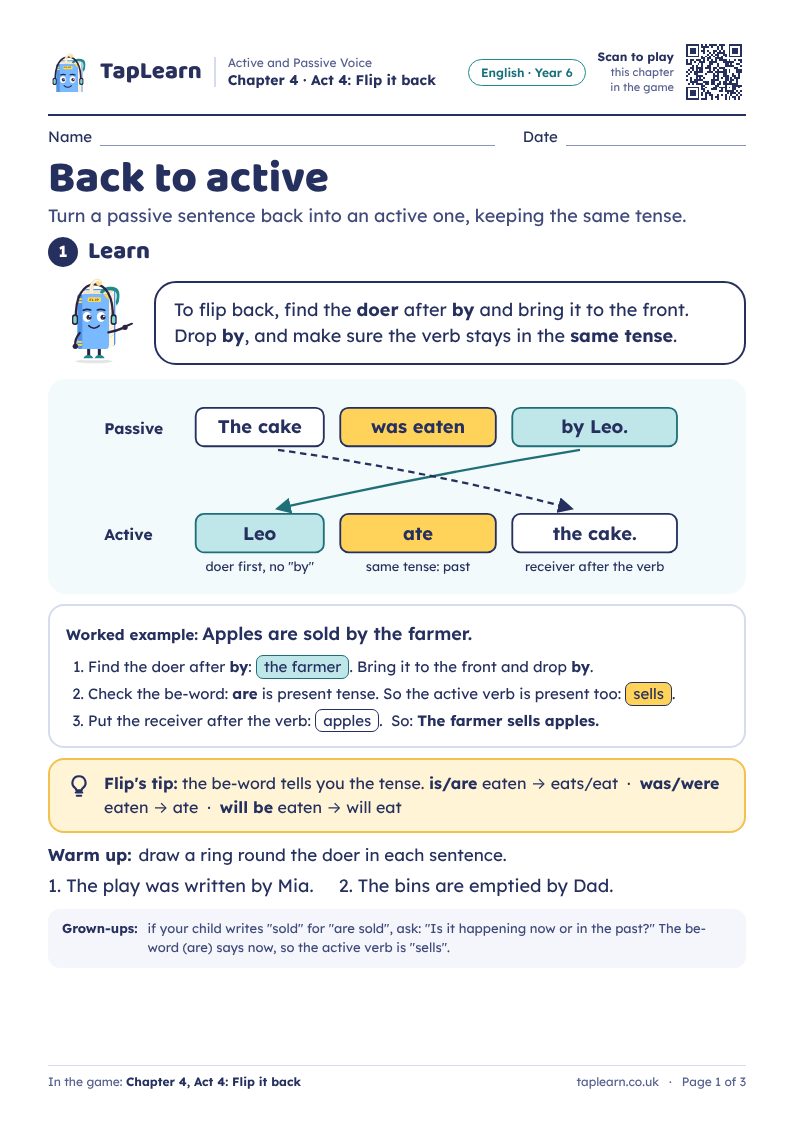
Back to Active is a printable passive to active worksheet for Year 6 (ages 10 to 11) that teaches children to bring the doer after by to the front and use the be-word to keep the same tense. It covers the Year 6 English statement on using the passive to affect the presentation of information in a sentence.
This worksheet is for members
Membership opens every chapter of every game and every worksheet, for all your children.
See the plansAlready a member? Log in to print it.
Start with the free one: Doers and receivers (chapter 1).
Print it on A4, in colour or black and white. Do it after the chapter, or before it to see what your child already knows.
What's on the worksheet
Your child turns passive sentences back into active ones: bringing the doer to the front, dropping by and keeping the same tense. Includes a who-did-it mystery game and an answers sheet.
- Page 1 · Learn
- The cake was eaten by Leo flipped back to active, a worked example for "Apples are sold by the farmer", Flip's tip that the be-word tells the tense, and a ring-the-doer warm-up.
- Page 2 · Try it together
- Who did it?: the grown-up secretly moves things in a room, the child reports in the passive with no doer, then asks who did it and says it in the active. Then swap.
- Page 3 · Practise
- Write the tense and active verb for passive verbs, flip passive sentences back, choose a sensible doer for passives with none, correct flips, and a challenge about tense.
- Answers sheet
- Every answer, mix-ups like leaving by in, and packet-detective ideas.
3 A4 pages and an answers sheet · about 25 minutes
Using it at home
- If your child writes "sold" for "are sold", ask "Is it happening now or in the past?" The be-word says now, so it's "sells".
- In who did it?, try a present one too: "The cushions are plumped by Dad every day" becomes "Dad plumps the cushions".
- Find "Made in…" or "Baked by hand" on packaging and say who might do it, in the active.
Watch out for
- Leaving by in, like "By Leo ate the cake".
- In the active, the doer comes first with no by.
- Changing the tense, so "are sold" becomes "sold".
- Use the be-word: is or are means present, was or were means past, will be means will.
- Forgetting to change pronouns.
- "By them" becomes "They…" and "by her" becomes "She…" when it moves to the front.
Questions from the worksheet
- Write the tense and the active verb: are sold, is written, were chosen, will be cleaned.
- Flip it back! Rewrite in the active: The play will be performed by Year 5. Leo was helped by them.
- These have no doer. Choose a sensible doer and write an active sentence: The road was closed.
- Sam flips The windows are cleaned by Mr Hill into Mr Hill cleaned the windows. Is it right? What would you change, and why?
The answers are on the answers sheet, for grown-ups.
National curriculum in England
This worksheet practises these statements from the Years 5–6 english programme of study:
- Develop their understanding of the concepts set out in English appendix 2 by: using passive verbs to affect the presentation of information in a sentence
- Sentence: use of the passive to affect the presentation of information in a sentence (Year 6 english)
- Terminology: subject, object, active, passive, synonym, antonym, ellipsis, hyphen, colon, semi-colon, bullet points (Year 6 english)
In the classroom
- Play who did it? as a class: move objects while children's eyes are closed, then report in passive and active.
- Use Practise A as a tense-matching starter on mini-whiteboards.
Questions and answers
How do you change a passive sentence to active?
Find the doer after by and bring it to the front, drop by, put the receiver after the verb and keep the same tense.
How do you keep the same tense when changing voice?
Look at the be-word: is or are means present, was or were means past, and will be means will. The active verb must match.
What if a passive sentence has no doer?
Choose a sensible doer. "The road was closed" could become "The council closed the road."
 TapLearn