5 times table worksheet for Year 2: Counting in fives
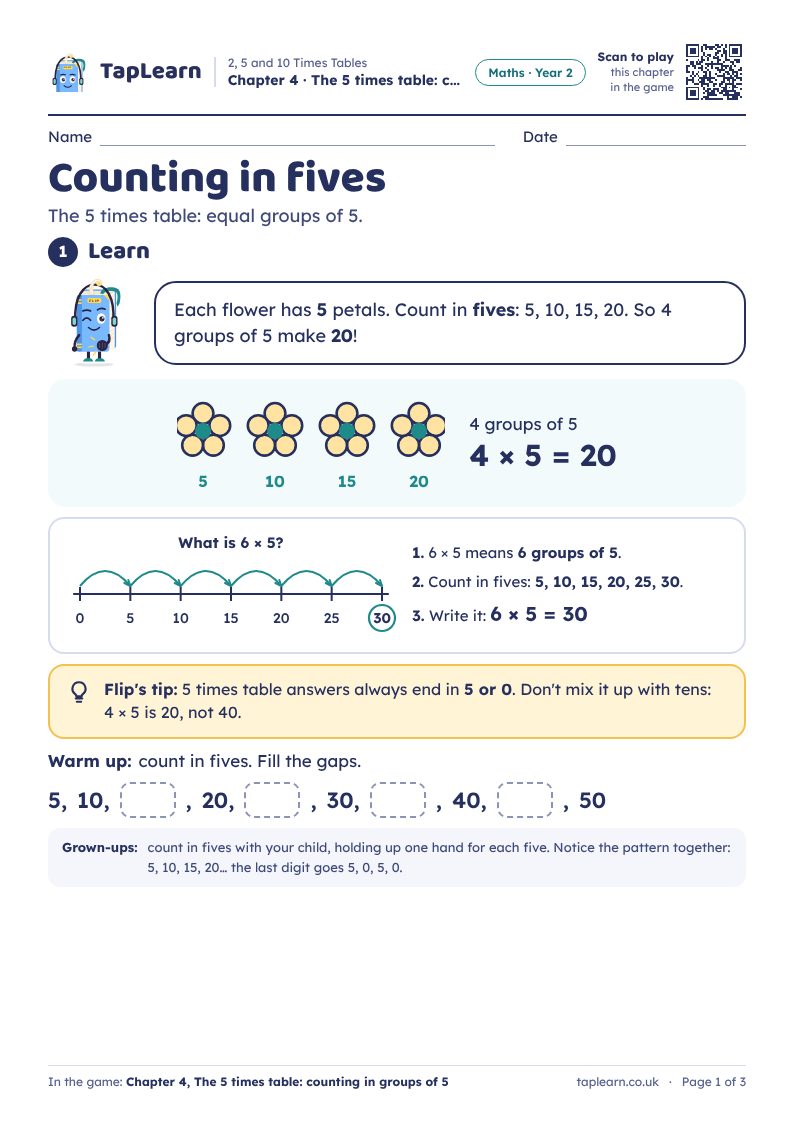
Counting in Fives is a printable 5 times table worksheet for Year 2 (ages 6 to 7) that teaches children to count equal groups of 5 and notice the answers end in 5 or 0, without mixing it up with the tens. It covers the Year 2 maths statement to recall and use multiplication and division facts for the 2, 5 and 10 times tables, including recognising odd and even numbers.
This worksheet is for members
Membership opens every chapter of every game and every worksheet, for all your children.
See the plansAlready a member? Log in to print it.
Start with the free one: Counting in twos (chapter 1).
Print it on A4, in colour or black and white. Do it after the chapter, or before it to see what your child already knows.
What's on the worksheet
Your child counts in fives and learns the 5 times table up to 10 × 5, including counting round a clock face. Includes a hand count activity and an answers sheet.
- Page 1 · Learn
- Flowers with 5 petals showing 4 × 5 = 20, a worked example for 6 × 5 on a number line, Flip's tip on 5 or 0 endings, and a count-in-fives warm-up.
- Page 2 · Try it together
- Hand count: draw round your hands, a grown-up's and even a teddy's paw, count all the fingers in fives, then write how many hands and the times table fact.
- Page 3 · Practise
- Count petals in fives, jump in fives on a number line, count round a clock face, match facts to answers, ring numbers in the 5 times table, and a challenge about 4 × 5.
- Answers sheet
- Every answer, mix-ups like using the 10 times table, and clock-fives and high-fives ideas.
3 A4 pages and an answers sheet · about 20 minutes
In the classroom
- Make a class display of drawn hands and count them in fives together.
- Count round a clock face in fives as a starter, linking to telling the time.
Questions from the worksheet
- Count round the clock in fives. Fill the gaps.
- Draw a line to match each fact to its answer: 3 × 5, 8 × 5, 5 × 5, 10 × 5, 9 × 5.
- Ava says 4 × 5 = 40. Is she right? What would you tell her?
The answers are on the answers sheet, for grown-ups.
National curriculum in England
This worksheet practises this statement from the Year 2 maths programme of study:
- Recall and use multiplication and division facts for the 2, 5 and 10 multiplication tables, including recognising odd and even numbers
Source: National curriculum in England: mathematics programmes of study (DfE)
Using it at home
- Count in fives together, holding up one hand for each five, and notice the last digit goes 5, 0, 5, 0.
- In hand count, ask "How many fingers on 6 hands? On 10 hands?" and stand together to check with real hands.
- Count high fives: "How many fingers in 7 high fives?"
Watch out for
- Adding instead of multiplying, like 3 × 5 = 8.
- Draw 3 hands and count the fingers in fives.
- Mixing up the 5 and 10 times tables, like 4 × 5 = 40.
- Fives go up by 5: count on a number line in jumps of 5.
- Losing the place when counting.
- Hold up a finger for each five you say.
Questions and answers
What do 5 times table answers end in?
They always end in 5 or 0, so the last digit goes 5, 0, 5, 0.
Why is 4 × 5 not 40?
4 × 5 means 4 groups of 5: 5, 10, 15, 20. 40 is 4 × 10, from the 10 times table.
How does a clock help with the 5 times table?
Counting round the numbers on a clock face in fives gives 5, 10, 15 and so on up to 60.
 TapLearn