Division facts worksheet for Year 2: Sharing and grouping
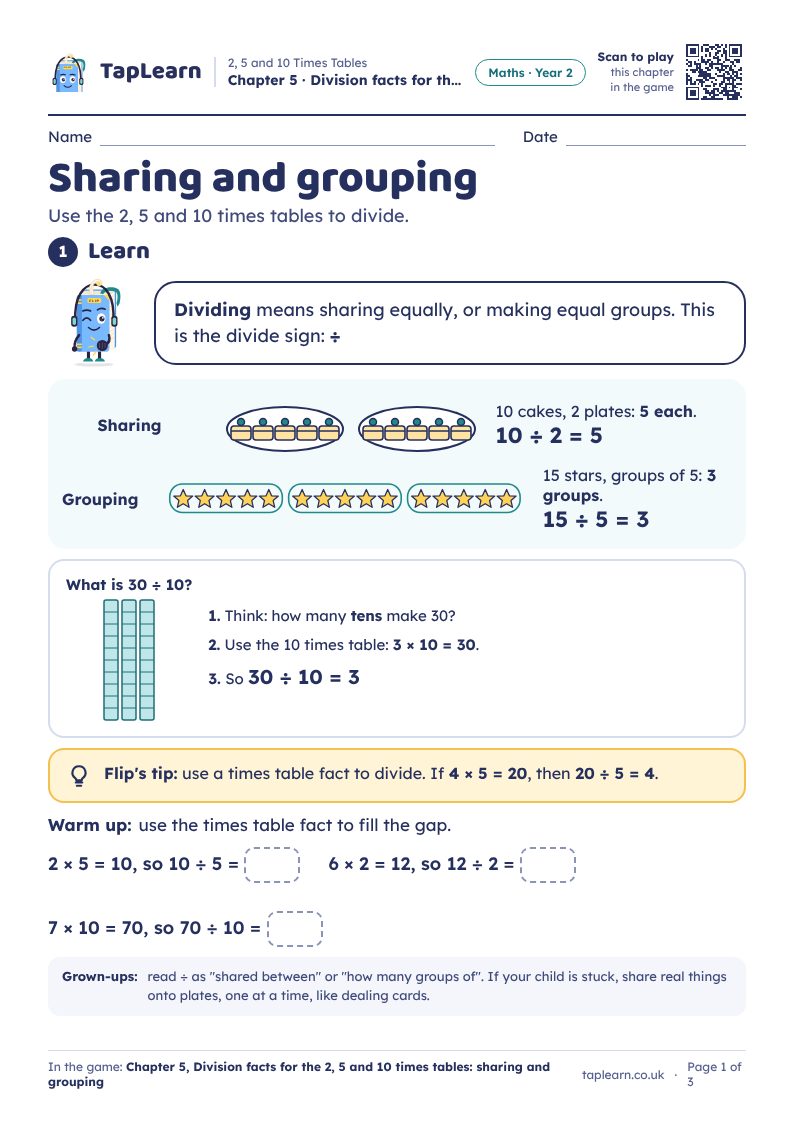
Sharing and Grouping is a printable division facts worksheet for Year 2 (ages 6 to 7) that teaches children to divide by sharing equally or making equal groups, and to use a fact like 4 × 5 = 20 to find 20 ÷ 5 = 4. It covers the Year 2 maths statement to recall and use multiplication and division facts for the 2, 5 and 10 times tables, including recognising odd and even numbers.
This worksheet is for members
Membership opens every chapter of every game and every worksheet, for all your children.
See the plansAlready a member? Log in to print it.
Start with the free one: Counting in twos (chapter 1).
Print it on A4, in colour or black and white. Do it after the chapter, or before it to see what your child already knows.
What's on the worksheet
Your child divides by sharing equally and by making equal groups, using the 2, 5 and 10 times tables to find facts like 30 ÷ 10 = 3. Includes a fair shares activity and an answers sheet.
- Page 1 · Learn
- 10 cakes shared between 2 plates and 15 stars put into groups of 5, a worked example for 30 ÷ 10, Flip's tip to use a times table fact, and a warm-up.
- Page 2 · Try it together
- Fair shares: share 12 things between 2 plates, put 20 into cups in groups of 5, put 30 into groups of 10, and write each division fact.
- Page 3 · Practise
- Share 8 apples between 2 plates, ring groups of 2 and 5, finish division facts from times table facts, divide using the 2, 5 and 10 tables, and a challenge about 14 ÷ 2.
- Answers sheet
- Every answer, mix-ups like taking away instead of dividing, and snack-shares and peg-groups ideas.
3 A4 pages and an answers sheet · about 20 minutes
Using it at home
- Read ÷ as "shared between" or "how many groups of". If your child is stuck, share real things onto plates, like dealing cards.
- After each fair share, ask for the times table fact that matches: 6 × 2 = 12, 4 × 5 = 20, 3 × 10 = 30.
- Put 20 pegs into groups of 5, then groups of 10, and ask how many groups each time.
Watch out for
- Multiplying instead of dividing, like 20 ÷ 5 = 100.
- Read ÷ as "shared between" or "how many groups of".
- Taking away instead of dividing, like 14 ÷ 2 = 12.
- Share 14 things onto 2 plates to see it.
- Making unequal shares.
- Check every plate or group has the same number.
Questions from the worksheet
- Draw rings round groups of 5. How many groups? 20 ÷ 5 = ___.
- Use the times table fact to finish the division facts: 10 × 5 = 50, so 50 ÷ 5 = ___ and 50 ÷ 10 = ___.
- Divide. Think: which times table fact helps? 18 ÷ 2, 35 ÷ 5, 60 ÷ 10, 45 ÷ 5.
- Leo says 14 ÷ 2 = 12, because he took 2 away. Is he right? What is 14 ÷ 2?
The answers are on the answers sheet, for grown-ups.
National curriculum in England
This worksheet practises this statement from the Year 2 maths programme of study:
- Recall and use multiplication and division facts for the 2, 5 and 10 multiplication tables, including recognising odd and even numbers
Source: National curriculum in England: mathematics programmes of study (DfE)
In the classroom
- Run fair shares in groups with counters and plates, recording each division fact.
- Use Practise C as a mini-whiteboard check linking times table and division facts.
Questions and answers
What is the difference between sharing and grouping?
Sharing splits a number equally between a set number of groups, like 10 cakes on 2 plates. Grouping makes groups of a set size, like 15 stars in groups of 5.
How do times tables help with division?
Use the matching fact: if 4 × 5 = 20, then 20 ÷ 5 = 4.
What does the ÷ sign mean?
The ÷ sign means divide. Read it as "shared between" or "how many groups of".
 TapLearn